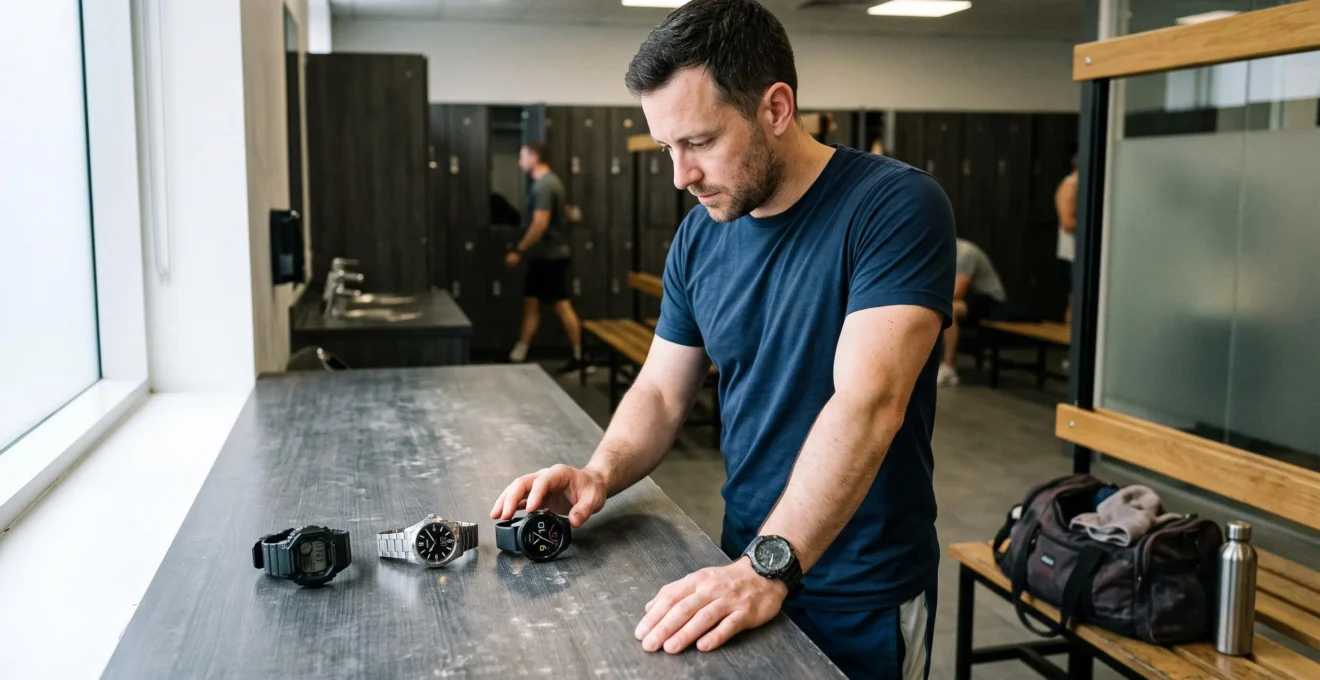
A sports watch can offer GPS navigation, advanced training metrics, water resistance, smartphone payments and dozens of activity modes. Yet a longer specification sheet does not necessarily make a better watch for running, swimming, hiking or everyday wear.
The features that matter are those that solve problems you encounter regularly. A runner may benefit from reliable pacing and a comfortable strap, while a swimmer needs appropriate water resistance. Someone who exercises occasionally but wears the same watch to work may care more about case dimensions, durability and battery maintenance than sophisticated performance analytics.
Choosing well means comparing actual activities with practical requirements before comparing models or prices. It also means understanding the limits of technical specifications: a water-resistance marking is not a universal diving guarantee, and a wrist sensor cannot measure every training metric with equal accuracy.
The goal is a durable watch that fits your routine comfortably, performs the functions you genuinely need and remains useful long after the excitement of buying it has faded.
What matters most when choosing a sports watch
- Match features to your most frequent activities rather than buying for an occasional or imagined use.
- Prioritise comfort, suitable water resistance, practical battery life and dependable core functions before premium sensors.
- Consider maintenance, strap options and long-term usability as part of the purchase decision.
- Why Does the Right Sports Watch Depend More on Your Activity Than on Price?
- How Can You Choose a Sports Watch for Running, Swimming, and Daily Wear?
- Traditional Sports Watch or Smartwatch: Which Better Fits an Active Routine?
- The Sports Watch Feature You May Be Paying for but Never Actually Use
- When Should You Service or Replace a Frequently Used Sports Watch?
- How Can You Turn Activity Tracker Data Into Three Realistic Daily Habits?
- Leather Strap or Steel Bracelet: Which Makes a Classic Watch More Versatile?
- How Can Men Build a Fitness Routine That Is Sustainable Beyond the First Few Weeks?
Why Does the Right Sports Watch Depend More on Your Activity Than on Price?
The right sports watch depends more on your activities than its price because every feature has value only when you use it. Water resistance matters for swimming, GPS can help with outdoor running, and shock protection is relevant to demanding environments. A more expensive watch is worthwhile only when its additional capabilities address your actual needs.
Start by separating essential functions from technical extras. A gym user who mainly performs strength training may benefit from a comfortable, sweat-resistant strap and an easy-to-read timer. A trail runner may place greater value on GPS, navigation and battery endurance. Neither user automatically needs the other’s equipment.
The following comparison provides a practical starting point for matching common activities to useful watch capabilities.
| Activity | Most useful features | Features to question |
|---|---|---|
| Road running | Low weight, comfortable fit, GPS pacing when needed | Specialist diving functions |
| Swimming | Manufacturer-approved swimming resistance, secure water-compatible strap | Advanced altitude tracking |
| Gym training | Durable case, stopwatch or interval timer, comfortable strap | Detailed outdoor navigation |
| Hiking | Battery endurance, readable display, navigation where appropriate | Extensive indoor workout modes |
| Everyday wear | Comfort, versatile design, practical maintenance | Specialist performance sensors |
Consider two hypothetical purchases. One buyer chooses a large multisport smartwatch for occasional gym sessions but rarely opens its training modes. Another chooses a simpler watch with a reliable timer, comfortable dimensions and the water protection he actually requires. The simpler model may offer better everyday value even if it has fewer capabilities.
Price can still reflect meaningful improvements. If you regularly swim, paying more for a watch explicitly approved for your intended swimming conditions can be justified. Likewise, dependable navigation may merit an upgrade for someone who frequently explores unfamiliar trails.
The three-activity test helps expose unnecessary specifications. Write down the three activities you performed most often during the previous month. For each candidate watch, identify which feature supports each activity. Treat any feature without a realistic use case as optional.
Once your activity priorities are clear, the next challenge is finding a watch that handles several everyday contexts without becoming uncomfortable or impractical.
How Can You Choose a Sports Watch for Running, Swimming, and Daily Wear?
Choose a sports watch for running, swimming and daily wear by testing every candidate against all three situations. Running requires comfort and appropriate tracking, swimming demands verified water resistance, and everyday use calls for suitable dimensions and styling. The strongest all-round choice is the watch that makes the fewest important compromises across those activities.
For running, consider how the watch feels after prolonged arm movement. Case weight, strap flexibility and a secure fit may influence comfort more than the number of workout modes. GPS is valuable when you actively use distance or pace information, but it is less essential if you already track routes through another device.
Swimming requires a more careful interpretation of specifications. Water-resistance ratings describe tested pressure resistance, not permission to use the watch at the equivalent marked depth in every situation.
For example, Victorinox‘s official watch FAQ classifies its 5 ATM watches as suitable for showering or shallow-water swimming, 10 ATM models for swimming or snorkelling, and 20 ATM models for scuba diving. These classifications apply to the manufacturer’s stated product guidance, not automatically to every watch with the same marking.
| Marking | Practical interpretation | What to verify |
|---|---|---|
| 3 ATM / 30 m | Generally intended for limited everyday water exposure | Manufacturer’s restrictions on immersion |
| 5 ATM / 50 m | Some manufacturers approve shallow-water swimming | Explicit swimming approval for the model |
| 10 ATM / 100 m | Often appropriate for swimming and some surface-water activities | Activity-specific manufacturer instructions |
| 20 ATM / 200 m | Higher pressure resistance; certain models support diving | Applicable diving standard and intended use |
ISO-related markings also deserve attention. ISO 22810 concerns water-resistant watches, while ISO 6425 addresses divers’ watches. A generic depth marking should not be treated as equivalent to a watch explicitly designed and certified for diving. Always follow the individual model’s documentation.
The strap can determine whether a watch works across multiple settings. Silicone or suitable rubber straps tolerate sweat and water well, while washable fabric straps can provide comfortable ventilation. Leather is generally less practical for repeated wet workouts.
A compatible quick-release system allows you to use a sport-oriented strap during training and a different strap for office wear. Check the actual fitting mechanism and ensure any replacement is secure for the intended activity.
Case dimensions are equally important. A substantial sports watch may look appealing on display but interfere with shirt cuffs, wrist movement or sleep. Try the watch in the least forgiving situation, not just during a workout.
Your five-step sports watch shortlist
- List your three most frequent activities and write down the two essential functions for each; produce a six-item requirements list.
- Check the manufacturer’s permitted water activities for every shortlisted model; record the relevant rating and restrictions.
- Compare case dimensions, weight and strap materials; create a comfort comparison for your candidates.
- Identify available compatible straps and changing mechanisms; record whether one watch can cover sport and work.
- Rank the remaining models by essential features met, compromises and expected maintenance; produce a final shortlist of no more than three watches.
Once fit and functionality are established, choosing between a traditional watch and a smartwatch becomes a question of how much information and ongoing device management you actually want.
Traditional Sports Watch or Smartwatch: Which Better Fits an Active Routine?
A traditional sports watch generally suits someone who prioritises durability, straightforward timekeeping and minimal charging. A smartwatch is more appropriate when training data, connected functions and regular feedback genuinely influence behaviour. The better choice depends on how frequently you use those capabilities and how much maintenance, charging and technological dependence you are willing to accept.
Purchase price is only one part of ownership cost. Traditional quartz sports watches usually require periodic battery changes, while mechanical models need movement maintenance. Smartwatches rely on rechargeable batteries, software compatibility and sometimes manufacturer-specific servicing.
Apple illustrates the battery consideration: according to Apple‘s official battery service and recycling information, Apple Watch batteries are designed to retain up to 80% of their original capacity at 1,000 complete charge cycles. This is a manufacturer design specification, not a guaranteed lifespan or a rule for all smartwatch brands.
Software support creates another ownership consideration. Connected features may depend on compatible operating systems, applications and services. Before purchasing, examine the manufacturer’s support and repair policies rather than assuming every function will remain available indefinitely.
| Consideration | Traditional sports watch | Smartwatch |
|---|---|---|
| Primary advantage | Direct, uncomplicated functions | Connected tracking and feedback |
| Power | Replaceable battery, solar charging or mechanical movement depending on model | Regular recharging on most models |
| Training information | Basic timing or model-specific functions | Potential access to GPS, heart rate and training history |
| Long-term concerns | Seals, battery replacement and mechanical wear | Battery ageing, repairs and software compatibility |
| Best fit | Users who value simplicity | Users who regularly act on collected data |
There is also a middle option: hybrid and digital sports watches. Depending on the model, these provide features such as basic activity counts, alarms, timers or limited connectivity without requiring the same interaction style as a full touchscreen smartwatch. Some still depend on smartphone applications for particular functions, so that dependency needs checking.
Ask yourself three questions: Do I review training metrics regularly? Would losing connected functions significantly reduce the watch’s value? Am I comfortable with its charging and software requirements? If the answer is consistently no, a simpler watch may be a better match.
Tracking quality also matters. A review of 65 articles published in the Journal of Medical Internet Research found substantial variation in accuracy across wrist-worn devices and measurement types. Energy-expenditure estimates were particularly unreliable in the models studied, so calorie readings should not be treated as precise measurements.
The most useful device is not necessarily the one that collects the most information. Its value depends on whether those capabilities contribute to decisions you actually make.
The Sports Watch Feature You May Be Paying for but Never Actually Use
The sports watch feature you may be paying for unnecessarily is any advanced capability that never influences your activities. Altimeters, specialist dive modes, navigation tools, contactless payments and voice assistants can be valuable, but only for users with a clear need. If a feature does not change how you train, navigate or manage daily tasks, it may not justify an upgrade.
Start with the obvious candidates. A barometric altimeter can be useful for hikers assessing elevation changes, but it provides limited practical value to someone who trains almost exclusively indoors. A dedicated dive function is important for compatible diving activities, yet unnecessary for pool swimming alone.
A compass or mapping system can support navigation on unfamiliar routes. If you always run the same urban circuit, those functions may remain untouched. Similarly, contactless payment is convenient when you regularly leave your phone and wallet behind, while a voice assistant matters only if you use compatible services.
| Feature | Who may benefit | When it may be unnecessary |
|---|---|---|
| Barometric altimeter | Frequent mountain hikers and trail users | Mostly indoor or flat-route exercise |
| Advanced navigation | People exploring unfamiliar routes | Repeated, familiar training routes |
| Specialist dive mode | Qualified users requiring supported diving functions | Ordinary pool swimming |
| Contactless payments | Users who frequently pay without a phone | Users comfortable carrying a wallet or phone |
| Voice assistant | Users relying on connected hands-free tasks | Users seeking independent basic timekeeping |
A simple usage audit makes these distinctions concrete. Open the activity history on your current device, where available, and review the previous month. Note the modes you actually used, the metrics you checked and the functions you ignored. Without a current tracker, use a written recollection of your recent training rather than imagined future habits.
Additional sensors and connected features can increase energy consumption when active. Complex interfaces can also introduce unnecessary menus and settings. However, a feature’s mere presence does not prove it will drain the battery or reduce reliability; implementation and configuration differ between watches.
The useful comparison is often between a flagship device and the model immediately below it. Examine which functions disappear with the lower tier. If those functions do not support a real activity, the simpler option may provide more appropriate value.
Removing unnecessary functions from the buying decision also makes durability easier to evaluate, because attention shifts toward the components you depend on and may eventually need to maintain.
When Should You Service or Replace a Frequently Used Sports Watch?
Service a frequently used sports watch when its seals, battery, strap or essential functions begin showing wear or when its manufacturer recommends preventive maintenance. Replacement becomes more reasonable when repairs are unavailable, disproportionately costly or unable to restore the features you use. Water resistance deserves particular attention because it can deteriorate even when a watch looks undamaged.
Inspect the strap regularly. Cracked silicone, damaged attachment points, worn spring bars or unreliable clasps increase the risk of losing the watch. A strap replacement is often more appropriate than replacing an otherwise functional timepiece.
Condensation beneath the crystal is a more urgent warning. It can indicate that moisture has entered the case, requiring prompt professional inspection. A significant impact should also raise concerns about seals and case integrity, particularly before swimming.
Battery behaviour offers further clues. For a quartz watch, unexpected stopping may indicate a depleted battery or another fault. For a smartwatch, substantially reduced operating time may justify reviewing battery health and available service options.
Water resistance is not permanent. Gaskets can deteriorate through ageing, heat, chemicals and repeated exposure. A watch that previously survived swimming should not automatically be assumed to retain the same protection years later.
18 months
Victorinox recommends water-resistance testing at this interval for its watches. This is manufacturer-specific guidance, not a mandatory servicing schedule for all sports watches.
Victorinox watch maintenance guidance.
The same manufacturer recommends maintenance servicing at intervals of 18 to 24 months and describes a complete overhaul interval of around six years, depending on the model, conditions and use. Other manufacturers may specify different requirements.
For a repair-versus-replacement decision, request a service quotation and compare it with the cost of obtaining an equivalent suitable watch. Consider whether the repair restores an essential capability, the availability of replacement parts and whether the watch has personal value beyond its resale price.
Preventive care is straightforward: follow manufacturer guidance on rinsing after pool or seawater exposure, keep the watch away from unnecessary heat and hot showers, clean compatible straps and arrange water-resistance testing when appropriate. Avoid operating controls underwater unless the manufacturer expressly permits it.
Maintenance protects the investment, but the long-term benefit of a sports watch also depends on how consistently its useful functions support your daily behaviour.
How Can You Turn Activity Tracker Data Into Three Realistic Daily Habits?
Turn activity tracker data into useful habits by connecting a small number of measurements to repeatable actions. A consistent morning routine, a regular movement break and a brief post-workout check can make tracking practical without constant score monitoring. Choose reminders you can maintain, then review weekly patterns rather than reacting to every daily fluctuation.
Step totals, sleep estimates, recovery scores and exercise records are not equally useful to everyone. Their value depends on whether the measurements help you make an appropriate decision. A high-resolution dashboard is unnecessary if you never change your behaviour in response.
Three simple habits offer a manageable starting point.
- Use sleep information as a morning cue. If your watch provides sleep tracking, review broad patterns and aim for a reasonably consistent wake-up window compatible with your schedule. Treat the device’s sleep estimates as approximate rather than diagnostic.
- Respond to a movement reminder. When a prolonged-sitting notification appears, take a short walking or standing break when circumstances permit. Adjust notification settings so they fit work and recovery needs rather than becoming disruptive.
- Check a completed workout. After training, confirm that the session was recorded and note one relevant indicator, such as duration or completion. Avoid turning every workout into an extensive performance review.
These are practical habit suggestions, not a scientifically validated three-step protocol. Their purpose is to reduce friction between receiving information and taking an action.
Evidence supports some uses of activity trackers, but not every claimed behavioural effect. The PubMed record of the systematic meta-analytic review describes research involving 48 eligible papers from 44 trials. It found improvements in daily steps and weekly moderate-to-vigorous physical activity, but not in light physical activity or sedentary behaviour.
That distinction matters. Owning a tracker does not automatically create more movement throughout the day, and notifications alone should not be assumed to change behaviour.
A weekly two-minute review is a reasonable personal routine: look for patterns in completed workouts, general movement and whether reminders remain helpful. The proposed review duration is a practical suggestion, not a research-established optimum.
When a habit repeatedly fails, reduce its demands. A reminder that arrives during an unavoidable meeting is poorly timed; a workout review that requires several applications is unnecessarily complicated. The objective is to make action easier, not to create another obligation.
Habits become easier to maintain when the device itself is comfortable and suitable for the environments where you spend most of your time, including work and social occasions.
Leather Strap or Steel Bracelet: Which Makes a Classic Watch More Versatile?
A steel bracelet generally makes a classic watch more versatile for an active routine because it tolerates regular contact with sweat and water better than ordinary leather. Leather remains attractive for office and formal wear, but repeated moisture exposure can accelerate deterioration. The best arrangement may be a classic watch with interchangeable straps rather than purchasing two separate watches.
Consider where the watch spends most of the week. Someone who works in an office and occasionally attends formal events may prefer the appearance and feel of leather. A man who walks to work, visits the gym regularly and wears one watch throughout the day may find steel more practical.
Neither material is universally suitable. A steel bracelet can retain sweat and dirt between links, requiring periodic cleaning. It may also feel heavy or uncomfortable during certain exercises. Leather can absorb moisture and become less comfortable after repeated workouts.
Victorinox states that its leather straps have an average lifespan of approximately 12 to 18 months under normal use, with actual durability influenced by conditions such as perspiration, humidity and chemicals. That figure should not be applied automatically to every strap or manufacturer.
| Situation | Leather strap | Steel bracelet |
|---|---|---|
| Office and formal occasions | Often a natural stylistic fit | Versatile, depending on design and dress code |
| Daily commuting | Comfortable but sensitive to persistent moisture | Durable with regular cleaning |
| Gym sessions | Less suitable for frequent heavy sweating | More sweat-tolerant but not always the most comfortable |
| Water exposure | Generally best avoided | Metal tolerates water, but the watch’s own rating still governs use |
| Maintenance | Conditioning or eventual replacement as appropriate | Cleaning around links and fastening points |
The practical alternative is a compatible quick-release system. A classic watch can use leather for formal occasions and a suitable silicone or other sport-oriented strap for active use. Changing the strap does not improve the watch case’s water resistance or transform a dress watch into a dedicated diving instrument.
For someone who trains moderately, such as attending the gym twice a week while spending most weekdays at a desk, this two-strap strategy may avoid an unnecessary second purchase. The deciding factors remain case durability, manufacturer-approved water exposure and the actual demands of training.
Equipment that fits several environments can remove barriers to daily activity. Ultimately, however, the most important fitness investment is a routine you can sustain, not an expanding collection of accessories.
Key takeaways before building your routine
- A watch is worth keeping when it remains comfortable and useful during activities you genuinely repeat.
- Tracking should reinforce consistent behaviour rather than create pressure to achieve ideal numbers every day.
- Choose equipment that reduces practical obstacles, then design training around the time and energy you actually have.
How Can Men Build a Fitness Routine That Is Sustainable Beyond the First Few Weeks?
Men can build a sustainable fitness routine by choosing activities they enjoy, scheduling sessions they can realistically complete and preparing a shorter alternative for demanding days. A sports watch can support consistency through reminders and simple progress records, but it cannot replace a workable schedule. Long-term adherence starts with repeatable actions rather than ambitious equipment purchases or performance targets.
Begin with an honest audit of your week. Identify when you can exercise without repeatedly sacrificing sleep, work or other responsibilities. Then choose movement that fits those periods and your preferences. A routine built entirely around activities you dislike may be difficult to sustain regardless of the technology used to track it.
For example, consider a hypothetical office worker who wants to train three times a week but regularly has unpredictable evenings. Instead of committing to lengthy sessions on fixed nights, he could schedule two preferred sessions and retain a flexible third opportunity. This is a planning illustration, not a documented intervention or guaranteed outcome.
The minimum-viable-session principle makes this flexibility more concrete. If your intended workout lasts an hour, prepare a 15-minute alternative for unusually busy days. The shorter session need not deliver the same training stimulus; its purpose is to preserve an achievable option when the full session is impractical.
Use a watch to answer simple questions: How many planned sessions were completed? Is weekly movement becoming more consistent? Are reminders helping or becoming distracting? These measures can guide adjustments without requiring detailed attention to every calorie, recovery estimate or heart-rate fluctuation.
Wearable research suggests that trackers can support some forms of physical activity, but results vary across individuals and intervention designs. A watch should therefore be treated as a support tool rather than a reliable source of motivation by itself.
The equipment trap works in both directions. Buying increasingly sophisticated devices can become a substitute for starting. On the other hand, a comfortable watch or suitable training shoes may remove a real practical obstacle. The distinction is whether the purchase enables an activity you already intend to perform.
Review your routine after several weeks. If sessions are repeatedly missed, reconsider timing, duration or activity choice before purchasing more equipment. If tracking data is creating unnecessary pressure, simplify the information you monitor.
For your next step, write down three activities you genuinely expect to repeat this month, choose a realistic minimum session for each and identify only the watch functions that would make those sessions easier. Use that short plan to guide both your training and your purchase.
Do you need GPS in a sports watch if you already carry a smartphone?
Not necessarily. Built-in GPS can be useful when you want to record routes, distance or pace without relying on a phone. If you consistently carry a compatible smartphone and are satisfied with its tracking, standalone watch GPS may be optional. Compare the actual functions supported by each device.
Can a 50-metre water-resistant watch always be used for swimming?
No. Some manufacturers approve 5 ATM or 50-metre models for shallow-water swimming, but the marking is not a universal guarantee for every watch or activity. Check the manufacturer’s instructions, the condition of the seals and any restrictions on underwater controls before entering the water.
Are sports watch calorie estimates accurate enough to guide daily eating?
Calorie estimates should be treated cautiously. A systematic review published in 2022 found substantial inaccuracies in energy-expenditure measurement across the wrist-worn devices it assessed. Those findings concerned specific devices and older research, so they do not establish the precision of every current model. Avoid treating a single watch estimate as an exact measure of calories burned.
Should you replace a sports watch when its strap wears out?
Usually, strap damage alone does not require replacing the entire watch. If the case and essential functions remain sound, a correctly fitted replacement strap may restore comfortable use. Inspect attachment points and spring bars, and ensure that any replacement is suitable for your intended activities.
Is a dedicated sports watch necessary for occasional gym workouts?
No. If your workouts mainly require basic timing and a comfortable, durable watch, a suitable digital or traditional watch may be sufficient. A dedicated training smartwatch becomes more compelling when you regularly use workout metrics, structured intervals or connected feedback to guide your sessions.