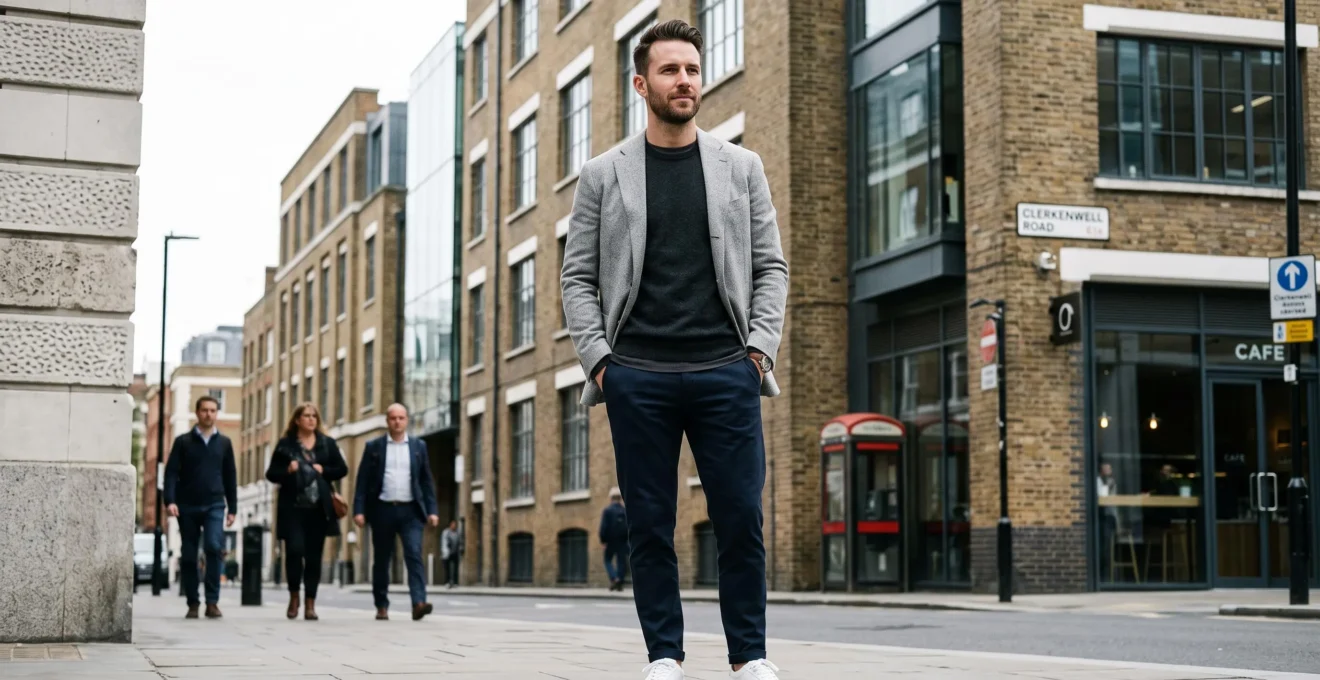
Modern tailoring looks smart without feeling stiff when a jacket follows the body’s natural shape rather than imposing a rigid silhouette. An unstructured blazer, well-cut trousers and carefully chosen textures can deliver the visual refinement of traditional tailoring while allowing greater freedom of movement and more casual combinations.
The difference is not simply choosing looser clothes. A relaxed jacket still needs a precise shoulder line, appropriate length and fabric that complements the rest of the outfit. Removing structure does not remove the importance of fit. Instead, it shifts attention towards proportion, drape and finishing details.
For men moving between offices, client meetings, travel and social occasions, this approach offers a practical alternative to wearing a complete suit. The key is understanding when a softer jacket works, how to combine it with everyday clothing and which details prevent an outfit from appearing unfinished.
Soft Tailoring: The Essentials
- Choose a jacket with natural shoulders, controlled proportions and lightweight construction rather than relying on oversized cuts for comfort.
- Combine one tailored garment with complementary smart-casual pieces, paying particular attention to fabric texture, trouser length and footwear.
- Match the degree of tailoring to the occasion: softer for relaxed workplaces and social settings, more structured when formality is expected.
- Why Does Soft Tailoring Work Better for Today’s Smart-Casual Wardrobe?
- How Can You Wear an Unstructured Blazer With Casual Trousers and Still Look Polished?
- Structured or Unstructured Blazer: Which Works Better for Your Weekly Routine?
- The Fit Mistake That Makes an Unstructured Blazer Look Untidy Instead of Relaxed
- When Should You Choose Soft Tailoring Instead of Standard Smart-Casual Clothing?
- How Can You Wear a Tailored Blazer With Jeans and Trainers Without Looking Mismatched?
- Wool, Cotton or Technical Dress Trousers: Which Are Best for Everyday Wear?
- How Can Men Build Elegant Outfits Without Wearing a Full Suit?
Why Does Soft Tailoring Work Better for Today’s Smart-Casual Wardrobe?
Soft tailoring works particularly well in modern smart-casual wardrobes because it preserves the clean lines of tailored clothing while reducing the visual rigidity associated with conventional suits. By using less shoulder padding, lighter internal construction or fewer linings, a jacket can follow natural movement more freely without abandoning the proportions that make tailoring look sophisticated.
A traditional tailored jacket relies on several components to establish its shape. Internal canvas supports the front of the jacket, shoulder padding can create a more defined upper body, and linings influence how the garment sits over other clothing. These elements serve practical and aesthetic purposes, but they also contribute to a more constructed appearance.
According to Proper Cloth‘s explanation of jacket construction, canvas helps provide structure and allows the outer fabric to drape cleanly. Fully canvassed jackets use this supporting layer throughout the body and lapels, while half-canvassed versions concentrate it in the upper body. Uncanvassed jackets omit that additional internal support.
Importantly, soft tailoring does not always mean completely unstructured tailoring. A jacket can retain canvas while using minimal shoulder padding and a lighter sleeve head. This distinction matters because some men benefit from gentle shaping even when they prefer a relaxed appearance.
Soft tailoring also differs from ordinary casual dressing. A sweatshirt or loose overshirt may be comfortable, but it does not necessarily establish the same silhouette as a blazer. Tailoring retains discipline through lapel shape, shoulder placement, garment length and the relationship between the jacket and trousers.
In workplaces where smart-casual clothing is accepted, the practical decision is often not whether to wear a suit, but how much formality the day requires. A softly constructed jacket over knitwear can make an outfit feel considered without suggesting that its wearer is dressed for a formal ceremony.
The result depends on choosing a construction that suits both the wearer’s shape and daily activities. Once that balance is established, the next challenge is making the jacket work with trousers that were never designed as part of a suit.
How Can You Wear an Unstructured Blazer With Casual Trousers and Still Look Polished?
Wear an unstructured blazer with casual trousers by matching their visual weight, texture and degree of formality. A soft cotton or linen-blend jacket generally pairs more naturally with chinos than with overtly sporty trousers. Keep the trouser hem controlled, choose understated footwear and use a shirt or knit with enough definition to anchor the relaxed silhouette.
The most useful starting point is a texture-and-weight check. Place the jacket next to the trousers and compare how their fabrics behave. Do they both look matte and relatively natural, or does one appear distinctly smooth, shiny or technical? Does one fabric feel substantial while the other is extremely thin?
For example, a cotton-linen blazer in muted olive can work with stone-coloured chinos because the materials occupy a similar casual register. A soft wool blazer can also complement brushed cotton trousers or fine wool trousers. By contrast, combining a textured blazer with glossy performance trousers may create a disconnect between their appearances.
Three finishing decisions carry much of the outfit’s polish:
- Trouser length: Choose a neat hem with little or no excess fabric gathering over the shoes. The exact break depends on the cut and footwear.
- Footwear: Suede loafers, simple leather shoes or minimal trainers can complement relaxed tailoring when their finish suits the trousers.
- Collar and neckline: A well-shaped Oxford shirt collar, fine polo or tidy crew-neck knit gives the upper body definition.
Consider the difference between a blazer worn over a clean, substantial T-shirt with pressed chinos and the same jacket worn with a stretched T-shirt and heavily creased trousers. The first combination may look intentional; the second risks appearing careless because nearly every component lacks visual definition.
This does not mean that all relaxed garments must be crisp. Linen naturally creases, and softer fabrics have their own character. The important distinction is between a deliberate texture and distracting signs of poor fit or maintenance.
When the trousers and jacket share a compatible visual language, the outfit needs surprisingly little additional styling. Whether the blazer itself should be structured or unstructured, however, depends on how it will actually be used throughout the week.
Structured or Unstructured Blazer: Which Works Better for Your Weekly Routine?
An unstructured blazer is often the more versatile option for relaxed offices, commuting and informal social occasions, while a structured blazer generally offers a sharper silhouette for formal meetings and conservative professional settings. Men who regularly encounter both environments may benefit from owning both styles or choosing a lightly structured jacket as a practical middle ground.
The most effective comparison starts with a typical working week rather than abstract rules about elegance. Consider how frequently you need a visibly formal silhouette, how much time you spend travelling and whether the jacket is worn for a few hours or throughout the day.
| Weekly situation | Structured blazer | Unstructured blazer | Practical choice |
|---|---|---|---|
| Formal client presentation | Creates a defined, conventional tailored silhouette. | May appear too relaxed in conservative settings. | Structured, unless the expected dress code is clearly informal. |
| Regular smart-casual office day | Looks polished but may feel more formal than necessary. | Pairs naturally with chinos and refined knitwear. | Unstructured or lightly structured. |
| Daily commuting | Maintains a deliberate jacket shape. | Can feel lighter and less restrictive, depending on fabric and cut. | Choose according to comfort, climate and wrinkle recovery. |
| Business travel | Provides a more formal appearance on arrival. | May pack more compactly but can require reshaping or steaming. | Consider fabric recovery as well as construction. |
| Restaurant or evening gathering | Works for dressier occasions. | Often blends better with casual trousers and knitwear. | Usually unstructured for informal invitations. |
The trade-off concerns more than appearance. A structured jacket has internal support that helps establish its intended silhouette, but this does not guarantee superior durability or wrinkle resistance. An unstructured jacket has fewer internal components, yet its behaviour after packing or repeated wear still depends on fabric, pattern and construction quality.
A soft jacket may fold more easily into luggage, but compact packing does not mean it will necessarily emerge without creases. Similarly, a structured jacket can preserve its outline well while still developing wrinkles in the outer fabric.
Lightly structured and half-canvassed jackets deserve particular attention when a wardrobe has room for only one versatile blazer. They can provide front-body definition while allowing softer shoulders and a less formal appearance.
However, this middle ground involves compromise. It may not feel as fluid as a completely unstructured jacket or look as sharply defined as a traditionally constructed blazer.
Construction establishes the character of a jacket, but it cannot compensate for incorrect sizing. This becomes especially noticeable with softer silhouettes, where the shoulders and body must create clean lines without substantial internal reinforcement.
The Fit Mistake That Makes an Unstructured Blazer Look Untidy Instead of Relaxed
The most damaging fit mistake is buying an unstructured blazer too large in an attempt to make it feel comfortable. Excess shoulder width, unnecessary body length and surplus fabric can make a relaxed jacket look borrowed rather than deliberately tailored. Comfort should come from the garment’s cut and construction, not simply from choosing a larger size.
Because an unstructured jacket has less internal support to define its silhouette, the relationship between the fabric and the wearer’s body becomes particularly visible. Oversized shoulders can droop, excess material may collect around the upper arms, and a long body can disrupt the proportions between torso and legs.
The first fitting checkpoint is the shoulder. The seam should sit close to the natural shoulder line, allowing for the intended design and a slight extension where appropriate. It should meet the upper sleeve smoothly rather than producing obvious divots, pulling or collapsed folds.
As a useful reference, Proper Cloth’s jacket shoulder fit guide recommends approximately half an inch of additional width across both shoulders in its fitting approach, or roughly a quarter inch on each side. This is a guide rather than a universal measurement for every jacket design.
The second checkpoint is sleeve length. When wearing a shirt, a small amount of cuff can create a neat transition between jacket and hand. A common styling preference is to reveal roughly a quarter to half an inch of shirt cuff, although the ideal result varies with arm position, shirt fit and personal style.
Finally, assess body length. A conventional blazer typically covers the seat or comes close to doing so, while contemporary casual designs may intentionally finish shorter. What matters is whether the hem looks proportionate to the wearer’s height and the trouser rise.
A useful fitting test is to button the jacket naturally, stand upright and then move your arms as you would during an ordinary day. The front should not pull severely across the chest, and the back should allow comfortable movement without creating large amounts of excess fabric. When the jacket is open, it should still follow the torso rather than hang like an oversized coat.
Five Checks Before Keeping an Unstructured Blazer
- Stand in front of a mirror and inspect both shoulders. Record whether each seam follows the shoulder line without obvious collapse or pulling.
- Wear your usual work shirt beneath the jacket. Check the sleeve length and note whether the cuff remains visible when your arms rest naturally.
- Button the blazer and inspect the chest and waist. Identify any strong tension lines or excessive folds that suggest the wrong size.
- Check the jacket from the side and rear. Confirm that the hem length looks balanced against the trousers and follows the jacket’s intended style.
- Sit, walk and reach forward while wearing the complete outfit. Make a final keep, alter or exchange decision based on both appearance and movement.
A correctly fitted unstructured blazer can look relaxed precisely because its proportions remain controlled. Once the fit is right, the next decision is whether that extra tailored layer improves the occasion compared with an ordinary smart-casual outfit.
When Should You Choose Soft Tailoring Instead of Standard Smart-Casual Clothing?
Choose soft tailoring when you want to look more considered than a shirt-and-chinos combination requires, without adopting the formality of a conventional suit. It is particularly useful for relaxed client-facing workplaces, business travel, warm-weather occasions and smart-casual social events. Structured tailoring remains more appropriate when a formal dress code or ceremonial setting calls for it.
The difference between standard smart-casual clothing and soft tailoring is often a single garment. A shirt with chinos can look perfectly presentable, but adding an unstructured blazer introduces lapels, a defined shoulder line and a more intentional upper-body silhouette.
That extra visual structure communicates effort without requiring a matching jacket and trousers. It can be particularly effective when the occasion falls between everyday casual dressing and traditional formalwear.
Consider these practical situations:
- Relaxed professional settings: A soft navy blazer with grey trousers and a fine knit adds polish while remaining compatible with a less formal office.
- Travel days: An appropriately lightweight jacket can be worn over a shirt or knit and adapted for an informal meeting after arrival.
- Warm-weather gatherings: A breathable, partially lined or unlined jacket may be more comfortable than a heavier fully lined alternative.
- Smart-casual social occasions: A textured blazer with well-fitting chinos gives the outfit a clear focal point without resembling a business suit.
Climate is an important reason to consider softer construction. A jacket with a breathable outer fabric and reduced lining may feel more manageable in warm conditions. Linen, lightweight wool and selected cotton blends can all be suitable, but actual comfort depends on the complete garment, not the fibre name alone.
For example, a loosely woven lightweight fabric may permit more airflow than a densely constructed alternative. Conversely, an unlined jacket made from a heavy fabric can still feel substantial in summer.
There are clear boundaries. Formal ceremonies, conservative business environments and occasions explicitly requiring a suit call for greater attention to conventional tailoring. A relaxed blazer should not be assumed to satisfy a dress code simply because it has lapels.
Soft tailoring is most effective when its level of refinement matches the setting. That same principle helps explain how an apparently contrasting combination, such as a tailored blazer with jeans and trainers, can become visually coherent.
How Can You Wear a Tailored Blazer With Jeans and Trainers Without Looking Mismatched?
Wear a tailored blazer with jeans and trainers by reducing the contrast between formal and casual elements. Choose a matte, understated blazer, dark or mid-indigo denim with a clean silhouette, and minimal low-top trainers in leather or suede. The combination looks deliberate when fabric textures, proportions and colours feel connected rather than competing for attention.
The difficulty is not that tailoring and denim are inherently incompatible. It is that a sharply structured business jacket and overtly sporty footwear communicate very different purposes. Bringing both towards the middle of the formality spectrum creates a more natural outfit.
A textured navy, charcoal or muted brown blazer usually integrates more easily with denim than a shiny jacket that looks as though it belongs to a formal suit. Patch pockets, softer shoulders and a less rigid chest can reinforce that casual character.
Denim selection is especially important. Straight-cut or moderately slim jeans generally provide a balanced shape beneath a blazer. Dark indigo and restrained mid-blue washes are versatile because they avoid the conspicuous wear patterns associated with heavily distressed denim.
Look closely at the hem. Jeans that stack excessively over the shoes can undermine an otherwise controlled silhouette. A neat hem, with a modest break or slightly shorter finish, usually creates a cleaner transition.
Raw hems, dramatic fading and prominent distressing are more difficult to integrate. They are not universally unsuitable, but they introduce additional casual signals that require greater attention elsewhere in the outfit.
Footwear should provide material continuity. Minimal leather or suede trainers have a relatively simple shape and surface, which can complement a matte blazer and clean denim. Technical running shoes, with performance mesh, pronounced soles or contrasting panels, often create a stronger stylistic mismatch.
This is a question of design rather than price. An understated, well-maintained pair of trainers may suit the outfit better than expensive shoes with prominent technical detailing.
For an immediately wearable combination, try a softly tailored grey blazer, an off-white fine-gauge knit, dark straight-leg jeans and plain suede trainers. The muted palette allows texture and fit to provide interest without forcing the jacket and footwear into competition.
Even when a blazer is not part of the outfit, this principle of material compatibility remains useful. It becomes particularly important when choosing everyday dress trousers, where fibre and fabric finish influence both practicality and appearance.
Wool, Cotton or Technical Dress Trousers: Which Are Best for Everyday Wear?
Wool is a strong everyday choice for men who want dress trousers that balance polish, versatility and natural wrinkle recovery. Cotton works particularly well in relaxed wardrobes and many warmer-weather outfits, while technical fabrics can offer easier care and crease resistance for commuting or travel. The best choice depends on climate, maintenance needs and the clothing already in your wardrobe.
Rather than ranking fabrics on appearance alone, compare them against four everyday requirements: how they recover from creasing, how they handle moisture and temperature, how easily they combine with other garments, and how much maintenance they require.
| Criterion | Wool | Cotton | Technical fabrics and blends |
|---|---|---|---|
| Wrinkle recovery | Generally good due to the fibre’s natural elasticity. | More prone to visible creasing. | Often strong when wrinkle-resistant synthetic fibres are used. |
| Breathability and moisture | Absorbs moisture vapour; performance varies with weave and weight. | Absorbent, with comfort dependent on fabric construction. | Varies considerably by fibre composition, weave and finishing. |
| Wardrobe versatility | Suitable for many professional and smart-casual combinations. | Particularly compatible with casual jackets and knitwear. | Best when texture and finish resemble the surrounding wardrobe. |
| Care requirements | Often benefits from airing and careful cleaning according to the label. | Many styles are washable but may require pressing. | Some blends are quick-drying and easier to maintain; follow the label. |
| Typical strength | Polished everyday dressing. | Relaxed, approachable tailoring. | Convenience for active routines and travel. |
Wool offers a useful range of possibilities. Lightweight tropical-style wool fabrics can suit warmer periods, while wool flannel provides a softer visual texture for cooler months. Both may work with unstructured blazers, although their weights and seasonal applications differ substantially.
Wool’s properties help explain its versatility. The Woolmark technical fact sheet on wool breathability describes how wool fibres absorb moisture vapour and release it into the surrounding environment. Its findings concern fibre characteristics and specific conditions rather than guaranteeing identical performance in every finished garment.
Up to 35%
Wool fibres can absorb moisture equivalent to up to 35% of their weight before feeling wet and clingy, according to Woolmark. This fibre-level property does not establish the comfort or breathability of every wool garment.
The Woolmark Company, technical fact sheet on wool breathability, 2018.
Cotton trousers have different advantages. Chinos and other cotton-based styles often integrate naturally with Oxford shirts, knitwear and softly constructed jackets. However, cotton generally creases more readily than wool, so maintaining a neat appearance may require more frequent pressing.
Technical blends present another trade-off. The University of Georgia Cooperative Extension‘s educational material on textile fibres explains that synthetic additions can improve characteristics such as strength, wrinkle recovery and wash-and-wear performance. These properties vary according to the composition and construction of the finished fabric.
For tailoring, the visual finish matters as much as easy maintenance. Some synthetic-rich trousers have a sheen, pronounced stretch texture or performance-oriented appearance that contrasts with natural-looking jackets. Others are sufficiently matte and refined to integrate well into an everyday wardrobe.
Start with the garments you already own. If most of your jackets, shirts and knitwear are cotton, linen and textured wool, trousers in similar visual registers will usually be easier to combine than conspicuously technical alternatives.
With compatible fabrics established, building elegant outfits no longer requires purchasing a matching suit. The remaining task is to combine tailored and casual pieces with enough visual unity to make each outfit feel complete.
Key Takeaways Before Building Your Outfits
- Select one garment to provide the tailored silhouette, then let the other pieces support rather than compete with it.
- Use compatible fabric finishes and a restrained colour palette to create visual continuity without matching every item.
- Build combinations around real weekly occasions, so the same tailored pieces can serve different levels of formality.
How Can Men Build Elegant Outfits Without Wearing a Full Suit?
Men can build elegant outfits without a full suit by using one tailored anchor piece, such as an unstructured blazer or refined trousers, and combining it with well-fitting smart-casual clothing. Keep the palette to two or three complementary colours, introduce texture deliberately and ensure that the formality of the shoes matches the rest of the outfit.
A matching suit creates visual unity automatically because the jacket and trousers share fabric, colour and finish. Without that built-in coordination, the wearer must create cohesion through other choices.
The simplest method is to establish a single tailored anchor. This might be a navy blazer worn with cotton chinos or wool trousers worn with a clean knit. The goal is not to ensure that only one piece has tailored qualities, but to avoid relying on a matching suit as the source of elegance.
For example, grey wool trousers and a charcoal fine-gauge jumper can form a polished outfit without any jacket. Conversely, a soft brown blazer can elevate dark jeans and a plain shirt while preserving the relaxed appearance of denim.
Colour restraint helps make these combinations deliberate. A wardrobe based on navy, grey, brown, olive, cream and white offers several possibilities without depending on exact fabric matches.
A practical starting rule is to use no more than two or three prominent colours and one noticeable texture contrast. This is a styling guideline rather than a rigid restriction: a subtle woven pattern or tonal accessory need not count as an entirely separate colour.
Consider three outfit formulas covering common situations.
| Occasion | Tailored anchor | Supporting garments | Why it works |
|---|---|---|---|
| Smart-casual office day | Unstructured navy wool blazer | Grey trousers, pale blue Oxford shirt, dark brown suede loafers | Classic colours create polish while softer textures reduce formality. |
| Evening dinner | Charcoal wool trousers | Fine-gauge black knit, dark brown suede jacket or no jacket, understated leather shoes | Controlled proportions and subdued colours replace traditional suit matching. |
| Smart weekend | Soft olive cotton blazer | Off-white knit, clean dark-indigo jeans, minimal suede trainers | Matte textures connect the jacket and casual garments without excessive contrast. |
These combinations can be adjusted seasonally. A lightweight knit may replace a shirt in cooler weather, while a breathable cotton or linen-blend layer can serve a similar purpose during warmer periods. Shoes can also adjust the outfit’s level of formality without requiring a complete change of clothing.
The most important refinement is to evaluate the complete silhouette rather than each item independently. A perfectly fitted blazer will not rescue trousers with an awkward hem, and expensive shoes will not compensate for incompatible textures or proportions.
A useful wardrobe exercise is to select one existing blazer and build three combinations around it: one for work, one for an evening occasion and one for the weekend. This reveals whether the jacket genuinely earns its place in a versatile wardrobe or requires too many specialised additions.
Start with one well-fitting tailored piece and two compatible casual combinations already in your wardrobe. Wear them in situations that reflect your normal week, then adjust the trouser length, footwear or layering based on how the complete outfit looks and feels. A versatile wardrobe develops through repeatable combinations, not through accumulating more formal clothing.
Can an unstructured blazer still look professional in a business setting?
Yes, particularly in workplaces where business-casual or smart-casual dressing is accepted. Choose a jacket with a clean shoulder line, restrained colour and suitable fabric, then pair it with well-fitting trousers and appropriate shoes. In conservative settings or formal meetings, a structured jacket or complete suit may still be more suitable.
Does an unlined blazer automatically feel cooler than a lined jacket?
Not necessarily. Removing lining can reduce the number of fabric layers, but comfort also depends on the outer fabric’s weight, weave, moisture management and air permeability. A lightweight, breathable lined jacket may perform better in warm conditions than an unlined jacket made from heavy, tightly woven fabric.
Can a soft blazer be altered if the shoulders are too wide?
Shoulder alterations are generally more complex than adjusting sleeve length or the waist because they can affect the sleeve attachment and upper-body balance. The feasibility depends on the jacket’s construction and the extent of the change. Prioritise correct shoulder fit when purchasing and consult an experienced alterations tailor before relying on substantial adjustments.
How should an unstructured blazer be stored between wears?
Place it on a hanger that supports the shoulders without forcing them into an unnatural shape. Allow the fabric to air between wears, avoid overcrowding and follow the garment’s care label for cleaning or steaming. Storage needs depend on the fabric and construction; minimal internal structure does not mean that the jacket requires no care.
Is it possible to wear soft tailoring throughout the year?
Yes, provided the fabric weight and layering suit the season. Lightweight wool, cotton-linen blends and breathable constructions can work in warmer conditions, while flannel, heavier wool and layered knitwear suit cooler periods. Jacket construction alone does not determine seasonal comfort, so consider the complete garment and the climate in which it will be worn.