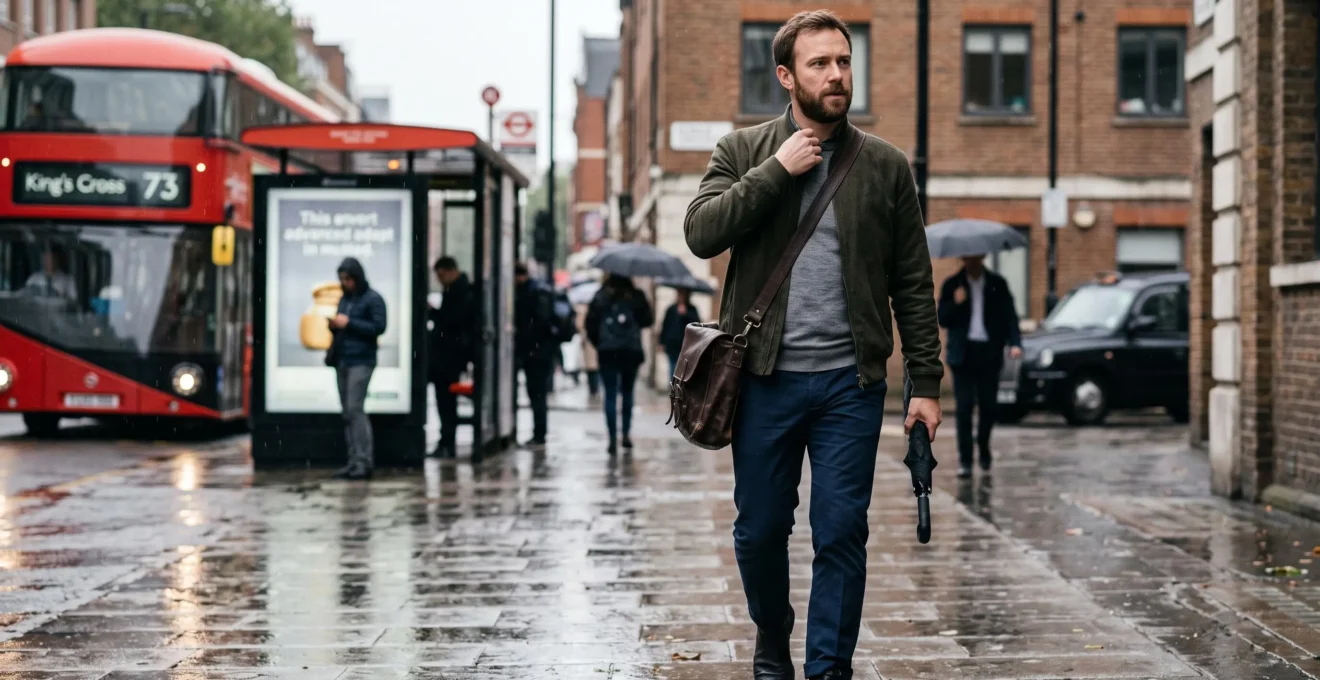
The best lightweight jacket for unpredictable British weather is one that matches your daily exposure to wind and rain while leaving enough room for adjustable layers. For most short urban commutes, a versatile bomber or water-resistant overshirt can be more practical than a heavily insulated coat. For longer, wetter journeys, a breathable waterproof shell offers more dependable protection.
British weather makes this choice particularly important. A cool morning can develop into a mild afternoon, while drizzle and wind change how comfortable the same outfit feels. The Met Office regional climate information for the UK also highlights meaningful differences between locations: southern and eastern areas generally tend to be warmer, drier and less windy than regions further north and west.
Choosing well therefore involves more than finding a jacket labelled lightweight. Cut, fabric, breathability, layering space and the amount of time spent outdoors all determine whether a jacket becomes an everyday essential or an occasional compromise.
Lightweight jackets for British weather: the essentials
- Choose a bomber for smart-casual versatility, an overshirt for flexible indoor layering, or a waterproof shell for prolonged rain exposure.
- Check the fit over your usual knitwear rather than judging the jacket over a T-shirt alone.
- Prioritise breathable, adjustable protection for changing conditions instead of buying maximum insulation or waterproofing by default.
- Why Can a Lightweight Jacket Get More Wear Than a Winter Coat?
- How Can You Layer a Lightweight Jacket Over Knitwear Without Creating Bulk?
- Bomber, Overshirt or Shell: Which Lightweight Jacket Suits Your Daily Routine?
- The Lightweight Jacket Mistake That Leaves You Too Hot or Too Cold
- When Should You Replace Your Winter Coat With a Lightweight Jacket?
- How Can You Build a Three-Layer Outfit for Cold Mornings and Warm Offices?
- Waterproof or Water-Resistant: Which Fabric Makes More Sense for Urban Wear?
- Which Functional Fabrics Actually Make Everyday Menswear More Comfortable?
Why Can a Lightweight Jacket Get More Wear Than a Winter Coat?
A lightweight jacket can get more wear than a winter coat because it works across a broader range of temperatures, outfits and daily activities. Rather than providing a fixed level of heavy insulation, it allows warmth to be adjusted with knitwear and base layers. Its usefulness extends beyond cold days into mild, windy and changeable weather.
The financial advantage becomes clearer through cost per wear: the purchase price divided by the number of times the garment is actually worn. A winter coat may be excellent value during prolonged cold weather, but its substantial insulation can limit opportunities to wear it during milder periods.
Consider a purely hypothetical comparison. If a £180 lightweight jacket is worn 120 times, its cost per wear is 1.50 £. A £240 winter coat worn 40 times costs £6 per wear. Those figures illustrate the calculation rather than establish typical UK wearing habits. Actual value depends on durability, maintenance and how frequently each garment suits your routine.
Adaptability creates another advantage. A lightweight jacket worn over a shirt can feel appropriate during a mild afternoon. Adding a fine merino jumper extends its usefulness on cooler mornings, without requiring an entirely different outer layer.
There is also a wardrobe consideration. Heavy winter coats are often removed immediately upon entering an office, café or shop. An unstructured bomber or overshirt can remain part of the outfit indoors, provided the room is cool enough. This makes it easier to move between different settings without constantly rearranging clothing.
However, versatility has limits. A thin jacket cannot reliably replace substantial insulation during sustained sub-zero temperatures, and ordinary woven fabrics are not substitutes for proper rain protection in severe conditions.
Before deciding where to spend more, assess how many genuinely cold days you experience, how long you remain outdoors and which garments you already own. A jacket worn frequently is valuable only when it remains comfortable and suitable for those conditions.
How Can You Layer a Lightweight Jacket Over Knitwear Without Creating Bulk?
To layer a lightweight jacket over knitwear without creating bulk, choose an outer cut that accommodates your usual jumper, keep inner layers relatively close-fitting and avoid stacking several thick garments. Check shoulder movement, sleeve clearance and hem alignment while wearing the complete outfit. Smooth, fine-gauge knitwear generally sits more neatly beneath structured or tightly woven jackets.
The most important measurement is not how a jacket fits over a lightweight shirt, but how it fits over the thickest knit you regularly intend to wear. A bomber that looks perfectly proportioned over a T-shirt may pull across the shoulders when combined with a wool jumper.
Roomier armholes and a relatively straight body often make layering easier. A close-fitting cropped jacket, by contrast, may be designed primarily for lighter clothing underneath. Going up a size is not always the solution: excessive length or shoulder width can undermine the intended silhouette.
Use a thickness hierarchy when assembling an outfit. A fine base layer, one substantial knit and a lightweight outer usually create a cleaner result than several overlapping mid-weight garments. The goal is to preserve insulation without accumulating unnecessary fabric around the chest and arms.
Texture matters as well. Chunky cable knits and bouclé fabrics can create friction beneath snug sleeves or rough linings. This may increase bunching and, with repeated wear, contribute to abrasion or pilling. Fine merino, smooth cotton knitwear and other low-profile fabrics are generally easier to combine.
Two simple fitting checks help identify problems before purchase. First, raise both arms and reach forward. The jacket sleeves should move over the knit without pulling it towards the elbows or restricting the shoulders. Second, inspect the waist: ideally, the outer hem sits at or slightly below the jumper’s hem, avoiding excessive fabric gathering underneath.
A slight amount of visible knit below the jacket can be a deliberate styling choice, but significant bunching usually indicates an unsuitable combination of lengths or cuts.
Five checks before choosing your layering jacket
- Wear your usual winter-to-spring knit. Identify the thickest everyday jumper the jacket must accommodate and note whether the fit remains comfortable.
- Check your shoulders and chest. Fasten the jacket and reach forward; confirm that the fabric does not pull tightly or restrict movement.
- Test sleeve clearance. Raise and lower your arms, then check that the jumper sleeves remain in position.
- Inspect the hem alignment. Look in a mirror and confirm that the waist stays smooth when standing and sitting.
- Review the complete outfit. Keep the combination only if it feels comfortable, maintains a balanced silhouette and works with clothing you already own.
Once fit is resolved, the next choice is the jacket style itself. A comfortable silhouette matters, but the daily routine should determine whether a bomber, overshirt or technical shell is the most useful option.
Bomber, Overshirt or Shell: Which Lightweight Jacket Suits Your Daily Routine?
A bomber jacket suits smart-casual commuting and relatively short periods outdoors, while an overshirt works best for days spent moving between heated indoor spaces. A technical shell is preferable for walking, cycling and prolonged exposure to rain or wind. The right choice depends primarily on your outdoor exposure, mobility needs and preferred level of formality.
These three styles solve different problems. A bomber typically provides shape and outfit versatility. An overshirt behaves more like an adaptable additional clothing layer. A shell prioritises weather protection, sometimes at the expense of a traditional tailored appearance.
| Daily requirement | Bomber jacket | Overshirt | Technical shell |
|---|---|---|---|
| Most suitable routine | Smart-casual commuting and social occasions | Office days and frequent indoor transitions | Walking, cycling and exposed commutes |
| Weather protection | Variable; depends on fabric and treatment | Usually limited unless specifically designed for weather resistance | Strongest option when fully waterproof and properly constructed |
| Layering versatility | Good with a suitable cut | Excellent as a removable or intermediate layer | Good with sufficient room beneath |
| Style character | Structured and smart-casual | Relaxed and understated | Functional and technical |
| Main compromise | Not inherently rainproof | Limited protection against prolonged exposure | Can feel less natural in formal settings |
For someone travelling between a train station, office and restaurant, an unstructured bomber in a densely woven fabric can be an effective compromise. It is easy to combine with chinos, dark denim and fine knitwear, while maintaining a clean outline.
An overshirt becomes particularly useful when the jacket is likely to remain on indoors. Its shirt-inspired construction makes it feel less like dedicated outdoor equipment. However, loosely woven wool or cotton overshirts may offer relatively little protection from wind-driven rain.
A shell is the more dependable choice when the journey involves cycling, prolonged walking or waiting outdoors in sustained rain. Look beyond the generic shell label: waterproof construction, seam sealing, hood design and ventilation all affect performance.
British conditions do not make maximum waterproofing necessary for everyone. A short walk between sheltered locations creates different demands from a long commute across exposed streets or open ground.
For men whose weeks include both smart office days and regularly wet active commutes, a two-jacket approach may be more effective than searching for one perfect compromise. A presentable bomber or overshirt covers ordinary routines; a waterproof shell handles demanding weather.
The objective is not to own every style, but to avoid relying on an unsuitable garment for situations it was never designed to handle. Once the silhouette matches your routine, temperature regulation becomes the next priority.
The Lightweight Jacket Mistake That Leaves You Too Hot or Too Cold
The most common lightweight jacket mistake is choosing for one imagined temperature rather than the range of conditions experienced throughout the day. A heavily insulated option may feel comfortable on a cold morning but become stifling later. A thin, poorly layered jacket may feel ideal indoors yet leave you cold when wind or rain increases heat loss.
Effective outerwear needs to balance insulation, breathability and protection. These qualities are related, but they are not interchangeable.
Insulation reduces heat loss. Wind resistance limits the cooling effect of moving air. Rain protection helps prevent external water from reaching inner clothing. Breathability and ventilation, meanwhile, influence how effectively moisture and excess heat escape.
This distinction explains why a man can feel cold and clammy inside a protective jacket. During a brisk commute, perspiration may accumulate beneath clothing that restricts moisture escape. If the base layer becomes damp, discomfort can develop even though the outer fabric blocks wind.
The REI expert guide to clothing layering explains the complementary functions of moisture-managing base layers, insulating middle layers and protective outer garments. It also recognises that exertion and individual temperature responses influence comfort.
A practical fitting-room check can reveal obvious problems. Put on the jacket with the layers you would normally wear, then walk briskly and move your arms for around two minutes. Notice whether the combination feels restrictive or becomes unpleasantly warm.
This is an informal comfort check, not a scientifically validated breathability test. It cannot reproduce wind, rain or sustained outdoor activity, but it can help you reject combinations that already feel uncomfortable in a controlled indoor setting.
If you regularly overheat, consider reducing mid-layer insulation, choosing a more breathable construction or selecting a jacket with useful ventilation. If you are consistently cold, check whether inadequate insulation, wind penetration or damp clothing is the likely cause before simply buying a heavier outer layer.
A garment that repeatedly causes discomfort is likely to become less useful in practice. The better solution is an adjustable system that reflects normal activity levels, not just the coldest temperature you can imagine.
When Should You Replace Your Winter Coat With a Lightweight Jacket?
Switch from a winter coat to a lightweight jacket when your heavy coat regularly feels too warm during normal daytime activity and a lighter outer layer with appropriate knitwear provides sufficient protection. This often occurs during spring and autumn, although mild winter spells can also favour lighter clothing. Actual conditions and outdoor exposure matter more than calendar dates.
The clearest signals come from your everyday routine rather than a fixed temperature threshold.
- You regularly remove or carry your winter coat before reaching your destination.
- You feel uncomfortably warm during a brisk walk, even with the coat partly unfastened.
- Daytime conditions are mild enough for knitwear and a wind-resistant outer layer.
- Your time outdoors is relatively short and you can adjust clothing when conditions change.
These observations suggest that your current level of insulation may exceed what the situation requires.
Regional differences also matter. Someone living in a relatively sheltered southern city may find a lightweight jacket practical across more days than someone regularly facing exposed, windy conditions further north or west. Personal sensitivity to cold and the length of each journey add further variation.
For most wardrobes, the transition is better understood as changing which coat is used most often, not permanently replacing winter outerwear.
A gradual approach works well. Begin by wearing a lightweight jacket over a fine jumper on mild days. As conditions cool, try a warmer knit or suitable insulating mid-layer. Pay attention to wind, dampness and how long the outfit remains comfortable outdoors.
Eventually, you may encounter conditions where extra layers make the outfit bulky without delivering adequate warmth. That is a useful indication that the heavier coat should return.
Men who spend very little time outdoors in consistently mild locations may find a layered lightweight jacket meets most of their needs. However, occasional freezing temperatures or severe weather can still justify retaining proper winter protection.
Making that transition gradually also helps establish which knitwear combinations deserve a permanent place in the wardrobe, particularly when mornings are cold but offices remain warm.
How Can You Build a Three-Layer Outfit for Cold Mornings and Warm Offices?
A practical three-layer outfit combines a moisture-managing base layer, an insulating jumper and a lightweight protective jacket. Each element should serve a distinct purpose and be removable without making the remaining outfit look unfinished. This allows you to dress for a cold commute, then reduce warmth comfortably when entering a heated office.
The base layer sits closest to the skin. A fine merino top or suitable technical shirt can help manage moisture without adding unnecessary thickness. Choose a fit that remains comfortable beneath knitwear and does not bunch around the shoulders.
The middle layer provides warmth. A fine-gauge or mid-gauge jumper is usually easier to combine with office clothing than a bulky fleece or oversized knit. Its colour, neckline and fit matter because this is often the layer colleagues will see once the jacket comes off.
The outer layer protects against wind and, depending on its construction, rain. A lightweight bomber, overshirt or shell can fulfil this role, provided it has enough room for the chosen combination.
For a straightforward smart-casual example, combine a close-fitting base layer, a navy merino crew neck and a lightweight charcoal bomber. Add tailored trousers or dark chinos for a coordinated outfit that remains presentable when the outer layer is removed.
Office compatibility is frequently overlooked. A technical insulating piece may perform well outdoors but feel visually out of place in a formal meeting. Choosing a middle layer that works independently avoids the need to change clothes when arriving.
Think about what happens to the jacket after removal. An unstructured overshirt may fold easily into a bag, while a structured bomber may be better hung over a chair or on a hook. Lightweight shells can be compact, but repeatedly compressing some fabrics can create creases or affect their appearance.
Three layers are not always necessary. On a mild morning with a short commute, a jumper and lightweight jacket may provide enough warmth. Carrying an optional layer makes more sense when conditions are uncertain than wearing everything from the outset.
The system becomes more reliable once the outer fabric is chosen for the amount of rain you actually face. That decision requires understanding the difference between water resistance and waterproof construction.
Waterproof or Water-Resistant: Which Fabric Makes More Sense for Urban Wear?
Water-resistant fabric is often sufficient for short urban journeys involving occasional drizzle, while a properly constructed waterproof jacket is more appropriate for prolonged or heavy rain. The distinction is not simply whether droplets bead on the surface. Waterproof performance depends on the fabric, construction and seams, while comfort also depends on moisture escape and ventilation.
Water-resistant jackets typically use tightly woven materials, surface treatments or other constructions that slow water penetration. They can provide useful protection in light rain, but their performance varies, and they may eventually allow water through during sustained exposure.
Waterproof jackets are designed to prevent water penetration under more demanding conditions. Membranes or coatings are commonly used, while sealed or taped seams help prevent leakage through stitching.
Technical performance involves more than rain resistance. The ISO 24232:2024 standard on protection against rain identifies water penetration resistance and water vapour resistance as separate characteristics of rain-protective clothing.
That distinction matters because waterproof materials do not all manage perspiration in the same way. Some restrict water vapour substantially, while others allow more moisture transmission. Construction, ventilation and activity level influence how comfortable the complete jacket feels.
Visible water beading can indicate that a surface treatment is functioning, but it does not, by itself, prove that a garment is waterproof. A jacket can initially shed droplets while still lacking the construction required for sustained protection.
For everyday British urban wear, consider your typical journey. If outdoor exposure consists of brief intervals between buildings, public transport and sheltered destinations, a water-resistant woven jacket may offer a useful combination of comfort, appearance and light-weather protection.
For a walk or cycle commute lasting more than roughly twenty minutes, especially where shelter is limited, a waterproof shell becomes worth considering. This is a practical decision guide, not a scientifically established exposure threshold: rainfall intensity, wind, activity and the individual garment can change the outcome substantially.
Those who cycle regularly should also assess hood adjustment, coverage when leaning forward, ventilation and freedom of movement. A jacket that blocks rain but traps substantial perspiration may still leave the wearer uncomfortable.
The most suitable jacket is therefore not automatically the one with the highest waterproof specification. Its fabric should provide the protection your journey requires while remaining manageable throughout the rest of the day.
Key takeaways before choosing your jacket fabric
- Identify the discomfort first: excess heat, damp clothing and restricted movement require different fabric properties.
- Assess the complete outfit rather than an isolated material specification, because inner and outer layers influence one another.
- Choose the performance level your commute actually requires, allowing for washing, durability and repeated everyday wear.
Which Functional Fabrics Actually Make Everyday Menswear More Comfortable?
The most useful functional fabrics are those that address a specific comfort problem. Moisture-managing materials help with perspiration, breathable constructions support heat and vapour movement, stretch improves mobility, and wind-resistant fabrics reduce exposure to moving air. No single material delivers every benefit equally, so the best choice depends on your activity, layering system and care requirements.
Fabric labels can make clothing sound more advanced than it needs to be. Terms such as technical, performance and weather-ready are not substitutes for understanding how a garment behaves during ordinary use.
Moisture management is particularly relevant for active commutes. Synthetic base layers can transport moisture away from the skin and often dry quickly. Merino wool can provide comfortable temperature regulation and useful odour resistance, though drying speed, durability and care requirements vary by construction and blend.
Breathability matters when physical activity generates heat. A breathable base layer is less effective as part of a moisture-management system if subsequent layers substantially restrict moisture escape and offer little ventilation.
Stretch addresses a different problem. A small amount of mechanical or fibre-based elasticity may make a jacket easier to wear when reaching, cycling or carrying a bag. However, stretch does not correct poor sizing or inadequate room through the shoulders.
Wind-resistant fabrics help reduce heat loss in exposed conditions. Dense weaves can provide useful protection without the insulation of a padded winter coat. The trade-off is that increasingly protective constructions may also affect airflow, depending on the material.
| Property | Main benefit | What to check |
|---|---|---|
| Moisture management | Helps move perspiration away from skin | Base-layer material, fit and drying behaviour |
| Breathability | Supports moisture vapour escape and comfort | Complete layering system and available ventilation |
| Stretch | Improves freedom of movement | Shoulder mobility and recovery after movement |
| Wind resistance | Reduces exposure to moving air | Weave, construction and intended activity |
| Waterproof construction | Protects against sustained precipitation | Fabric performance, seams, coverage and ventilation |
Natural and synthetic materials both have advantages. Merino may appeal to someone seeking a comfortable, versatile jumper that can be worn repeatedly between appropriate washes. Polyester and other synthetics can be attractive where rapid drying, abrasion resistance or easier maintenance are priorities, although odour retention varies among garments and treatments.
Blended fabrics can offer practical compromises, but their performance depends on composition and construction rather than the presence of a particular fibre alone.
Finally, avoid specification inflation. Higher waterproof ratings, more complex membranes or increasingly dense materials may offer benefits in demanding environments, but those features do not automatically improve an ordinary urban commute. Additional technical performance can involve higher cost, weight or different comfort characteristics without delivering a meaningful advantage for your routine.
Before buying, identify your main discomfort, select the fabric properties that address it and try the jacket with your regular layers. A practical lightweight jacket should feel comfortable on the journey, look appropriate at the destination and earn its place in the wardrobe through repeated use.
Can a lightweight jacket keep you warm in winter?
Yes, in some mild winter conditions, especially when combined with an appropriate insulating layer and wind protection. However, a lightweight jacket is not necessarily suitable for prolonged freezing temperatures or severe weather. Consider the jacket’s construction, your activity level and the length of time spent outdoors.
Is a hood essential on a lightweight jacket in the UK?
A hood is particularly useful for exposed journeys and sustained rain, but it is not essential for every urban routine. Someone making short, sheltered journeys may prefer a clean-collared bomber or overshirt and carry a separate rain layer when needed. A functional hood should offer sufficient coverage and adjustment without obstructing vision.
Should a lightweight jacket fit tightly or loosely?
It should provide enough ease for the layers you intend to wear without excessive fabric around the body. Test the jacket over your usual jumper, then check shoulder mobility, sleeve movement and waist bunching. A closer cut can work well over shirts, while regular layering generally benefits from additional room.
Can you restore water resistance after washing a jacket?
Some jackets use durable water-repellent finishes that can be maintained or renewed following the manufacturer’s care instructions. Appropriate cleaning and compatible treatments may help restore surface water repellency. However, treating the exterior does not turn a non-waterproof garment into a fully waterproof jacket or repair damaged membranes and seams.
Which lightweight jacket colour is easiest to combine with everyday menswear?
Navy, charcoal, olive and other restrained neutral colours are versatile choices for many smart-casual wardrobes. The most practical option depends on the trousers, knitwear and footwear you already wear. Checking several complete outfits before purchase is more useful than choosing a colour solely because it is considered classic.