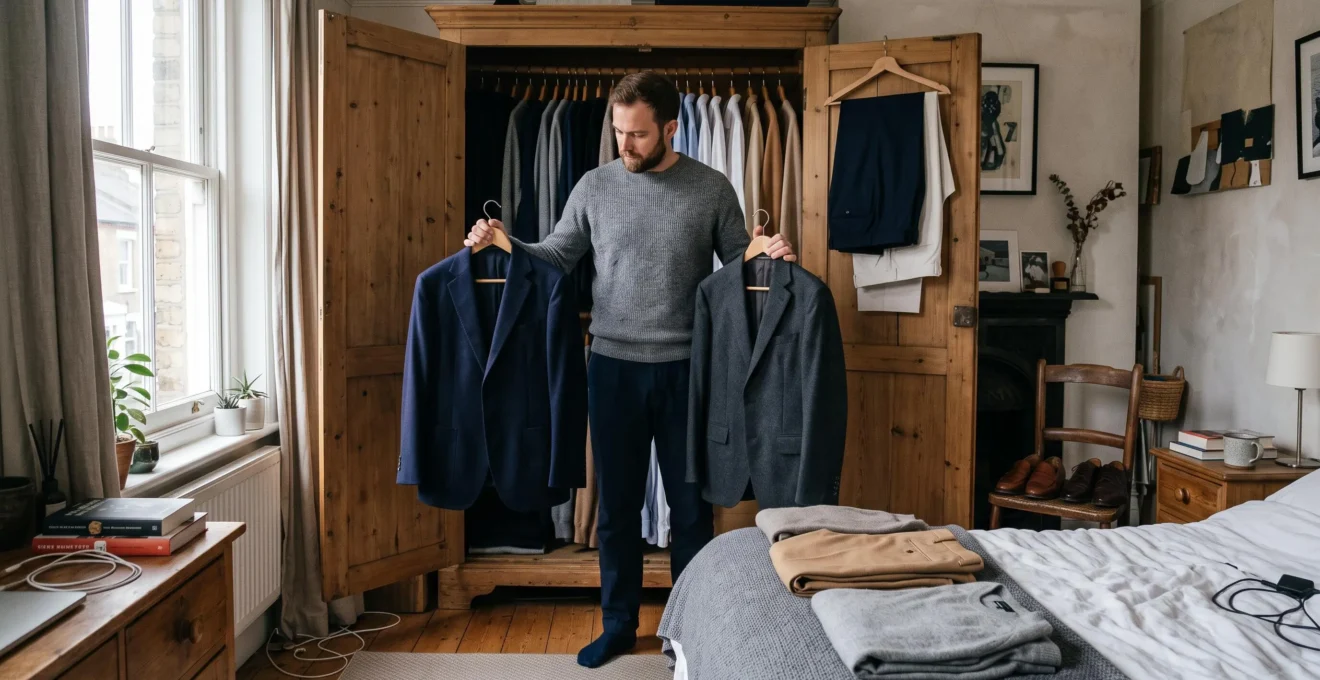
The most useful timeless wardrobe essentials for men are versatile trousers, well-fitting plain shirts and T-shirts, adaptable knitwear, understated outer layers and shoes that complement several outfits. Their value comes less from being universally fashionable than from working together across the situations a man actually encounters.
A dependable wardrobe does not need to contain every classic item recommended by fashion publications. A navy blazer may be indispensable for someone attending regular client meetings but unnecessary for a man working in a casual environment. Similarly, dark denim might serve as an everyday foundation in one wardrobe while tailored trousers do more work in another.
The objective is to build a compact collection that offers meaningful choices without requiring constant shopping. That means selecting compatible colors, distinguishing durable design from temporary trends, checking how garments perform in complete outfits and replacing pieces when they stop serving their purpose. A practical core wardrobe should simplify getting dressed while remaining flexible enough for changing seasons, occasions and personal preferences.
The essentials of a versatile men’s wardrobe
- Prioritize understated garments with adaptable proportions, compatible colors and few trend-dependent details.
- Build a core around pieces that produce multiple wearable outfits rather than following a universal shopping checklist.
- Review fit, condition and compatibility regularly; update or replace individual staples instead of rebuilding everything.
- Why Do Some Wardrobe Staples Stay Relevant for Decades While Others Date Quickly?
- How Can You Build a 12-Piece Core Wardrobe for Work and Weekends?
- Classic or Updated Staple: Which Version Gives Better Long-Term Wear?
- Why Buying Every Recommended Wardrobe Essential Can Waste Money?
- When Should You Replace a Wardrobe Staple That Still Looks Acceptable?
- How Can You Audit Your Wardrobe in 30 Minutes to Find the Pieces That Do Not Work Together?
- Polo, Shirt, Knit or T-Shirt: Which Top Works Best for Smart-Casual Days?
- How Can Men Build a Personal Style That Feels Consistent Without Looking Overdone?
Why Do Some Wardrobe Staples Stay Relevant for Decades While Others Date Quickly?
Wardrobe staples tend to remain useful when their proportions are balanced, their colors are easy to combine and their appearance does not depend on conspicuous branding or fashionable details. By contrast, exaggerated shapes, distinctive finishes and highly recognizable trend features can make garments feel associated with a particular period, even when their materials remain in good condition.
Three characteristics are particularly helpful when assessing long-term versatility: simple proportions, adaptable colors and restrained detailing. A straight-cut navy blazer with conventional lapels, for example, can accommodate several styles of trousers and shirts. An otherwise similar blazer with unusually exaggerated lapels may be harder to integrate once surrounding clothing preferences change.
This is partly a matter of how fashion history works. The Victoria and Albert Museum’s history of 1960s British menswear documents how lapels and trouser proportions became increasingly exaggerated during the transition towards the 1970s. These details help identify the visual character of that period. The historical examples illustrate changing silhouettes, although they cannot predict which contemporary garments will remain desirable decades from now.
A useful distinction is between the garment itself and the details that date it. Blazers, shirts and trousers continue to exist across generations, but their proportions, buttons, collars and finishes evolve. Choosing relatively restrained versions can reduce dependence on any particular fashion cycle. Replaceable buttons and alterable hems may also make a garment easier to maintain or adapt.
Before buying, try a simple visual test: could the garment plausibly appear in a photograph from twenty years ago and in a contemporary film without immediately looking unusual? This is a personal decision aid, not a scientifically validated test. It can reveal distinctive design features, but historical fashions sometimes return and individual tastes differ.
Price is another unreliable shortcut. Expensive tailoring can feature highly fashionable proportions, while an affordable plain shirt may remain visually appropriate for years. Construction, fit, maintenance and compatibility matter independently of the price tag.
Timelessness is therefore better understood as a reduction in unnecessary design constraints, not immunity from changing fashion. Once that principle is established, the next challenge is choosing a small number of garments that genuinely work together.
How Can You Build a 12-Piece Core Wardrobe for Work and Weekends?
A 12-piece core wardrobe works best as a flexible allocation of tops, trousers, layering pieces and shoes rather than a mandatory list of garments. Start with the settings in which you spend most of your week, establish a compatible color palette and select items that create several realistic combinations. Adjust the selection for climate and dress codes.
Begin by deciding what proportion of your clothing needs comes from professional activities, casual days and more formal occasions. Someone spending most weekdays in a business-casual office may need more collared tops and structured layers. Someone working remotely may benefit more from casual shirts, knitwear and comfortable trousers.
For a hypothetical wardrobe serving a mixture of office and weekend activities, the following allocation offers one starting point. The exact garments are examples, not universal requirements.
| Category | Suggested allocation | Example garments |
|---|---|---|
| Tops | 4 pieces | White Oxford shirt, light-blue shirt, plain T-shirt, knitted polo |
| Trousers | 3 pieces | Dark jeans, neutral chinos, tailored trousers |
| Layering pieces | 3 pieces | Fine-gauge sweater, unstructured blazer, casual jacket |
| Footwear | 2 pairs | Minimal trainers, versatile leather shoes |
This example counts footwear but excludes underwear, socks, accessories and specialized clothing. It is a planning exercise rather than an ideal garment count established by research. A different lifestyle might justify replacing the blazer with another casual layer or exchanging tailored trousers for a second pair of chinos.
Choose the palette before choosing the garments. Two dominant neutral colors, such as navy and grey, can provide the foundation, while a limited accent such as olive or burgundy adds variation. White or other light shades can act as connecting colors. The important test is whether the proposed garments create outfits you would actually wear, not whether every possible color pairing is theoretically acceptable.
Next, evaluate each item through outfit counting. A candidate should contribute to at least two useful combinations with other core pieces. For example, navy chinos might work with a white shirt and leather shoes for the office, then with a T-shirt and trainers at the weekend. A distinctive top that works with only one pair of trousers may be better treated as an occasional item.
This compatibility-first approach reflects the broader principle described in GQ’s men’s capsule wardrobe recommendations: the ideal selection varies by individual, and versatile pieces should function across combinations, occasions and seasons. GQ’s editorial selection is an example rather than proof that a particular wardrobe size is optimal.
Seasonality needs explicit consideration. In a moderate climate, several shirts, trousers and shoes may remain useful year-round while knitwear and outer layers rotate. In climates with extreme temperatures, a 12-piece core may need a stable year-round foundation plus seasonal substitutions. A single fixed selection should not be expected to cover every weather condition.
The goal is not to prove that twelve pieces are sufficient for everyone. It is to identify a manageable foundation whose components reinforce one another, then decide where classic designs and selective updates offer the greatest value.
Classic or Updated Staple: Which Version Gives Better Long-Term Wear?
Classic versions generally make sense for expensive garments worn frequently, while updated versions can offer more flexibility for lower-cost or occasional pieces. The decision depends on purchase cost, expected use, personal preference and the prominence of fashionable details. An updated staple can remain versatile, but a strongly trend-driven version may restrict future combinations.
The distinction between updated and trend-dependent matters more than whether an item looks modern. An updated Oxford shirt might use a slightly more relaxed fit or a different cotton texture while retaining its recognizable shape. A shirt with an unusually shaped collar, conspicuous hardware or extreme proportions makes a more specific stylistic statement.
For frequently worn investment pieces, understated design may reduce the risk of having to replace an otherwise serviceable garment because its styling no longer suits the rest of the wardrobe. For less expensive pieces used occasionally, experimentation may be a reasonable choice if it brings genuine enjoyment and fills an existing wardrobe need.
The comparison below provides a practical decision framework rather than a guarantee of garment lifespan.
| Decision factor | Classic version | Updated version |
|---|---|---|
| Expected frequency of wear | Often a practical choice for everyday rotation | Useful when a newer fit better suits current needs |
| Purchase investment | Limits exposure to strongly recognizable trends | Reasonable when experimentation carries acceptable cost |
| Existing wardrobe | May preserve established combinations | Can refresh familiar outfits without a complete rebuild |
| Distinctive details | Typically restrained | Should be assessed for future compatibility |
Gradual updating provides another advantage. Replacing one worn shirt with a slightly more relaxed version allows the remaining wardrobe to absorb the change. Buying several strongly contemporary pieces at once can create a collection heavily dependent on one period’s aesthetic preferences.
However, some categories do not offer a permanently stable classic silhouette. Trouser widths, rises and footwear sole proportions regularly change, and supposedly timeless examples may still look or feel unsuitable on a particular wearer. Choosing an older-looking design simply because it is called classic can be as limiting as chasing a new trend.
The most reliable approach is to test the new version against current clothing. If an updated trouser cut works with existing shoes, shirts and layers, it may provide better long-term usefulness than a traditional cut that fits poorly or feels uncomfortable.
Long-term value comes from compatibility and actual use, not from treating historical design as inherently superior. That also explains why purchasing every item on a recommended essentials list can undermine an otherwise coherent wardrobe.
Why Buying Every Recommended Wardrobe Essential Can Waste Money?
Buying every recommended wardrobe essential can waste money because generic lists cannot account for individual lifestyles, climates, workplace expectations or existing clothing. Even traditionally versatile garments become poor purchases when they duplicate items already owned or fail to create useful outfits. A smaller, personalized selection can offer more practical variety than a larger collection of disconnected staples.
An essentials list is best treated as a catalogue of candidates rather than a shopping obligation. A wool overcoat may be useful in a cold climate and largely irrelevant in a hot one. A formal blazer may be valuable for frequent presentations but unnecessary in a workplace where almost everyone dresses casually.
A straightforward two-stage filter helps avoid unnecessary additions. First, identify which recommended items meet a genuine need in your daily life. Second, check each candidate against at least two garments already worn regularly. If it cannot make useful combinations with those pieces, reconsider the purchase or identify precisely what it would replace.
This approach also exposes the limits of evaluating clothes solely through cost per wear. Dividing the purchase price by the number of times an item is worn can describe its historical usage, but it says little about whether the resulting outfits are appropriate, comfortable or satisfying.
Consider a hypothetical situation: a man owns several nearly identical navy blazers but lacks a casual jacket suitable for weekend outings. A further navy blazer might receive some use, yet it would contribute little new functionality. A complementary layer might serve additional contexts and create combinations unavailable with the existing jackets.
The distinction is between duplication and complementarity. Multiple similar pieces can be justified by frequent use, laundry requirements or different seasons. However, where their functions are interchangeable, additional purchases may increase the number of garments without meaningfully increasing outfit variety.
Before buying another supposed essential, consider whether the new item would create a new type of outfit, improve an existing one or simply replace something already adequate. This shifts the decision from collecting approved garments to solving identifiable wardrobe problems.
A selective wardrobe also makes replacement decisions clearer. Once each staple has a defined role, it becomes easier to notice when wear, fit or changing preferences prevent that garment from performing it.
When Should You Replace a Wardrobe Staple That Still Looks Acceptable?
Replace a wardrobe staple when physical deterioration or poor compatibility makes it less useful, even if it still appears acceptable at first glance. Common warning signs include persistent pilling, fading, deformation, weak seams and uncomfortable fit. A garment may also need altering or replacing when changes in body shape or personal style prevent it from working with the rest of the wardrobe.
Physical deterioration and changes in suitability are distinct problems. A sweater may fit perfectly but have worn cuffs and extensive surface pilling. Conversely, a clean, structurally sound jacket may no longer fit comfortably or combine with the trousers and shirts worn most often.
Evidence of physical garment failure is documented in the European Commission research summary on common garment failure causes. The summary discusses research examining nearly 1,500 garments donated to UK charities and considered unsuitable for resale. It identifies problems including pilling, color fading, fabric damage and loss of shape.
55%
Pilling was observed on 55% of the discarded garments examined in the reported UK charity-donation study. This figure describes the surveyed discarded items, not the prevalence of pilling across all clothing in use.
European Commission, Directorate-General for Environment, 2022; summarizing research by Cooper and Claxton.
These findings help identify deterioration worth checking, but they do not establish how often any individual garment should be replaced. A mildly pilled sweater may remain suitable for casual use, while more extensive deterioration may undermine its appearance in professional settings.
A full-day wear test can reveal problems that a quick mirror check misses. Wear the garment during an ordinary day and notice whether you repeatedly adjust its collar, pull down its hem, reposition its waistband or avoid certain movements. These observations can indicate that the fit or construction no longer serves its purpose.
Condition also affects complete outfits. A visibly worn sweater beneath a neat jacket can make an otherwise polished combination appear less considered. Because frequently worn staples appear in many outfits, restoring or replacing a single deteriorated piece may improve several combinations at once.
Replacement should not be automatic, however. Cleaning, depilling, minor repairs and alterations may extend useful life where the material and construction permit. The decision should account for repairability, comfort, appearance and the garment’s actual role.
When an item has consistently worked well, replacing it with a close equivalent can preserve existing combinations. Similar color, fit and proportions reduce the risk of discovering that a new garment requires additional purchases to work with familiar outfits.
The best replacement decision starts with a clear picture of the wardrobe as a whole. A short audit can reveal whether the problem lies in one worn garment or in combinations that have gradually stopped working together.
How Can You Audit Your Wardrobe in 30 Minutes to Find the Pieces That Do Not Work Together?
A 30-minute wardrobe audit identifies weak combinations by examining garments together rather than individually. Sort the clothing you actually use, identify neglected pieces, test common tops against suitable trousers and separate items that fail to create workable outfits. The result should be a practical map of what to keep, what serves occasional purposes and what needs attention.
The purpose is not to judge every garment’s quality or decide immediately what to discard. A well-made shirt can be the wrong color for all your trousers, while an inexpensive sweater may complete several dependable outfits. Pairing performance matters more than isolated appeal when evaluating a core wardrobe.
Use a timer to keep the process focused. The following schedule is a practical exercise, not a formal method validated by the supplied research.
- Minutes 0–5: Sort by category. Gather the main shirts, T-shirts, knitwear, trousers and frequently used layers. Keep specialized clothing separate so it does not distort everyday wardrobe decisions.
- Minutes 5–10: Identify neglected garments. Note pieces not worn during the relevant recent season, distinguishing lack of opportunity from poor fit or difficult styling.
- Minutes 10–25: Test combinations. Place tops against trousers in pairs, then check whether appropriate shoes and layers complete the outfits. Record combinations you would realistically wear.
- Minutes 25–30: Classify the results. Identify dependable core pieces, useful occasional garments and items that may need repair, alteration, resale, donation or removal.
The pairing stage is especially revealing. A patterned shirt might look attractive on its hanger but compete with every available jacket. A neutral pair of trousers may successfully connect several tops that previously seemed difficult to wear.
After testing, distinguish between items that belong in the everyday core and pieces worth retaining for specific occasions. Formalwear, technical outerwear and seasonal garments need not be discarded simply because they offer fewer everyday combinations. They should, however, stop influencing purchases intended for regular use.
A particularly useful outcome is a list of unsuccessful pairings. If several tops work poorly with existing trousers, the gap may be a compatible trouser color rather than another shirt. If otherwise good outfits repeatedly fail at the footwear stage, the next purchase may need to address shoes.
Your five-action wardrobe audit checklist
- Choose your most frequently worn garments and create a visible, category-sorted selection of everyday clothes.
- Mark pieces unused during their relevant recent season and produce a short list of neglected items with possible reasons.
- Test each potential core piece in at least two realistic outfit combinations and record the successful pairings.
- Divide the reviewed garments into core, occasional-use and reconsider categories, producing three clearly identified groups.
- Identify the most common failed pairing and write one specific repair, alteration or purchasing requirement to address it.
A thirty-minute audit will not establish every possible outfit, particularly in a large wardrobe. Its value lies in identifying recurring compatibility problems quickly enough to guide the next decision. More thorough testing can follow where a purchase is expensive or the results are unclear.
The audit turns vague dissatisfaction into a specific wardrobe requirement. Often, the most useful next step is not buying another complete outfit but identifying a versatile top that can adjust to several levels of formality.
Polo, Shirt, Knit or T-Shirt: Which Top Works Best for Smart-Casual Days?
A well-fitting shirt is often the safest smart-casual choice when a situation requires structure, while a polo or fine knit can suit more relaxed professional settings. A plain, good-quality T-shirt can work in informal environments, especially beneath an appropriate layer. The best option depends on the dress code, garment condition and the trousers, shoes and outerwear worn with it.
A useful starting point is a flexible formality scale. Shirts usually offer the most conventional structure, followed by polished knitwear and polos, while T-shirts depend heavily on their cut, fabric and overall presentation. This is a styling framework rather than a universal ranking: a refined knit can appear more polished than a badly fitted shirt.
Workplace context determines what is acceptable. The UC Davis guidance on men’s professional dress explains that business-casual expectations differ between companies. Depending on the employer, collared shirts, knitted shirts, polos and casual sport coats may be appropriate. The guidance also emphasizes clean, pressed clothing, rather than treating the garment category alone as sufficient.
For practical selection, consider the following common situations.
| Situation | Practical choice | What to check |
|---|---|---|
| Client meeting or structured office day | Collared shirt or structured fine knit | Fit, neatness and employer expectations |
| Relaxed office without strict dress requirements | Plain polo or fine-gauge sweater | Fabric condition and trouser compatibility |
| Travel or informal working day | Substantial plain T-shirt under a suitable layer | Clean neckline, balanced proportions and appropriate setting |
| Smart-casual social occasion | Oxford shirt, knitted polo or understated knit | Venue, footwear and desired level of formality |
The condition of the garment can overturn the usual hierarchy. A substantial, well-fitting plain T-shirt may look more intentional than a stretched polo or heavily creased shirt. That does not mean it automatically satisfies a professional dress code requiring a collar; appearance and appropriateness are separate considerations.
Layering can also change how a top is perceived. A plain T-shirt under an unstructured blazer may suit a relaxed social setting, while the same T-shirt on its own may feel too casual for an office. A polo with tailored trousers and clean leather shoes can appear more polished than the same polo with athletic shorts and casual trainers.
A frequent mistake is overcorrecting. Wearing a very formal shirt-and-jacket combination in a distinctly casual setting can feel as mismatched as arriving underdressed. A practical heuristic is to dress slightly more polished than the prevailing standard when uncertain, rather than several levels above it. Explicit dress requirements always take priority.
Because these tops can serve different occasions without demanding completely different wardrobes, they are useful tools for developing a consistent personal style. The next challenge is creating that consistency without repeating an identical outfit every day.
Key takeaways before defining your personal style
- Use a recurring color palette and compatible materials to connect different outfits without requiring identical garments.
- Keep everyday clothing dependable while leaving controlled room for new proportions, textures or combinations.
- Choose a small number of distinctive details so that the overall outfit feels coherent rather than excessively coordinated.
How Can Men Build a Personal Style That Feels Consistent Without Looking Overdone?
Men can develop a consistent personal style by repeating a limited set of colors, proportions and material preferences while varying the garments used in each outfit. One recognizable element, such as a favorite color or footwear style, can create continuity without becoming a rigid uniform. A stable foundation with occasional experimentation allows personal style to evolve naturally.
The distinction between a signature and a uniform is useful. A signature might be a preference for navy outerwear, textured knitwear or understated leather shoes. Those elements can appear across different combinations. A uniform, by contrast, repeatedly relies on essentially the same outfit, which may simplify daily decisions but offer fewer opportunities for variety.
Consistency often comes from visual relationships rather than individual garments. A navy sweater with grey trousers and a white shirt with navy chinos can feel connected because they share a restrained palette and similar levels of refinement. The pieces differ, but their overall appearance follows recognizable principles.
Texture can provide a similar connection. Cotton shirts, wool knitwear, suede shoes and matte outerwear can create a cohesive visual character when their colors and levels of formality work together. There is no requirement that every fabric match. Contrast can be useful when it remains intentional and appropriate to the occasion.
One way to balance stability and experimentation is a personal 80/20 approach. As a flexible planning heuristic, roughly 80% of regular outfits might draw from familiar colors, silhouettes and combinations, while the remaining 20% leave room for trying something different. The proportions are not a measured optimum; they simply encourage experimentation without making every new trend a reason to rebuild the wardrobe.
For example, a man who usually wears straight trousers, plain shirts and neutral knitwear might introduce a textured overshirt or a different trouser proportion. Testing that single change alongside dependable garments helps determine whether it fits his preferences before additional purchases follow.
Too many recognizable details can make an outfit appear overly constructed. A bold scarf, distinctive patterned shirt, conspicuous footwear and several accessories may compete for attention. One deliberate focal point per outfit is a useful starting rule, though personal taste and more expressive settings may justify additional details.
The aim is not to eliminate personality in favor of anonymous basics. It is to build a wardrobe whose dependable combinations make experimentation easier. The strongest personal signature is one that remains recognizable across different outfits rather than depending on a single repeated formula.
Start with three outfits you already enjoy wearing. Identify the colors, fits and materials they share, then test one new combination using those same principles. Keep what feels comfortable, appropriate and genuinely useful. Over time, that repeated process can create a distinctive wardrobe without unnecessary complexity.
What colors are easiest to combine in a men’s core wardrobe?
Navy, grey, white and other restrained neutral shades often provide useful starting points because they can support several different combinations. However, no single palette is mandatory. Choose two dominant neutrals that suit your preferences, then introduce complementary lighter shades or a controlled accent color. Test the combinations using garments you already own before buying more.
Can a small wardrobe work without a blazer?
Yes. A blazer is only essential when it meets a recurring clothing requirement. Men working in relaxed environments may find that an overshirt, fine knit or adaptable casual jacket offers more frequent use. The decision should reflect your workplace, social occasions, climate and existing garments rather than a universal essentials checklist.
Should expensive wardrobe essentials always be bought first?
No. Purchase priority should depend on the wardrobe’s most significant practical gap. Correctly fitting trousers or a compatible everyday shirt may be more useful than an expensive jacket that rarely gets worn. Higher prices do not independently guarantee a longer useful life, better styling compatibility or resistance to changing trends.
How many pairs of shoes does a versatile men’s wardrobe need?
There is no universally correct number. Two complementary pairs, such as understated trainers and versatile leather shoes, can serve as a starting point for some everyday wardrobes. Formal events, demanding weather, occupational requirements and sports may require additional footwear. Select shoes based on the outfits and activities they actually need to support.
How often should men review their wardrobe essentials?
A review when seasonal clothing changes, or whenever dressing becomes unnecessarily difficult, is a practical approach. Check fit, fabric condition, neglected items and unsuccessful outfit pairings. There is no evidence-based universal replacement schedule for all staples. Repair or alter functional garments where appropriate, and replace pieces when their condition or compatibility no longer meets your needs.