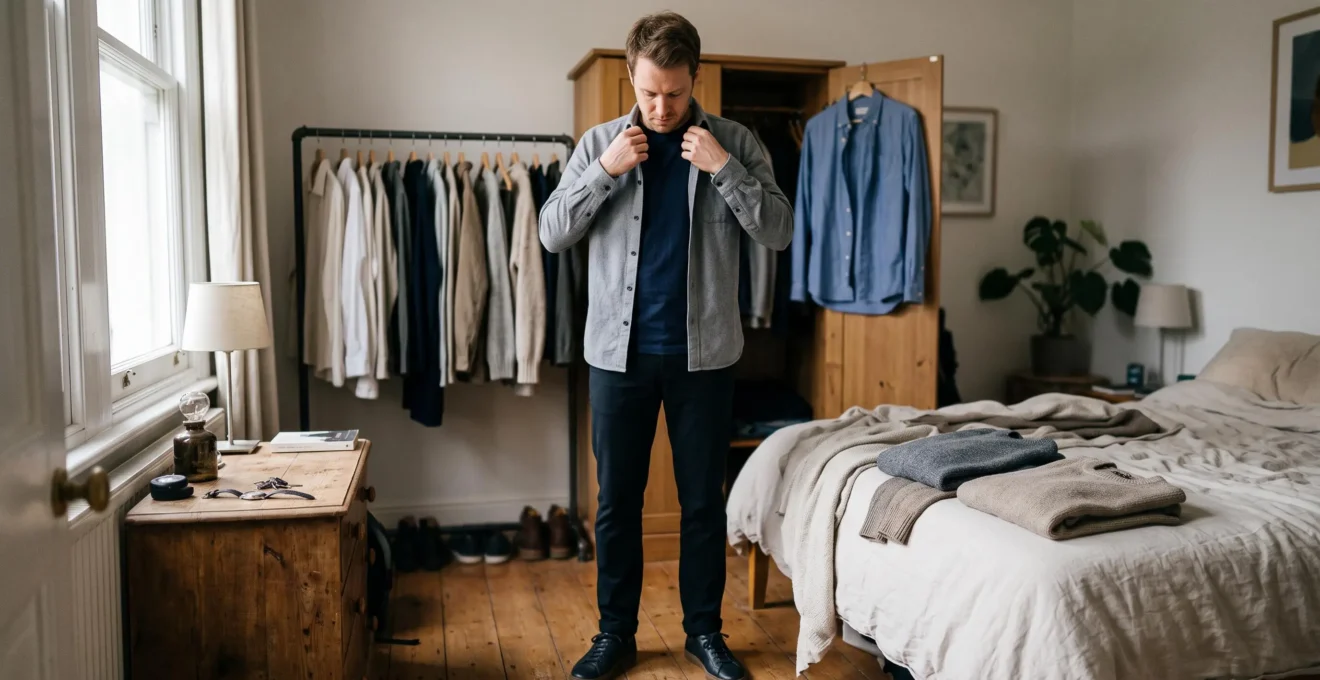
A recognisable personal style rarely comes from wearing the same outfit every day. It comes from making consistent choices about fit, colour, proportion and the impression clothes create, even when the occasion changes.
For men moving between work, weekends and social occasions, the challenge is finding enough continuity to feel comfortable without making every outfit look deliberately constructed. A navy knit and relaxed trousers might belong to the same personal style as a tailored jacket and dark denim, provided their proportions, colours and overall attitude remain familiar.
The most useful starting point is the wardrobe already being worn. Favourite garments reveal practical preferences that aspirational purchases and online inspiration often conceal. From there, a limited colour palette, dependable cuts and selective experimentation can create a style that feels distinctive without demanding constant attention.
The goal is not to eliminate variety. It is to make everyday choices easier while leaving room for personality, changing circumstances and occasional new influences.
Building a personal style that feels natural
- Identify the colours, silhouettes and combinations you already wear confidently before introducing new pieces.
- Build around versatile favourites, and make every prospective purchase pass a practical outfit-pairing test.
- Introduce trends gradually and update your wardrobe when your daily life changes, rather than replacing everything at once.
- Why Does Copying Other Men’s Outfits Often Make Your Style Feel Unnatural?
- How Can You Identify the Colours and Cuts That Actually Belong in Your Wardrobe?
- Trend-Led or Timeless Clothing: Which Better Fits Your Everyday Identity?
- The Wardrobe Mistake That Leaves Good Clothes Sitting Unworn for Months
- When Should You Update Your Personal Style Without Rebuilding Your Entire Wardrobe?
- How Can You Audit Your Wardrobe in 30 Minutes to Find the Pieces That Do Not Work Together?
- Classic or Updated Staple: Which Version Gives Better Long-Term Wear?
- Which Contemporary Menswear Trends Are Worth Adopting for Everyday Wear?
Why Does Copying Other Men’s Outfits Often Make Your Style Feel Unnatural?
Copying another man’s outfit often feels unnatural because the original combination was built around his proportions, colouring, lifestyle and surroundings. Even identical garments can create a different impression on someone else. A more reliable approach is to understand why an outfit works, then apply those principles to clothes that suit your own body and daily routine.
An outfit functions as a system. The width of the trousers influences how substantial the shoes appear. The length of a jacket changes the perceived relationship between torso and legs. Colours establish whether the overall impression feels restrained, energetic or formal.
Removing one component from that system can upset the balance. A boxy jacket that looks convincing with roomy trousers may feel disproportionately large above slim chinos. Likewise, a sharply tailored outfit designed for formal professional settings can appear overly deliberate in a workplace where most colleagues dress casually.
Copy the wardrobe logic, not the exact shopping list. Instead of asking which jacket or trousers another man owns, consider the relationships that make his outfit effective.
- Silhouette: Is the outfit balanced through similar volumes, or does a structured piece contrast with something relaxed?
- Colour: Does the combination use related neutrals, a restrained accent or deliberate contrast?
- Context: Would the outfit work during your ordinary commute, working day and social activities?
- Purpose: Is the wearer communicating ease, professionalism, creativity or something else?
Consider a hypothetical example: a tall man wears a long overcoat, loose trousers and substantial leather shoes. Someone shorter could reproduce the same relaxed character with a slightly shorter coat and trousers adjusted to avoid excessive fabric gathering at the ankles. The underlying idea transfers even though the precise proportions change.
Before copying a look, describe its purpose in one sentence: “This outfit makes casual clothes feel more polished without becoming formal.” Then ask whether that purpose matches a situation you regularly encounter.
Once a reference look passes that test, the next task is identifying which colours and cuts can reproduce its appeal using pieces that already feel comfortable on you.
How Can You Identify the Colours and Cuts That Actually Belong in Your Wardrobe?
The colours and cuts that belong in your wardrobe are those you repeatedly enjoy wearing, that suit your proportions and that combine easily with your existing clothes. Start by photographing familiar outfits, comparing their fit and colour relationships, and identifying recurring strengths. Use those observations to establish dependable choices rather than relying on abstract rules about what should suit you.
Begin with three outfits you regularly choose without hesitation. Photograph each in consistent daylight, ideally from a similar distance and angle. Compare the shoulder line, torso length, trouser shape and overall visual balance.
Look for patterns rather than individual compliments. Perhaps slightly relaxed trousers appear in every successful outfit. Maybe your favourite tops share a similar shoulder shape, or darker colours near the face consistently feel more comfortable than brighter alternatives.
These repetitions offer practical evidence of preference, although photographs alone cannot establish universal rules about what is flattering.
For colour, choose two or three neutral bases you already enjoy wearing, such as navy, charcoal and stone. Introduce a small selection of accents that work with those foundations. Olive, burgundy or muted blue might be useful, but only if you genuinely like wearing them.
This approach does not require following seasonal colour classifications. In fact, peer-reviewed PLOS ONE research on clothing colour coordination found that moderately coordinated combinations received higher fashionability ratings than combinations that were either extremely similar or strongly contrasting in the experimental settings studied.
The 2014 research assessed selected colour combinations, not complete everyday wardrobes, so it should inform rather than dictate personal choices. Its practical relevance is that coherence need not mean matching everything exactly.
Fit requires a similarly individual approach. Use a garment you already like as an anchor piece for each category. Compare prospective shirts against its shoulder placement and body length, or new trousers against a familiar rise, leg shape and break.
Brand size labels are less useful than those physical comparisons because sizing and intended fit vary. A garment that fits properly in isolation can still become a poor purchase if its volume, colour or formality makes it difficult to wear with anything else.
Once your preferences are visible, they become a framework for deciding how much experimentation your wardrobe can accommodate without losing its recognisable character.
Trend-Led or Timeless Clothing: Which Better Fits Your Everyday Identity?
Neither trend-led nor timeless clothing is automatically the better choice. A consistent personal style usually benefits from a stable foundation of frequently worn garments and a smaller experimental selection. The right balance depends on your workplace, social environment, preferences and willingness to accommodate changes in silhouette or colour.
Timeless clothing offers predictability. Straightforward shirts, well-proportioned trousers and versatile outerwear can remain useful across different combinations and occasions. Trend-led pieces introduce variation, making familiar outfits feel contemporary or more personally expressive.
The distinction becomes useful when treated as a question of proportion rather than an absolute rule. Someone working in a conservative office may prefer a particularly stable foundation. A man in a creative environment might comfortably introduce more experimental shapes and textures.
A potential purchase should satisfy three conditions:
- It works with several garments already in your wardrobe without requiring additional purchases.
- It suits the settings in which you spend most of your week.
- You would remain comfortable wearing it if the trend stopped receiving attention within a year or two.
The third condition is particularly revealing. If a piece only feels appealing because it looks current, its role may depend more on external approval than personal preference.
Trend-led buying also carries a less obvious cost: wardrobe complexity. A distinctive new garment can require different shoes, proportions or layering choices. As these purchases accumulate, assembling outfits may become more difficult rather than easier.
That does not make classic clothing the universal answer. Dressing exclusively in conventional staples can produce a functional but anonymous result.
A recognisable personal signature might come from a recurring colour, textured knitwear, a preferred trouser silhouette or consistently understated accessories. One or two repeated choices often communicate more individuality than several unrelated statement garments.
The strongest wardrobe foundation therefore consists of clothes you actually wear, not merely pieces described as essential. That distinction becomes especially important when attractive purchases remain untouched for months.
The Wardrobe Mistake That Leaves Good Clothes Sitting Unworn for Months
The mistake is buying clothes for their individual appeal without checking how they fit into complete outfits. These orphan pieces may be well made, flattering and attractive, yet lack suitable partners in the existing wardrobe. Avoiding them requires a pairing test before buying and a realistic assessment of when the garment will actually be worn.
Imagine buying an excellent suede jacket in an unusual shade. It fits comfortably and looks impressive in the shop, but at home it clashes with the trousers you usually wear and feels too delicate for your typical commute. Nothing is necessarily wrong with the jacket itself. Its problem is that it has no established role.
This is why garment quality and wardrobe usefulness should be evaluated separately.
The issue is visible in broader clothing-consumption research. Oxfam’s 2026 State of Style report states that 32% of clothing in British wardrobes is never worn. The figure concerns British wardrobes, and the report’s publicly presented findings do not establish the causes of each unused garment.
32%
Share of clothing in British wardrobes reported as never worn in Oxfam’s 2026 State of Style report. This is not a men-specific finding or a measure of orphan garments alone.
Oxfam GB, State of Style 2026.
One common purchase pattern is aspirational dressing. A man may buy formal shoes for a social life he imagines developing, or striking outerwear suited to occasions he rarely attends. Such purchases reflect an intended identity rather than the demands of an ordinary week.
Use the three-outfits test before buying: identify three complete, realistic outfits incorporating the new item and clothes you already own. Each should suit an occasion you regularly encounter.
If the combinations depend on buying additional items, postpone the purchase. The same applies if the only suitable occasion is hypothetical.
Existing orphan pieces deserve a fair assessment before being discarded. Once a month, select one neglected garment and deliberately style it with familiar favourites. Try different combinations on your body rather than simply holding items together.
If the piece repeatedly resists practical styling, determine whether alteration could improve its usefulness. Otherwise, consider resale, donation or another appropriate route for reuse, depending on its condition.
Reducing these disconnected purchases also makes future style changes less disruptive, because the existing wardrobe becomes a more reliable foundation to build upon.
When Should You Update Your Personal Style Without Rebuilding Your Entire Wardrobe?
Update your personal style when your clothes no longer suit your daily activities, preferences or sense of identity. A new workplace, lifestyle change or repeated dissatisfaction with familiar outfits can justify adjustments. Temporary boredom or a passing trend usually does not require a complete wardrobe rebuild, especially when much of what you own still works.
Changes in personal circumstances can alter what feels appropriate. Moving from a formal office to remote work may reduce the need for structured tailoring. A different commute might make practical outerwear more important. Changes in social activities can also shift how frequently certain categories are worn.
These are reasons to reconsider the wardrobe’s function, not automatically its entire appearance.
Update in layers, starting with the least disruptive changes.
- Accessories and colour: Experiment with a different belt, scarf, watch strap or accent colour while maintaining familiar outfits.
- Silhouette: Introduce one alternative cut, such as a straighter trouser or slightly roomier overshirt, and assess its compatibility.
- Foundation: Replace frequently worn staples only when existing versions no longer fit your lifestyle, proportions or preferences.
This sequence makes experimentation more informative. You can identify what improves your appearance and comfort before making decisions that are expensive or difficult to reverse.
Premature wardrobe overhauls create another problem: they remove the reference points that help you understand your own preferences. If every garment is replaced at once, it becomes harder to recognise which changes genuinely helped.
Keep proven favourites during any transition, even when considering a different aesthetic direction. A familiar jacket, for example, provides a useful comparison when testing a new silhouette.
Then observe behaviour rather than relying only on your initial reaction. Are you reaching for the new pieces on ordinary mornings? Do they combine easily with the rest of your clothing? Do they work beyond the occasion for which they were purchased?
If a garment still requires considerable deliberation after several realistic wearing opportunities, reconsider its place in the updated wardrobe. Some unfamiliarity is normal, but persistent practical friction is a useful warning.
Before buying replacements, however, it is worth identifying which existing pieces are causing that friction. A short wardrobe audit can reveal the answer.
How Can You Audit Your Wardrobe in 30 Minutes to Find the Pieces That Do Not Work Together?
A 30-minute wardrobe audit identifies clothing that fails to combine with your regularly worn favourites. Group garments by type, isolate neglected items, test them in complete outfits and classify the results. The objective is not to judge which pieces are fashionable or expensive, but to find the compatibility problems that make everyday dressing unnecessarily difficult.
Choose a manageable section of your wardrobe if reviewing everything would exceed the time limit. Have your most frequently worn shoes, trousers and tops available for pairing tests, along with your phone for quick photographs.
Use the following four-stage routine.
- Minutes 0–5 — Group: Separate tops, trousers, outerwear and other relevant categories so their roles are visible.
- Minutes 5–10 — Identify: Pull out pieces you have not worn recently, excluding items that are reasonably stored for another season or specific occasion.
- Minutes 10–25 — Test: For each neglected item, try to assemble two complete outfits using garments you regularly wear. Put the combinations on rather than judging them on hangers.
- Minutes 25–30 — Decide: Classify each tested garment as keep, repair or alter, or remove from the working wardrobe.
The process measures wardrobe connectivity: how easily individual pieces contribute to combinations suited to your real life. A high-quality shirt that works with none of your trousers may create more dressing difficulty than a simpler shirt that complements several outfits.
Physical try-ons matter because colour relationships and proportions can change once garments are worn together. A jacket and trousers that appear compatible on separate hangers might create an awkward silhouette on the body.
The audit should reveal specific issues, not merely produce a pile of rejected clothing. Record patterns such as trousers that work with only formal shoes, tops that clash with your dominant colours or outerwear that feels too structured for daily use.
Your five-action wardrobe audit checklist
- Photograph three frequently worn outfits and save a clearly labelled reference album.
- Identify your most-used neutral colours and write down a working palette of two or three foundations.
- Select five neglected garments and record whether each produces two complete wearable combinations.
- Assign each tested garment a keep, repair/alter or remove decision, recorded in a short note.
- Write down the two most frequent pairing problems and create a targeted purchase or alteration list.
Repeat the diagnostic after a significant purchase, a substantial change in your daily routine or the discovery that familiar combinations have stopped working. There is little value in continually auditing clothing that already performs well.
With those gaps established, selecting replacements becomes more precise, including the decision between a conventional staple and a contemporary variation.
Classic or Updated Staple: Which Version Gives Better Long-Term Wear?
Classic staples generally offer better long-term versatility when they are worn frequently and across multiple settings. Updated versions can be equally worthwhile when a distinctive cut or detail genuinely reflects your preferences. The best decision depends on how often the piece will be worn, what it pairs with and how well its materials and construction withstand regular use.
A classic staple typically has restrained proportions and detailing. An updated version might introduce a roomier silhouette, a different collar, distinctive pockets or a stronger texture. Neither is inherently better made or more appropriate for every wearer.
The comparison becomes clearer when evaluated against everyday requirements.
| Decision criterion | Classic staple | Updated staple |
|---|---|---|
| Versatility | Often easier to combine across familiar settings | Depends more heavily on silhouette and existing outfit proportions |
| Visual longevity | Restrained details may be less closely associated with a particular trend | Distinctive details may feel dated sooner, although some changes become established |
| Wardrobe compatibility | Usually straightforward when colours and cuts already match | Requires testing against current favourites |
| Personal expression | Supports a consistent, understated signature | Can communicate a more individual preference |
| Practical wear | Depends on materials, construction and maintenance | Depends on the same quality and care factors |
For high-frequency garments such as plain shirts, versatile trousers and everyday outerwear, restrained designs often make practical sense. These pieces have to accommodate different layers, shoes and occasions.
A distinctive jacket or occasionally worn shirt carries a different commitment. Because it is not required to support most daily outfits, a more individual design may be worth choosing.
However, construction quality matters more to physical durability than the classic-versus-modern label. Examine fabric suitability, seam quality, stitching, lining where relevant and the garment’s care requirements.
A conventional coat made from poorly chosen materials may deteriorate sooner than a more contemporary design constructed appropriately for its intended use. Conversely, a beautifully made garment offers limited practical value if its silhouette no longer appeals to the wearer.
Long-term wear therefore has two dimensions: the garment must remain physically serviceable, and you must continue wanting to put it on.
Choose whichever version meets both requirements while complementing the clothes you already own.
That same framework offers a sensible way to evaluate contemporary menswear trends without turning the entire wardrobe into a collection of short-lived experiments.
Key takeaways before adopting a new trend
- Give priority to garments that work with the clothing you already wear, rather than trends that require supporting purchases.
- Test changes in silhouette against your established proportions before experimenting with several distinctive details.
- Judge a new piece by how naturally it fits your ordinary week, not by how striking it looks in isolation.
Which Contemporary Menswear Trends Are Worth Adopting for Everyday Wear?
The most worthwhile menswear trends are those that improve familiar outfits without making them harder to wear. Relaxed tailoring, straighter trousers, adaptable brown tones and understated workwear influences can offer practical starting points. Their suitability depends on your workplace, existing palette, preferred proportions and ability to integrate each change without purchasing an entirely new outfit.
Contemporary menswear provides plenty of inspiration, but editorial attention is not proof that every trend will last or suit every wardrobe.
For example, MR PORTER‘s 2026 menswear trend editorial highlights straight-leg trousers, brown shades, leather jackets, smaller watches, bohemian influences and distressed workwear among its selected directions.
These are editorial observations from a commercial menswear retailer, not measurements of universal adoption. Their value lies in providing concrete options to evaluate against personal needs.
Silhouette adjustments are often a useful first experiment. A straight-leg trouser, for instance, can create a slightly more relaxed impression while retaining familiar shirts, knitwear and understated footwear.
Changes to overall proportions can influence how a wardrobe feels for longer than a particular graphic or seasonal colour, although no individual silhouette is guaranteed to remain fashionable.
Other trend formats involve different levels of commitment:
- Relaxed tailoring: Consider a softer jacket or less restrictive trouser shape if your professional environment permits it.
- Brown tones: Try an accent that complements your existing neutrals before introducing several new brown garments.
- Workwear influences: A practical overshirt or simple utility-inspired jacket may add texture without radically changing your appearance.
- Smaller watches: A relatively contained accessory experiment, provided the design and proportions suit your preferences.
- Distressed or bohemian details: More dependent on individual taste and setting, so introduce them selectively rather than treating them as essentials.
The easiest adoption method is to change one element at a time. Replace your usual trousers with a straighter alternative while keeping your familiar knitwear and shoes. Or introduce a brown jacket into outfits built around colours you already wear.
This creates a controlled comparison. You can judge whether the new piece genuinely improves comfort, visual balance and everyday usefulness.
Stacking multiple trends into one outfit makes that evaluation more difficult. Wider trousers, heavily distressed outerwear, an unfamiliar colour combination and several statement accessories may each be appealing individually, but together they can obscure the wearer’s established style.
The aim is not to avoid noticeable clothing. It is to ensure that a new detail feels intentional within the broader wardrobe rather than demanding attention simply because it is fashionable.
Choose one contemporary detail you would genuinely wear during an ordinary week, build three outfits with existing favourites and test those combinations before committing to more changes. A personal style becomes recognisable through repeated, comfortable decisions—not through wearing every new idea at once.
How long does it take to develop a recognisable personal style?
There is no fixed timeline. Start by identifying outfits you already enjoy wearing, then observe which colours, proportions and garments continue to feel right across different occasions. Consistency develops through repeated practical choices rather than a single wardrobe overhaul.
Can a man develop personal style without buying new clothes?
Yes. Recombining existing garments, adjusting proportions, improving care and identifying a consistent colour palette can substantially change how a wardrobe functions. Alterations may also improve the usefulness of certain pieces without requiring replacements.
Does a consistent personal style require wearing neutral colours?
No. Neutral colours often simplify coordination, but a consistent style can include bold colours or patterns. What matters is establishing combinations that feel natural, repeat successfully and suit the wearer’s preferences. A recurring accent colour can become part of a recognisable signature.
How can you dress consistently for both casual and formal occasions?
Maintain recognisable elements across different levels of formality. Similar colour relationships, preferred trouser proportions and consistent accessory choices can connect casual knitwear with more formal tailoring. The garments change to meet the occasion, while the underlying preferences remain familiar.
How do you know when a signature style has become too repetitive?
Repetition becomes limiting when your wardrobe no longer accommodates the occasions you encounter or prevents you from expressing preferences that have genuinely changed. If familiar outfits still feel comfortable, appropriate and satisfying, repetition itself is not a problem. Introduce variety when it serves a purpose rather than simply to avoid wearing similar combinations.