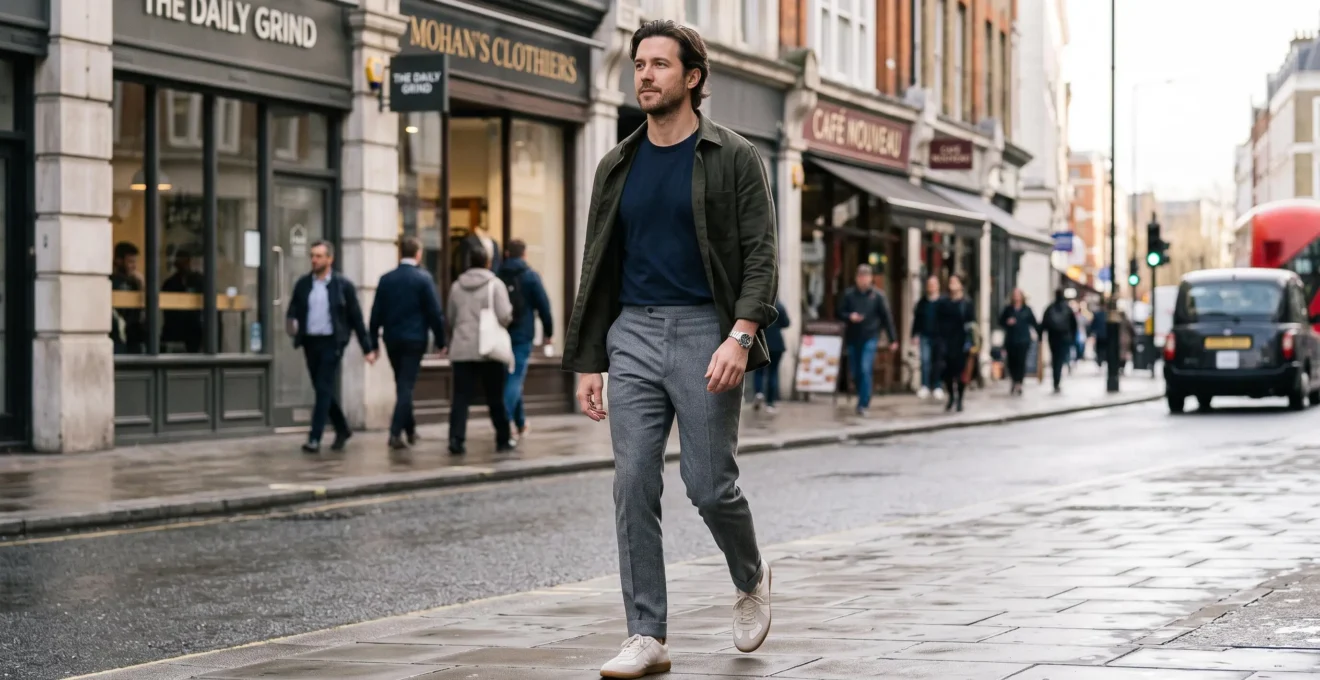
Dress trousers can work just as well for a weekend lunch as they do for a business meeting. The difference rarely comes down to the trousers alone. Fabric texture, leg shape, footwear and the way each garment relates to the others determine whether an outfit looks intentionally relaxed or simply unfinished after work.
The easiest approach is to keep the precision of tailoring while removing some of its traditional formality. A matte pair of grey wool trousers, a substantial plain T-shirt and understated suede trainers can feel contemporary without looking careless. Replace the T-shirt with a knitted polo or add a soft blazer, and the same trousers become suitable for dinner or a relaxed workplace.
There is no need to replace an entire wardrobe. Many existing dress trousers can be restyled through better proportions, different combinations or a straightforward alteration. The essential skill is recognising which details make tailoring versatile and which continue to signal traditional office wear.
Dress Trousers, Without the Office Look: The Essentials
- Choose matte fabrics, comfortable tailored cuts and clean hems that work with casual footwear.
- Balance smart trousers with relaxed pieces such as heavyweight T-shirts, knitted polos, overshirts and suede trainers.
- Adjust trouser length and proportions before buying replacements; small alterations can make familiar trousers much more versatile.
- Why Do Some Dress Trousers Work With Trainers While Others Look Too Formal?
- How Can You Wear Dress Trousers With a T-Shirt and Trainers Without Looking Mismatched?
- Wool, Cotton or Technical Dress Trousers: Which Are Best for Everyday Wear?
- The Trouser-Length Mistake That Can Make Tailoring Look Untidy
- When Should You Alter Dress Trousers Instead of Replacing Them?
- How Can You Wear an Unstructured Blazer With Casual Trousers and Still Look Polished?
- Tonal or Contrasting Colours: Which Creates a More Elegant Outfit?
- How Can Men Build Smart-Casual Outfits Without Looking Too Formal or Too Relaxed?
Why Do Some Dress Trousers Work With Trainers While Others Look Too Formal?
Some dress trousers work with trainers because their fabric, silhouette and finishing details sit comfortably between formal and casual clothing. Matte wool, cotton twill and softly tapered cuts are easier to dress down than shiny suiting fabrics with pronounced creases. The shoes matter too: understated trainers complement relaxed tailoring, whereas bulky or highly athletic designs can create an awkward contrast.
Start with the fabric. Smooth, lustrous worsted wool, sharply pressed creases and conspicuously formal finishing details tend to suggest business tailoring. Brushed wool, flannel and cotton twill usually provide a softer visual impression. These are styling tendencies rather than absolute rules: high-twist wool can also work casually when its finish is relatively matte and the overall cut is relaxed.
A useful wardrobe test is to examine the fabric in natural light. Does it reflect light prominently? Does its sharply defined crease dominate the silhouette? If so, casual styling may require more careful balancing. Fabric sheen and crease retention are clues, not definitive tests, because they depend on the weave, finishing process and garment construction.
Silhouette can outweigh fabric. A moderately tapered leg with a neat opening tends to sit naturally over low-profile trainers. Wide, straight trousers with a long, pronounced break can look more traditional, particularly when combined with sharp creases and formal footwear. However, wider tailored trousers can also look contemporary when their length and volume are deliberate. Skinny trousers are not a prerequisite for dressing casually.
Footwear provides the final signal. Polished leather Derbies often move an outfit towards business dress, while low-profile suede trainers introduce a less formal texture. A chunkier trainer may need more room at the hem and a slightly different length to avoid bunching. The objective is proportional compatibility, not forcing every trouser cut to work with every shoe.
For a versatile starting point, look for:
- A matte or subtly textured fabric.
- Minimal pleating, unless the extra volume suits the intended silhouette.
- A tapered-but-not-tight leg opening.
- A plain hem, or a discreet turn-up that works with the shoes.
- Unobtrusive waist detailing, such as side adjusters or a simple waistband.
None of these features guarantees a successful outfit independently. Their combined effect determines how easily the trousers move between dress codes.
Once the trousers are suitable, the next challenge is combining them with casual clothing without making the contrast look accidental.
How Can You Wear Dress Trousers With a T-Shirt and Trainers Without Looking Mismatched?
To wear dress trousers with a T-shirt and trainers, balance the relaxed upper half with the trousers’ sharper silhouette. Choose a substantial, well-fitting T-shirt rather than a thin undershirt, and keep the trainers understated. Coordinate colours and fabric weights so the outfit looks planned, then add an overshirt or casual jacket if it needs more structure.
Think of the combination as moving one step up and one step down on the formality scale. Tailored trousers provide the smarter element. A heavyweight crew-neck T-shirt and suede trainers introduce casualness. An open overshirt or chore jacket can sit between those extremes, connecting the two halves visually.
Fit contrast is particularly important. If the T-shirt is slightly boxy, trousers with a clean taper prevent excess volume from spreading through the entire outfit. If the trousers are straight-legged or relaxed, a more controlled T-shirt fit can supply definition. The aim is balanced proportions rather than matching tightness.
A thin, clingy T-shirt paired with narrow suit trousers can make the outfit resemble office clothing with the shirt removed. Conversely, an oversized T-shirt and very loose trousers may lack enough structure to look deliberately tailored. Neither extreme is automatically wrong, but both require stronger control of length, drape and layering.
Colour creates another connection. Charcoal trousers with a medium-grey T-shirt produce a restrained tonal effect. Beige trousers with an ecru T-shirt look softer, particularly alongside light suede trainers. With contrasting colours, repeating one shade can bring cohesion: a white T-shirt and white trainers, for example, frame navy trousers.
All-black combinations can also work, provided the materials do not merge visually. A washed cotton T-shirt, matte wool trousers and suede trainers introduce enough surface variation to give the outfit depth.
Finally, consider fabric weight. A very light, fluid trouser can look insubstantial beneath a particularly heavy cotton T-shirt. Similarly, stiff trousers may look disconnected from extremely lightweight knitwear. Matching the visual weight and drape of both garments often matters more than their exact fibre composition or fabric weight in grams.
For an uncomplicated dinner outfit, try mid-grey tailored trousers, an off-white heavyweight T-shirt, a navy overshirt and grey suede trainers. Each piece has a clear role, and none competes for attention.
Once the combination works visually, fabric selection determines whether it remains comfortable and practical through regular wear.
Wool, Cotton or Technical Dress Trousers: Which Are Best for Everyday Wear?
Wool, cotton and technical dress trousers suit different everyday needs. Wool generally offers elegant drape and useful shape recovery, cotton provides a familiar casual texture and often simpler washing, while technical blends prioritise features such as stretch and easy care. The best option depends on climate, commuting, maintenance preferences and how frequently the trousers will be worn.
Each material has advantages, but fibre names alone do not tell the whole story. Fabric weight, weave, finishing and garment construction can change how trousers perform. Two wool trousers may behave very differently, just as a cotton-rich blend can resist creasing better than an untreated pure-cotton fabric.
The IWTO‘s wool care information explains wool’s natural elasticity and resilience, properties that help suitable garments recover their shape. It also emphasises the importance of garment-specific care. Not every wool trouser requires dry cleaning, and not every wool garment can safely be machine washed.
The comparison below focuses on common characteristics rather than guarantees for every garment.
| Everyday consideration | Wool | Cotton | Technical blends |
|---|---|---|---|
| Wrinkle recovery | Often good, depending on weave and finish | Frequently creases more visibly | Varies; some are designed to resist wrinkles |
| Breathability | Depends strongly on weight and weave | Often comfortable in lighter constructions | Depends on fibres, construction and finishing |
| Washing | Follow the care label; some require specialist cleaning | Many styles are machine washable | Many offer convenient care, but labels vary |
| Visual character | Fluid drape, from refined to softly textured | Matte, familiar and naturally casual | Can look tailored or noticeably synthetic |
| Potential weakness | Care requirements and sensitivity to wear | Creasing, fading or knee bagging | Shine, pilling or changes to stretch performance |
Choose according to your routine. Someone who travels regularly may prefer crease-resistant technical trousers or resilient high-twist wool. For warm-weather weekends, lightweight cotton or an appropriate breathable blend may feel more practical. Mid-grey or navy wool can be particularly adaptable for a wardrobe that moves between relaxed workplaces and evening plans.
Climate deserves more consideration than it usually receives. Heavy flannel may be pleasant outdoors in a cold winter but uncomfortable in a heated office. Lightweight open-weave wool can be more suitable for warmer conditions. Cotton is not automatically cooler than wool: the actual fabric construction matters.
For a wardrobe used across changing seasons, owning lighter and heavier trousers may be more useful than expecting one fabric to perform equally well all year.
Cost per wear should also influence the decision. A hypothetical pair costing £150 and worn 100 times represents £1.50 per wear before cleaning and alteration costs. A £70 pair worn only 20 times represents £3.50 per wear. These are illustrations, not evidence that wool always lasts longer or that technical trousers necessarily wear out faster.
Longevity depends on fabric quality, fit, friction, care and frequency of use. The better purchase is the garment that fits the owner’s actual routine, not simply the one with the more prestigious fibre label.
Even the most practical fabric cannot compensate for poor length, which is often the most visible reason otherwise good trousers look untidy with casual shoes.
The Trouser-Length Mistake That Can Make Tailoring Look Untidy
The most common trouser-length problem is excessive fabric gathering around the shoes. When dress trousers are worn with trainers, a long hem can bunch or fold awkwardly, especially on tapered legs. A no-break or slight-break finish often produces a cleaner result, but the correct length depends on leg width, footwear shape and the silhouette you want.
The term trouser break describes the fold formed where the front of the trouser leg meets the shoe. Understanding the difference between break lengths makes alterations easier to discuss with a tailor.
- No break: The hem barely touches or sits just above the shoe, producing a clean, uninterrupted line. Often effective with tapered trousers and slim footwear.
- Slight break: A small fold forms at the front. This provides a little extra coverage without creating substantial bunching.
- Full break: More fabric rests on the shoe, creating a deeper fold. This can suit certain wider or traditional silhouettes.
- Pooling: Excess fabric gathers in multiple folds around the ankle. Unless intentional within a particular style, this often makes tailoring look poorly adjusted.
The important detail is the relationship between length and width. A narrow leg with a full break can form untidy folds because the fabric has limited room to fall over the shoe. A wider leg may require more length to achieve a balanced visual line. An extremely short hem on wide trousers can sometimes make the outfit appear unintentionally cropped.
For a detailed explanation of those proportions, Gentleman’s Gazette‘s guide to trouser break and length discusses different break styles, trouser widths and shoe profiles. Its examples are useful reference points rather than universal measurements.
Turn-ups, also called cuffs, introduce another variable. They add weight and a visible horizontal detail at the hem. This can complement broader, traditional trousers, but a deep turn-up may look heavy with narrow trainers. A plain hem is often easier to integrate into minimalist smart-casual outfits, although well-proportioned cuffs are not inherently too formal.
Before requesting an alteration, try the trousers with the exact footwear you expect to wear most often. Stand naturally and take photographs from the front and side. Look for fabric collecting above the trainers, an uneven line between the front and back, or a hem that floats too far above the shoe.
Do not copy someone else’s preferred inseam measurement without accounting for your own proportions. A tailor should assess the garment while you are wearing it and consider whether shortening alone will work or whether the lower leg also needs refinement.
Five Checks Before Having Your Trousers Hemmed
- Put on the intended trainers and trousers. Record which footwear you used so the fitting can be repeated accurately.
- Stand naturally and photograph both legs from the front and side. Save two clear reference views.
- Identify any pooling, excessive folding or hovering fabric. Write down the visible problem you want corrected.
- Fold the hems temporarily to compare no break and slight break. Photograph the preferred option without cutting the fabric.
- Show the photographs to a tailor and request a pinned fitting that considers leg width and any existing turn-ups. Leave with an agreed alteration plan before work begins.
A clean hem can transform the appearance of existing trousers, but it is worth checking whether other fit problems are realistically alterable before spending money on tailoring.
When Should You Alter Dress Trousers Instead of Replacing Them?
Alter dress trousers when the fabric remains sound, the overall cut suits you and the necessary changes are relatively minor. Hem shortening, modest waist adjustments and restrained tapering can make a good pair more wearable. Replacement is usually the better option when the rise is fundamentally wrong, the seat or thighs are severely restrictive, or the fabric is badly worn.
The first consideration is whether the original garment has a sound foundation. Well-made wool trousers with comfortable hip and thigh room can often justify careful alterations. Poorly fitting trousers with several structural problems are more difficult to rescue, regardless of their original price.
Common alterations include:
- Shortening the hem: Often useful when adapting formal trousers for trainers or loafers.
- Taking in the waist: Can address a modest change in waist fit when the garment’s construction allows it.
- Tapering the lower leg: Can refine an overly wide opening if the existing knee and thigh proportions remain balanced.
- Adjusting turn-ups: Removing, reducing or remaking cuffs can change the visual weight of the hem.
More substantial work has limitations. Letting out the seat or thigh depends on the seam allowances available inside the garment. Some trousers have enough reserve fabric for a small adjustment; others have very little. Taking fabric in is usually more feasible than adding it, but excessive tapering can distort the original silhouette or restrict movement.
The rise, which describes the relationship between the waistband and crotch, is particularly difficult to change substantially. Moving pockets or comprehensively recutting the upper trousers also involves significant construction work. These are not straightforward equivalents to hemming.
Creases require separate consideration. A pressed crease can sometimes be softened, but permanently altering its appearance depends on the material and finishing process. On certain fabrics, pressing marks may remain visible. Removing cuffs likewise requires checking that enough cloth is available for the desired new hem.
Cost matters, although there is no universal price threshold. Ask for an alteration estimate, then compare it with the cost of replacing the trousers with something that fits correctly from the outset. Consider whether the altered garment will genuinely be worn more often.
Condition matters just as much. A small waist-size change is not a reason to discard otherwise excellent trousers. By contrast, extensive thinning around the crotch or seat, significant abrasion or widespread fabric deterioration may make further investment difficult to justify. Repairs are sometimes possible, but an invisible and durable result cannot always be guaranteed.
Once a pair fits correctly, it becomes much easier to introduce another tailored item without returning to a conventional business outfit.
How Can You Wear an Unstructured Blazer With Casual Trousers and Still Look Polished?
An unstructured blazer works with casual trousers because its softer construction reduces the visual formality associated with traditional suit jackets. Pair it with trousers that have clean proportions and compatible fabric weight, then choose a knitted polo, T-shirt or relaxed shirt underneath. The result should feel coordinated without resembling a complete business suit.
Traditional structured tailoring often uses padding, canvassing and other construction details to create a defined shoulder and chest. An unstructured blazer generally uses less internal structure, allowing it to follow the body more naturally. Some styles also have partial lining or minimal lining, although the exact construction varies.
FashionBeans‘s guide to unstructured blazers explains how softer construction makes these jackets suitable for combinations with tailored chinos, casual shirts and trainers, as well as smarter clothing.
Fabric weight is the next consideration. A soft brushed-wool blazer often works naturally with flannel trousers. A cotton blazer can pair well with chinos or moderately structured cotton tailoring. Lightweight linen may complement airy warm-weather trousers, but mixing a deliberately rumpled jacket with extremely crisp, stiff trousers can create a more noticeable disconnect.
Texture contrast is welcome when the garments remain compatible. A brushed navy blazer with smooth grey trousers creates depth without demanding strong colour contrast. What matters is that neither garment looks disproportionately heavy, stiff or delicate compared with the other.
Keep the trousers controlled. A softly constructed jacket provides less rigid structure, so excessively bunching trousers or a poorly defined waistband can make the overall outfit appear shapeless. A comfortable rise, clean drape and considered hem help retain polish. Relaxed or wide trousers can work too, provided their volume is deliberate and balanced against the jacket.
The final decision is what to wear underneath. A crisp business shirt, formal tie and polished Derbies may push the combination towards office wear. A knitted polo or substantial crew-neck T-shirt keeps it less formal. Loafers add refinement for dinner, while subdued trainers suit a casual workplace or weekend setting.
For example, combine a navy unstructured blazer with mid-grey wool trousers, a cream knitted polo and dark-brown suede loafers. Alternatively, wear the same trousers and jacket with an off-white T-shirt and minimalist trainers. The second version is more relaxed without requiring a different tailored foundation.
With the proportions established, colour becomes one of the simplest ways to adjust the outfit’s overall level of elegance.
Tonal or Contrasting Colours: Which Creates a More Elegant Outfit?
Tonal dressing is often the easier way to make casual tailoring look understated and cohesive, while contrasting colours can create a sharper, more noticeable outfit. Neither approach is automatically more elegant. Tonal combinations rely on texture and subtle shade changes; contrasting combinations require careful colour placement, clear proportions and a consistent level of formality.
A tonal outfit uses related colours rather than necessarily identical shades. Navy trousers might sit alongside a faded-blue knitted polo and a darker navy overshirt. Mid-grey trousers could work with charcoal knitwear and grey suede trainers. The limited contrast allows fabric and silhouette to become more prominent.
The potential weakness of tonal dressing is flatness. If every garment has almost the same colour and surface finish, the outfit can lose definition. Introducing different textures solves much of that problem: brushed wool, smooth cotton knitwear and suede footwear reflect light differently even when their colours are closely related.
Contrasting colours work differently. Navy trousers with an ecru top create a clear division between upper and lower body. Beige trousers with a dark-brown polo introduce stronger definition. These combinations can feel confident and expressive, but the separation also draws attention to the fit and proportions of each garment.
A practical approach is to build around one trouser colour and introduce variation gradually.
| Trouser colour | Tonal combination | Contrasting combination |
|---|---|---|
| Mid-grey | Charcoal polo, grey suede trainers | Off-white T-shirt, navy overshirt |
| Navy | Dusty-blue knit, dark-blue outer layer | Cream polo, brown suede loafers |
| Beige | Ecru T-shirt, taupe overshirt | Dark-brown polo, off-white trainers |
When using contrast, consider limiting the outfit to one dominant contrasting area. This might be a light top against dark trousers or a darker jacket against an otherwise tonal base. Introducing several unrelated statement colours can make the combination more difficult to coordinate.
Body proportions also influence the visual result. A continuous tonal line can create an impression of vertical continuity, while a sharply contrasting top and bottom can emphasise the waistline and divide the silhouette. These are optical styling effects, not fixed rules for particular body types. Garment fit, personal preference and occasion remain more important than prescriptive advice about height or build.
For a restrained workplace or sophisticated dinner, tonal colours provide a straightforward starting point. For a relaxed social occasion, a deliberate contrast can add personality without sacrificing polish.
Once colour, fabric and fit work together, smart-casual dressing becomes less about copying complete outfits and more about adjusting a few dependable pieces.
Key Takeaways Before Building Your Outfits
- Choose trousers that can move between dress codes without needing every other garment to compensate for their formality.
- Change footwear, layering or knitwear one element at a time to suit the occasion rather than assembling an entirely new outfit.
- Judge the complete silhouette in context: a good outfit needs compatible proportions, fabric weights and footwear, not merely individually attractive garments.
How Can Men Build Smart-Casual Outfits Without Looking Too Formal or Too Relaxed?
Build smart-casual outfits around versatile tailored trousers, then adjust the other garments to suit the occasion. Keep at least one relaxed element, such as suede trainers or an overshirt, and one refined element, such as a knitted polo or blazer. Treat formality as a sliding scale: small changes in footwear or layering should be enough to transform the outfit.
The most adaptable trousers sit somewhere in the middle of the formality spectrum. Mid-grey wool with a subdued finish, navy cotton tailoring or a well-draped technical blend can all provide a useful foundation. The exact material matters less than its compatibility with both casual and smarter separates.
From there, think in terms of adjusting the formality dial rather than switching between completely separate wardrobes.
For a relaxed weekend, combine grey trousers with a substantial white T-shirt, an overshirt and low-profile trainers. For dinner, replace the T-shirt with a knitted polo and the trainers with loafers. For a smart-casual workplace, add an unstructured blazer while retaining the polo and loafers.
These changes are consistent with the broader approach outlined in John Lewis‘s men’s smart-casual dressing guide, which emphasises balancing comfort and formality through versatile separates and appropriate footwear.
A compact starting wardrobe might contain:
- One pair of mid-grey high-twist wool trousers in a versatile weight and finish.
- One navy or charcoal unstructured blazer.
- One substantial plain T-shirt in white, ecru or another adaptable neutral.
- One knitted polo that can replace the T-shirt for smarter occasions.
- One pair of understated white, off-white or grey suede trainers.
- One pair of loafers for evenings and more polished settings.
This is a suggested capsule, not a required shopping list. Existing pieces can fulfil most of these roles, and the ideal selection will vary according to climate, lifestyle and personal taste.
A useful final check is to examine the outfit as a whole. If every element is formal—sharp wool trousers, crisp business shirt, structured jacket and polished business shoes—the combination is likely to read as office wear. If everything else is extremely relaxed, with oversized layers, worn athletic trainers and uncontrolled trouser drape, the tailored foundation can become visually lost.
Neither result is inherently inappropriate, but both can miss the intended middle ground. A full-length photograph often makes the problem easier to identify than looking at individual garments in a mirror. Check whether the trouser hem meets the shoes cleanly, whether the jacket and trousers balance in volume, and whether at least one item establishes the level of refinement you want.
Instead of purchasing several new outfits, experiment with a few controlled substitutions. Trainers can become loafers; a T-shirt can become knitwear; an overshirt can become a soft blazer. The trousers remain constant while the outfit adapts to weekends, dinners and relaxed work environments.
Start with the best-fitting pair of trousers already in your wardrobe. Try it with a plain T-shirt and your most understated trainers, take a full-length photograph, and change just one element at a time. A handful of thoughtful adjustments can reveal far more versatility than an entirely new set of clothes.
Can you wear suit trousers separately without the matching jacket?
Yes, provided the trousers work as a standalone garment. Matte fabrics, restrained detailing and a versatile fit are generally easier to combine with casual tops and footwear. Trousers made from very shiny or distinctive suit fabric may look noticeably separated from their original jacket. Frequent independent wear can also cause the trousers and jacket to age differently.
Should you tuck a T-shirt into dress trousers?
Either approach can work. Tucking in a substantial T-shirt defines the waist and highlights the trouser rise, which can suit pleated or higher-waisted designs. Leaving it untucked creates a more relaxed impression, particularly when the T-shirt finishes around the upper hip. Avoid excess fabric bunching at the waist or an untucked hem that overwhelms the trousers.
Are white trainers suitable for wearing with tailored trousers?
White and off-white trainers can pair well with tailored trousers, especially when their shape is understated and the trousers have a clean hem. Smooth leather creates a sharper appearance, while suede often looks softer and less formal. The suitability of trainers for a workplace still depends on the organisation’s dress code.
Can pleated dress trousers look casual?
Yes. Pleats add room and shape, but they do not automatically make trousers unsuitable for casual wear. Softly pleated wool or cotton trousers can work with knitwear, T-shirts and trainers when the thigh volume, leg opening and hem length are balanced. Deep pleats combined with a sharp crease, shiny fabric and long hems will generally require more careful styling.
What should you wear with dress trousers when trainers feel too casual?
Suede loafers, understated leather loafers or refined casual boots can offer a useful middle ground. Pair them with a knitted polo, a textured jumper or an unstructured blazer to increase formality without recreating a conventional office outfit. Check trouser length with the intended footwear, as different shoe profiles change how the hem falls.