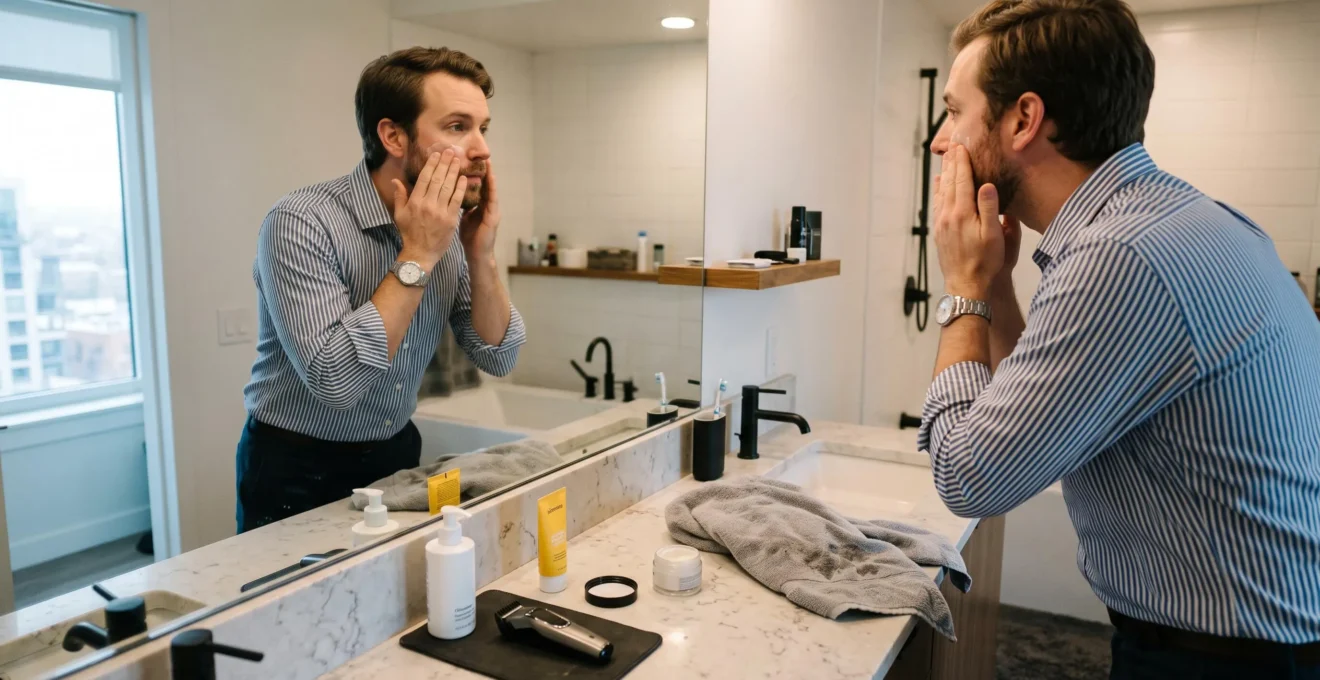
A manageable men’s grooming routine should make getting ready for work more predictable, not introduce another demanding task. The most practical approach is to establish a short daily sequence for facial cleansing, moisturising, sun protection, hair and oral hygiene, then reserve trimming and other detailed maintenance for scheduled sessions.
For men balancing early meetings, commuting, travel or unpredictable working hours, the challenge is rarely a complete lack of grooming knowledge. It is maintaining good habits when time and motivation are limited. An elaborate routine may work on Sunday but become impractical before an important Monday meeting.
The solution is a stable foundation with a few adjustable elements. Skin type determines which formulations feel comfortable. Hair texture influences washing and styling frequency. Beard length determines how much trimming is necessary. By organising these decisions around actual needs rather than an expanding collection of products, it becomes easier to look consistently well groomed without spending excessive time in front of the mirror.
Men’s grooming routine: the essentials
- Keep a reliable daily core: cleanse, moisturise, protect exposed skin from the sun, tidy your hair and maintain oral hygiene.
- Move time-consuming tasks, including beard shaping and haircut planning, into scheduled weekly or periodic maintenance.
- Choose products according to skin and hair needs, introduce changes gradually and adjust the routine when conditions change.
- Why Does an Irregular Grooming Routine Make Small Problems More Noticeable?
- How Can You Build a 10-Minute Grooming Routine Before Work Without Rushing?
- Which Grooming Products Are Actually Worth Keeping in a Minimal Men’s Routine?
- Why Adding Several New Grooming Products at Once Can Trigger Irritation
- When Should Men Increase or Reduce Their Grooming Routine Through the Year?
- How Can You Build a Four-Step Hair Routine Without Spending Too Much Time Each Morning?
- Dry, Oily or Sensitive Skin: Which Routine Should You Start With?
- How Can Men Keep a Beard Looking Neat Without Spending Too Long on Maintenance?
Why Does an Irregular Grooming Routine Make Small Problems More Noticeable?
An irregular grooming routine allows small changes in skin, hair and facial hair to accumulate until they become more visible. Uneven beard edges, dry-looking skin or an overgrown haircut can create a noticeable difference from one working day to another. Consistent basic maintenance limits these fluctuations without requiring an intensive routine.
Appearance is influenced by contrast. Someone who regularly maintains a tidy haircut and beard establishes a relatively consistent appearance. When maintenance suddenly stops, changes such as stray hairs, uneven edges or visible flaking may stand out more than they would against a less consistent baseline. This is a practical observation about presentation, not a scientifically established rule about how colleagues judge appearance.
Irregular habits can also create a cycle of corrective work. A beard left untrimmed for an extended period may require more reshaping than a small scheduled touch-up. Likewise, repeatedly neglecting moisturiser may leave dryness that takes additional attention to manage. The exact time involved varies, but predictable maintenance can make these tasks easier to organise.
Three situations commonly disrupt weekday routines: rushed mornings, travel days and evenings when motivation is low. Rather than planning around an ideal schedule, build a routine that still works under these conditions. Keep the essential products together, pack travel-friendly equivalents when necessary and leave detailed grooming for less pressured periods.
Identifying which parts of your appearance change first when maintenance lapses helps establish the right priorities. A man with fast-growing facial hair may need more frequent edge checks, while someone with a dry scalp may benefit more from consistent conditioning.
Five checks to identify your grooming priorities
- Examine your face after your usual morning wash and record whether dryness, flaking or visible shine needs attention. Deliverable: one written skin observation.
- Check your beard or shaving area for stray hairs and uneven edges. Deliverable: one clearly identified maintenance task, or confirmation that none is needed.
- Assess whether your haircut retains its intended shape without extensive styling. Deliverable: a decision to maintain, restyle or schedule a haircut.
- Review what you skipped during your last rushed morning. Deliverable: a short list of the steps most vulnerable to time pressure.
- Select the three grooming actions that most improve your daily readiness. Deliverable: a personal priority list to guide your morning routine.
Consistency does not require treating every detail as urgent. It means knowing which small actions preserve an acceptable baseline and performing them often enough that catching up rarely becomes a major project. The next step is fitting that baseline into a realistic working morning.
How Can You Build a 10-Minute Grooming Routine Before Work Without Rushing?
A 10–minute grooming routine works best when essential tasks follow a fixed sequence and optional steps are handled separately. Cleanse and moisturise the face, apply appropriate sun protection, tidy the hair and complete basic oral hygiene. Prepare products and shaving decisions the previous evening so morning time is spent on execution rather than searching or planning.
The critical distinction is between active grooming time and elapsed time. Some products need a moment to settle before the next step, but that does not necessarily require standing still. Similarly, hair can be lightly towel-dried while moving between other preparations. The goal is to arrange compatible tasks efficiently without compromising product directions or proper oral hygiene.
Here is an illustrative 10-minute schedule. It is a planning model, not a clinically tested duration, and individual needs may require more time.
| Time | Action | Priority |
|---|---|---|
| 0:00–1:00 | Wash the face gently and pat dry | Core |
| 1:00–2:00 | Apply moisturiser and suitable facial sun protection | Core |
| 2:00–5:00 | Brush teeth thoroughly and complete basic oral hygiene | Core |
| 5:00–7:00 | Arrange hair and apply styling product if needed | Core |
| 7:00–9:00 | Check beard, shaving edges and overall appearance | Flexible |
| 9:00–10:00 | Complete a final check and put products away | Flexible |
The schedule assumes that a full shower, substantial shave and detailed beard trim are handled separately. A moisturiser containing suitable broad-spectrum sunscreen may simplify the sequence, provided it is used correctly and offers adequate protection. Product application should never be rushed to the point that coverage becomes incomplete.
Morning efficiency often depends on decisions made the night before. Place the cleanser, moisturiser and sunscreen within easy reach. Decide whether shaving is necessary, charge the trimmer if needed and handle significant beard shaping before bedtime. Even a short evening preparation can remove several small decisions from the next morning.
It also helps to distinguish between a minimum routine and optional additions. A fresh shave, beard balm or more deliberate hairstyle may be worthwhile before a presentation, but these should not become conditions for completing the everyday routine.
The most useful test is a genuinely difficult working morning. If the routine consistently overruns its allowance, move a nonessential task to the evening rather than cutting corners on cleansing, sun protection or toothbrushing. The target should be calm repetition, not a race against the clock.
A short sequence becomes easier to maintain when every product has a clear purpose. Once the timing works, the next improvement is to remove unnecessary products rather than add more steps.
Which Grooming Products Are Actually Worth Keeping in a Minimal Men’s Routine?
A minimal men’s grooming routine needs products that perform four functions: cleaning, protecting, hydrating and controlling appearance. A gentle cleanser, appropriate moisturiser, broad-spectrum sunscreen and any necessary hair or beard product usually cover much of the daily work. Additional products should address a specific unmet need rather than simply expand the routine.
The most useful way to evaluate grooming products is by function rather than by product category, marketing claim or packaging. Two products advertised for different lifestyles may still perform essentially the same job.
| Function | Typical essentials | When extras make sense |
|---|---|---|
| Clean | Gentle facial cleanser, suitable shampoo | When scalp or skin needs are not met by the existing cleanser |
| Protect | Broad-spectrum sunscreen | When outdoor exposure or activities require a different formulation |
| Hydrate | Facial moisturiser, hair conditioner as needed | When dryness persists despite appropriate basic care |
| Style and control | Comb, trimmer, optional styling product | When beard length or hairstyle requires additional control |
Basic dental hygiene products also belong in the daily routine, although they are separate from skincare and hair styling.
The American Academy of Dermatology‘s skincare recommendations for men emphasise choosing products according to skin type, using a mild cleanser, moisturising and protecting exposed skin with broad-spectrum, water-resistant SPF 30 or higher sunscreen. Sunscreen needs reapplication during outdoor exposure, generally every two hours and after swimming or sweating, rather than being treated as a one-time morning task.
Preventive products deserve priority over occasional corrective treatments. Consistent moisturising may help manage dryness, while appropriate sun protection addresses avoidable ultraviolet exposure. Masks, specialised serums and spot treatments may have a place, but they should solve a defined problem instead of becoming automatic additions.
A practical replacement rule is simple: a new product should fill an unmet function or replace something already in use. Unless a product is causing an adverse reaction, finishing and evaluating the existing one before buying an alternative can help distinguish genuine dissatisfaction from impulse purchasing.
Apply the same test to grooming kits sold as complete routines. A set containing multiple cleansers, oils or treatments is not necessarily appropriate for every skin or hair type. Assess each item independently before deciding whether it deserves daily use.
Having fewer, better-matched products reduces decisions and makes the routine easier to repeat. It also limits the temptation to experiment with several unfamiliar formulas simultaneously, which can complicate the identification of skin reactions.
Why Adding Several New Grooming Products at Once Can Trigger Irritation
Introducing several grooming products simultaneously can increase irritation risk when their ingredients overlap or when the skin is sensitive to particular formulations. It also makes identifying the responsible product difficult. Adding one item at a time, testing it appropriately and observing the skin’s response provides a more controlled way to improve a routine.
Imagine introducing a new exfoliating cleanser, fragranced aftershave and treatment serum on the same evening. If redness or stinging appears, it may be unclear whether one product caused the problem or whether the combined routine was too irritating.
This attribution problem can lead to two unhelpful responses: abandoning every new product, including those that might have been suitable, or continuing to use an irritating product because the wrong one was blamed.
Skin irritation also depends on total exposure. Multiple products containing exfoliating ingredients, retinoids or fragrances may create a routine that the skin tolerates poorly, even if an individual product seems manageable. Labels such as “gentle” or “for men” do not guarantee that a formulation will suit every user.
The American Academy of Dermatology’s guidance on testing skincare products recommends applying a new product to a small test area twice daily for seven to ten days, or following the appropriate instructions for rinse-off products. This is a product-testing procedure, not proof that every routine change requires exactly that interval.
7–10 days
The AAD’s recommended period for testing an individual skincare product on a small area before incorporating it into a routine. This does not eliminate the possibility of a later reaction.
American Academy of Dermatology, guidance on testing skincare products.
When introducing something new, note the application area, how soon any discomfort appears and whether symptoms occur repeatedly. This brief record can be useful if the reaction persists or professional advice becomes necessary.
If redness, itching or swelling develops, stop using the suspected product. Severe reactions, significant swelling or breathing difficulties require urgent medical assessment rather than home experimentation. Recurrent or unresolved reactions should also be evaluated professionally.
For busy men, avoiding avoidable irritation is an efficiency decision as well as a skincare consideration. Managing a flare-up can be more disruptive than patiently evaluating a product before making it part of the daily routine.
Once a small number of compatible products is established, keep them stable until actual changes in skin, hair or working conditions justify an adjustment.
When Should Men Increase or Reduce Their Grooming Routine Through the Year?
Men should adjust grooming habits when changes in weather, indoor conditions, activities or skin and hair behaviour create different needs. Increased dryness may call for richer moisturising, while greater outdoor exposure requires more deliberate sun protection. When these pressures decrease, optional steps can be removed while the essential routine remains consistent.
Seasonal grooming should respond to observable conditions rather than calendar dates alone. A man working in an air-conditioned office in a hot climate may experience different skin concerns from someone working outdoors in the same city. Indoor heating, humidity, wind and occupational exposure can all influence what feels comfortable.
Useful signals include tightness after washing, new flaking, persistent beard itch, a change in scalp oiliness or styling products no longer performing as expected. These observations help identify which part of the routine needs attention.
For example, cold or dry conditions may justify switching from a light moisturiser to a richer formulation. During periods of heavier sweating, the priority may instead be comfortable cleansing and suitable sunscreen reapplication. Dryness and oiliness can occur together, so a complete change to harsher products is not automatically appropriate.
| Observed change | Possible adjustment | What to keep consistent |
|---|---|---|
| Tight or flaky facial skin | Review cleanser gentleness and moisturiser richness | Appropriate gentle cleansing |
| More outdoor sun exposure | Improve sunscreen coverage and reapplication planning | Daily skin protection habits |
| More frequent scalp oiliness | Reassess shampoo frequency based on scalp needs | Gentle washing technique |
| Beard dryness or itch | Review cleansing and moisturising beneath the beard | Regular beard hygiene |
The opposite adjustment matters too. If an additional conditioner, richer cream or styling product is no longer useful, stop using it unless there is a specific reason to continue. A routine should be allowed to contract rather than accumulate permanent steps after every seasonal change.
Life events provide another reason for review. Moving to a different climate, starting a job with more outdoor work or changing from a clean-shaven look to a full beard can alter the practical requirements of daily maintenance.
A useful system preserves its core while adapting a few variables at a time. Haircare is a particularly good example because washing frequency, conditioning and styling needs can vary substantially between individuals.
How Can You Build a Four-Step Hair Routine Without Spending Too Much Time Each Morning?
A simple men’s hair routine consists of four functions: cleansing, conditioning, drying and shaping, and controlling the finished style. These steps do not all need to happen every morning. Adjust shampoo frequency to scalp oiliness and hair texture, handle washing at a convenient time and choose a haircut that requires minimal daily correction.
The largest potential time saving comes from separating hair hygiene from morning styling. Some men can wash their hair the previous evening, dry it appropriately and refresh the shape quickly before work. Others, particularly those with oily scalps, may prefer morning washing. The most efficient schedule is the one that keeps both the scalp comfortable and the hairstyle manageable.
- Cleanse: Shampoo according to scalp oiliness, dirt accumulation and hair type rather than assuming everyone needs the same washing frequency.
- Condition: Use conditioner where needed to manage dryness, friction and tangling, adapting the application to hair texture.
- Dry and shape: Remove excess water gently and use fingers, a comb or a suitable brush to establish the intended direction.
- Control: Apply a small amount of styling product only when the haircut requires additional hold or definition.
According to the American Academy of Dermatology’s healthy hair care recommendations, washing frequency should reflect how quickly hair becomes dirty or oily. Straight hair with an oily scalp may need daily shampooing, while dry, textured, curly or thick hair may need considerably less frequent washing. Shampoo should focus primarily on the scalp, and conditioning should suit the hair’s texture and needs.
This flexibility matters because excessive cleansing can contribute to dryness and hair damage. It is also inaccurate to assume that over-washing always causes the scalp to produce more oil. If hair becomes uncomfortable or difficult to manage after frequent washing, reassess the cleanser, technique and schedule rather than assuming a single mechanism explains the problem.
Haircut choice affects the time required for the last two steps. A cut that follows natural growth direction and texture may be easier to arrange than one requiring extensive blow-drying or strong styling products. Ask a barber how the chosen shape will behave on an ordinary working morning, not only immediately after the appointment.
For many men, the simplest practical test is whether the hairstyle can be restored with a brief comb-through or light dampening. If it consistently requires a lengthy reconstruction, either the styling method or the haircut may be poorly matched to the available time.
The same principle applies to facial skincare: maintain a fixed structure while tailoring the products and techniques to individual needs rather than following a routine designed for someone else’s skin.
Dry, Oily or Sensitive Skin: Which Routine Should You Start With?
Men with dry, oily or sensitive skin can begin with the same basic skincare structure: gentle cleansing, moisturising and suitable sun protection, with shaving care as needed. The difference lies in product texture, cleansing strength and ingredient tolerance. Observe how skin behaves after washing before deciding which adjustments are necessary.
A practical starting point is to examine the face roughly an hour after a normal, gentle wash, without introducing new treatment products. Tightness or flaking may suggest dryness. Noticeable shine, particularly around the forehead and nose, may suggest oiliness. Stinging or burning after product application can indicate sensitive or reactive skin.
This observation is a starting guide rather than a diagnostic test. Many men have combination skin, with an oily T-zone and drier cheeks. Sensitivity may also occur alongside dryness or oiliness, so the categories are not mutually exclusive.
| Skin pattern | Cleanser approach | Moisturiser and product choices |
|---|---|---|
| Dry | Gentle, non-stripping cleanser | Comfortable, potentially richer moisturiser |
| Oily | Gentle cleanser suitable for oilier skin | Lightweight, non-comedogenic moisturiser |
| Sensitive | Mild, preferably fragrance-free cleanser | Simple, fragrance-free formulations introduced cautiously |
| Combination | Gentle cleanser for the whole face | Adjust moisturiser texture or amount by facial area |
One common mistake is responding to facial shine with increasingly aggressive cleansing while avoiding moisturiser entirely. Harsh washing can irritate the skin and compromise comfort, while oily skin can still require hydration. The visible amount of oil alone does not establish the cause, so persistent problems should not automatically be attributed to over-cleansing.
Keep sunscreen in the routine regardless of skin type. Choose a formulation comfortable enough for adequate application and reapplication. A product that feels excessively greasy or causes stinging may make consistent use difficult, which is a practical reason to seek a better-tolerated alternative.
Change one variable at a time when possible. Switching cleanser strength, moisturiser texture and treatment products simultaneously makes it harder to determine what improved or worsened the skin.
Persistent burning, significant redness, repeated reactions, sudden skin changes or symptoms that do not settle warrant assessment by a qualified healthcare professional. Conditions such as eczema, rosacea or acne may need care beyond an ordinary grooming routine.
Once daily skincare feels comfortable and predictable, the final major variable is facial hair. Beard maintenance benefits from the same separation between brief everyday care and planned shaping sessions.
Key takeaways before building your beard routine
- Choose a beard length and shape that suit the maintenance time you can reliably provide, not just the appearance immediately after a barber visit.
- Separate everyday beard hygiene from detailed edge shaping so rushed mornings do not become trimming sessions.
- Schedule maintenance based on visible growth and comfort, and avoid removing more hair than necessary during quick touch-ups.
How Can Men Keep a Beard Looking Neat Without Spending Too Long on Maintenance?
Men can maintain a neat beard with brief daily cleansing and conditioning, supported by occasional planned trimming. The right maintenance schedule depends on beard length and growth pattern. A well-chosen shape, a consistent neckline and modest daily attention usually make more sense for a busy working week than repeated corrective trimming.
A beard’s overall appearance is strongly influenced by the shape established during a proper trim. If the outline complements natural growth and can be maintained easily, daily upkeep may be limited to cleaning, brushing and checking for obvious stray hairs. A complex, sharply defined style may demand more frequent attention.
Daily maintenance can follow a straightforward framework:
- Clean the beard and underlying skin using a gentle cleanser suited to the skin type.
- Moisturise the skin beneath the facial hair and use beard conditioner or a suitable beard oil when needed.
- Comb or brush an established beard gently into its intended direction.
- Check whether any visible stray hairs require attention, leaving major reshaping for a planned session.
The daily work may fit within a few minutes, but this is a practical target rather than a scientifically established universal duration. A long beard, sensitive skin or a complicated style may require a different schedule.
The American Academy of Dermatology’s beard care recommendations emphasise daily cleansing, appropriate moisturising and adapting care to beard development. These recommendations focus on beard and skin health rather than prescribing a fixed aesthetic trimming schedule.
Maintenance should also match the stage of beard growth. Short stubble generally requires attention to shaving comfort and visible edges rather than extensive conditioning. During a growing-out phase, uneven lengths may be more noticeable, but aggressive reshaping can undermine the intended growth. An established beard may need more conditioning and combing, alongside occasional length and outline maintenance.
A dedicated weekly trimming check can be useful for some styles, although not every beard needs weekly trimming. Examine the neckline and cheek edges in good light, remove only hairs clearly outside the intended outline and avoid cutting the neckline excessively high. Taking off too much hair is difficult to reverse without waiting for regrowth.
A useful barber appointment should address more than the immediate finish. Discuss how quickly the beard grows, which edges are difficult to maintain and whether a softer outline would remain presentable for longer. A manageable beard style reduces the temptation to make rushed adjustments just before leaving for work.
Beard care also supports the broader grooming system. Facial hair is a prominent part of appearance for men who wear it, so predictable cleaning and shaping can help avoid the accumulation of small maintenance tasks.
Start by choosing a beard shape you can maintain comfortably, then reserve a regular slot to check its length and edges. Combine that appointment with a brief review of your skincare and hair routine. The objective is not perfect grooming every morning, but a practical system that keeps you ready for work without repeatedly rebuilding your appearance.
Is it better to groom before bed or in the morning?
Both can be useful. Morning grooming covers tasks linked to daily readiness, including facial hygiene, sun protection, oral hygiene and hair tidying. Evening sessions are convenient for detailed beard trimming, preparing products and washing hair when appropriate. Dividing tasks between the two periods can make busy mornings more predictable.
Do men need separate skincare products for their face and beard?
Not always. A gentle cleanser suitable for the skin may also be appropriate for washing facial hair. Moisturising needs differ according to skin type and beard length, so a separate beard conditioner or oil is useful only when it addresses dryness or helps manage longer facial hair.
How can a grooming routine stay consistent during business travel?
Pack the products required for the daily core and avoid changing formulations unnecessarily. Travel-sized versions of familiar products, an appropriate toothbrush and a compact comb or trimmer may be sufficient. Check airline liquid restrictions where applicable, and complete substantial grooming tasks before departure when practical.
Should men use exfoliating products every day?
Daily exfoliation is not necessary for every man and may irritate some skin types. The appropriate frequency depends on the product, its ingredients and individual skin tolerance. Men with sensitive or reactive skin should be particularly cautious about combining exfoliating products with other potentially irritating treatments.
How often should men review their grooming products and routine?
Review the routine when something changes or stops working: persistent dryness, increased scalp oiliness, a different haircut, a new beard length or a change in climate or working conditions. There is no need to replace effective products on an arbitrary schedule. Make targeted changes and evaluate their effects before introducing additional products.