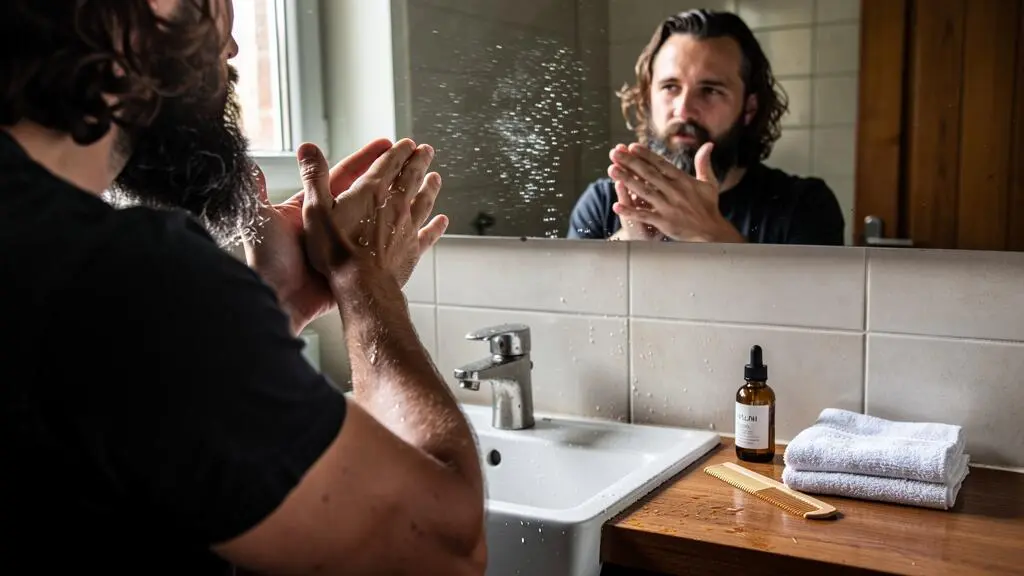
Beard oil can make facial hair feel softer, improve grooming comfort, and help relieve dryness beneath a beard. Its benefits are primarily cosmetic and conditioning: it coats the hair, reduces the sensation of roughness, and supplements the skin’s natural oils. What it cannot reliably do is make a beard grow faster, create new follicles, or transform naturally sparse facial hair into a dense beard.
The difference between a comfortable, well-groomed beard and an oily-looking one often comes down to application. A small amount distributed through slightly damp facial hair and the underlying skin is generally more useful than repeatedly coating dry hair with extra product.
Beard length, skin type, climate, and the formula itself also matter. Men with short beards may need very little oil, while longer beards sometimes benefit from additional conditioning or a separate styling balm. Understanding these differences makes it easier to build a routine that improves comfort without unnecessary products or residue.
Beard oil essentials: what actually works
- Conditioning, not growth: Beard oil helps facial hair feel softer and supports skin comfort, but it has not been shown to accelerate beard growth.
- Start small: Apply a few drops to a slightly damp beard, massage the skin underneath, and comb through before adding more.
- Adjust to your beard: Length, dryness, skin sensitivity, and climate determine whether oil alone is enough or whether your routine needs changing.
- Why Does Beard Oil Make Facial Hair Feel Softer but Not Grow Faster?
- How Can You Apply Beard Oil Without Making Your Beard Look Greasy?
- Beard Oil or Beard Balm: Which Is Better for Your Beard Length?
- The Beard Oil Mistake That Can Leave Facial Hair Heavy and Uncomfortable
- When Should You Use Beard Oil More Often?
- How Can You Maintain a Neat Beard in Less Than 10 Minutes a Day?
- Clean-Shaven, Stubble or Beard: Which Requires the Least Daily Maintenance?
- How Can Men Keep a Beard Looking Neat Without Spending Too Long on Maintenance?
Why Does Beard Oil Make Facial Hair Feel Softer but Not Grow Faster?
Beard oil makes facial hair feel softer because its conditioning ingredients coat the hair shaft, improving the way individual hairs feel and move against one another. It does not stimulate the follicles responsible for producing facial hair. Softer, smoother strands can make a beard look healthier, but that improvement should not be mistaken for faster growth or greater follicle density.
Facial hair has an outer protective layer called the cuticle. Everyday washing, friction, and exposure to dry conditions can leave beard hair feeling coarse. Conditioning oils provide lubrication along the hair surface, helping reduce roughness and making hairs easier to comb and arrange.
Common carrier oils include jojoba, argan, and castor oil. As explained in the Chemical & Engineering News infographic on beard-product chemistry, carrier oils form the main component of beard oils and help reproduce some of the conditioning functions of natural skin oils.
They are not chemically identical to human sebum, however. Nor is there an established beard length at which natural oil production suddenly becomes insufficient. Rather, longer hairs may be harder to condition evenly using the skin’s natural oils alone.
Hair softness and hair growth are separate processes. Beard oil acts mainly on existing hair and skin. Beard growth depends substantially on genetic characteristics, age, and the responsiveness of hair follicles to hormonal signals.
The Cleveland Clinic‘s explanation of beard growth identifies genetics as an important influence on facial-hair thickness and explains why products marketed for fuller beards should not automatically be considered effective.
Well-conditioned hairs may also be easier to handle without excessive pulling or friction. That could help limit avoidable grooming damage, although the available sources do not establish a measurable reduction in beard-hair breakage from ordinary beard oil.
For someone whose beard feels stiff, the improvement after application can be noticeable even though no new growth has occurred. This is a practical conditioning benefit, not biological evidence of increased density.
The useful question is therefore not whether beard oil can produce a thicker beard, but whether it makes existing facial hair and the skin beneath it more comfortable. Achieving that result depends heavily on how much oil is applied.
How Can You Apply Beard Oil Without Making Your Beard Look Greasy?
To apply beard oil without a greasy finish, start with a clean, slightly damp beard and use only a small amount. Rub the drops between your palms, massage the oil through the facial hair and onto the underlying skin, then comb to distribute it evenly. Add more only if the beard still feels insufficiently conditioned.
The American Academy of Dermatology‘s beard-care recommendations emphasize moisturizing slightly damp skin, using beard oil sparingly, and combing facial hair to distribute grooming products.
Applying oil while the skin retains some moisture helps the product complement the beard’s existing hydration rather than simply leaving a surface coating.
- Clean or rinse your beard. Remove accumulated dirt and grooming residue, using a gentle cleanser when needed.
- Pat it until slightly damp. Avoid leaving the beard dripping wet or rubbing it aggressively with a towel.
- Dispense a small amount. For a short beard, three to four drops can be a practical starting experiment, not a medically established dosage.
- Warm and distribute the oil. Rub your palms together, then work through the beard from the roots toward the tips, making gentle contact with the skin underneath.
- Comb and assess. Distribute the remaining product evenly before deciding whether another drop is necessary.
For longer beards, the starting quantity may need to increase because there is more hair surface to cover. Product viscosity, individual hair thickness, and natural skin oiliness also influence how much feels comfortable. There is no universally validated drop count for each beard length.
Pay particular attention to the skin under the beard. Coating only the visible hair can leave underlying dryness unaddressed while creating unnecessary shine on the outer strands. That does not mean forcing large amounts of oil onto the skin; gentle, even application is enough.
A practical self-check is to assess the beard roughly 30 minutes after application. If it still looks unusually shiny, feels sticky, or transfers obvious oil to your fingers, try reducing the next dose. This is a personal troubleshooting technique, not a clinically validated test.
Five checks for a clean beard-oil application
- Check moisture: Pat your freshly rinsed beard and confirm that it feels slightly damp rather than wet.
- Record a starting dose: Count the drops used so the next application can be adjusted consistently.
- Confirm skin contact: Massage gently beneath the beard and check that the product is not concentrated only on the outer hair.
- Inspect distribution: Comb once through the beard and check for visibly clumped or uneven sections.
- Review the finish: After approximately 30 minutes, note whether the beard feels comfortable or retains unwanted surface oil.
Once the smallest comfortable dose is established, the next decision is whether the beard needs conditioning alone or additional control over its shape.
Beard Oil or Beard Balm: Which Is Better for Your Beard Length?
Beard oil is usually the simpler option for short facial hair and men primarily concerned with dryness or roughness. Beard balm becomes more useful as a beard grows longer or needs light styling control. The two products serve different purposes: oil conditions hair and skin, while balm combines conditioning ingredients with waxes or butters that help manage shape.
Oil spreads relatively easily through facial hair and is particularly practical when the objective is comfort rather than hold. Balm is usually thicker and may contain beeswax, shea butter, cocoa butter, or similar ingredients that create more structure.
That structural difference matters as hair becomes longer. Strands around the chin and cheeks may begin growing in different directions, and a light styling product can make them easier to organize.
The following comparison offers a practical starting point rather than a strict product rule.
| Beard length or concern | Beard oil | Beard balm |
|---|---|---|
| Short stubble | Optional for comfort when skin is dry | Usually unnecessary for styling |
| Short beard | Useful for softness and conditioning | Optional when individual hairs need control |
| Medium beard | Useful for conditioning the skin and hair | Helpful for managing stray hairs |
| Long beard | May help condition the longer strands | Can add shape and light hold |
| Primary concern is dryness | Consider oil if appropriate for skin type | Not necessarily required |
| Primary concern is styling | Limited hold | Usually more suitable |
Oil and balm can be complementary rather than competing products. For a medium or long beard, one workable method is to apply a little oil to slightly damp skin and hair, allow it to distribute, and finish with a small quantity of balm where styling is needed.
This oil-first sequence is a practical grooming approach, not a universally proven requirement. Some men may prefer balm alone, particularly if its formula already provides adequate conditioning.
A heavy balm is not automatically better for a longer beard. Excess wax or butter may make strands stick together, produce a stiff or shiny appearance, and increase the effort needed to wash out accumulated product.
For oily or acne-prone skin, richer formulas deserve particular caution. A beard conditioner or another skin-type-appropriate moisturizer may be a better starting choice than adding multiple oil-based products.
The most effective combination is the lightest one that keeps the beard comfortable and manageable. Using more product than necessary can undermine both conditioning and appearance.
The Beard Oil Mistake That Can Leave Facial Hair Heavy and Uncomfortable
The most common practical mistake with beard oil is applying too much in the hope of obtaining greater softness or hydration. Once the beard has enough conditioning product, additional oil may remain on the surface, producing a heavy, sticky, or greasy feeling. More oil does not necessarily mean more moisture, and excessive application may make grooming less comfortable.
It is easy to misunderstand how conditioning works. Oil can help reduce moisture loss and improve surface lubrication, but it does not directly supply water to dry skin. Repeatedly adding oil to an already saturated beard often increases residue instead of solving the original dryness.
Several problems can follow:
- Visible clumping: Neighboring hairs stick together, making the beard look less full or freshly groomed.
- Unwanted shine: Excess surface oil can create an oily appearance that persists after combing.
- Product transfer: Oil may remain on fingers, clothing, or surfaces when too much is used.
- Skin discomfort: Certain ingredients may aggravate sensitive skin, especially when exposure is repeated.
Oil-rich formulas may also be unsuitable for some acne-prone individuals. However, excess beard oil should not automatically be described as a proven cause of blocked pores or acne in every user. Individual skin characteristics and formulation matter.
Fragrance is another consideration. The American Academy of Dermatology information on contact dermatitis identifies fragrance as a common trigger of skin reactions. A strongly scented beard oil may therefore be uncomfortable for someone susceptible to fragrance irritation.
If the beard already feels overloaded, the solution is straightforward: cleanse gently to remove excess residue, then use less oil at the next application. Avoid repeatedly adding new layers to compensate for hair that feels heavy.
A useful adjustment is to reduce the quantity substantially, assess the result, and increase gradually only if needed. The goal is to identify the smallest dose that delivers a comfortable finish, rather than to reach a predetermined number of drops.
Ingredient transparency also matters. A formula with identifiable carrier oils and clearly disclosed fragrance components is easier to assess than one with ambiguous product claims. A short ingredient list can simplify evaluation, but it does not guarantee safety or suitability.
Persistent redness, burning, swelling, or a recurring rash should prompt discontinuation of the suspected product and, when appropriate, medical advice. Treating those symptoms as ordinary beard dryness can delay recognition of irritation or contact dermatitis.
Once the dose and formula are suitable, frequency becomes the next variable. Using beard oil more often can help in some conditions, but only when the skin and hair actually need it.
When Should You Use Beard Oil More Often?
Beard oil may be useful more frequently when facial hair feels persistently rough or the skin beneath it becomes dry, particularly during cold weather, low indoor humidity, or as a beard grows longer. Frequency should follow actual comfort rather than a universal daily requirement. Increasing applications without adjusting the amount can create the same greasy buildup as excessive dosing.
A simple baseline is to assess the beard after washing and moisturizing. If the hair feels manageable and the skin is comfortable, there is no reason to add another application solely because a fixed interval has passed.
Situations in which a change might be useful include:
- Cold or dry weather: Lower humidity and indoor heating can contribute to uncomfortable skin dryness.
- Longer facial hair: More hair surface may require greater attention to even conditioning, although there is no proven length-based threshold.
- Frequent cleansing: Washing routines that remove natural oils may leave the beard feeling rough.
- Recent trimming or close shaving: Newly exposed or recently shaved skin may need gentle moisturizing, although beard oil is not automatically the best product for irritated skin.
Dryness can present as tightness, fine flakes, or an itchy sensation beneath the beard. Hair that feels increasingly coarse may also suggest that the grooming routine needs adjustment.
These signs are not specific to a lack of oil. Persistent flaking, redness, or itch can be associated with skin conditions such as seborrheic dermatitis or contact dermatitis, which may require a different approach.
The time of application is often as important as its frequency. After cleansing, gently pat the beard dry and apply a suitable conditioning product while the skin remains slightly damp. This supports more consistent distribution and helps avoid repeatedly applying oil over accumulated residue.
Consider a hypothetical example: someone with a medium beard is comfortable using a small dose after a morning shower. When indoor heating increases during winter, the beard starts feeling dry by evening. Rather than doubling every application, the person could first review cleansing habits and moisturizer suitability, then test whether a smaller additional dose helps.
The important principle is to adjust frequency and quantity together. If more frequent applications are needed, each dose may be smaller. Monitor whether comfort improves without increasing shine or residue.
Men with acne-prone or very sensitive skin should not assume that more oil is the correct solution to dryness. A non-comedogenic or fragrance-free moisturizer may be more suitable depending on the skin’s needs.
Once the frequency is settled, beard oil can fit into a very short daily grooming routine without requiring a collection of additional products.
How Can You Maintain a Neat Beard in Less Than 10 Minutes a Day?
A neat beard can usually be maintained in less than 10 minutes a day by combining gentle cleaning, light conditioning, and consistent combing or brushing. The essential steps are to remove everyday residue, apply a small amount of moisturizer or beard oil when appropriate, and direct the hairs into shape. More detailed trimming can be handled separately when needed.
Short, regular grooming sessions tend to be more manageable than repeatedly allowing tangles and stray hairs to accumulate. A predictable routine also makes it easier to notice changes in dryness, skin sensitivity, or the amount of product required.
Here is a practical example of a daily routine. The timings are illustrative and can vary according to beard length, density, and individual habits.
| Step | Approximate time | Main purpose |
|---|---|---|
| Gentle rinse or cleansing | 2 minutes | Remove dirt and residue |
| Pat dry | 1 minute | Leave skin slightly damp |
| Apply a small amount of oil or moisturizer | 1 minute | Support comfort and conditioning |
| Comb or brush | 2 minutes | Distribute product and organize hairs |
| Apply optional balm and inspect shape | 1–2 minutes | Control stray hairs and check appearance |
In this example, the entire routine takes approximately seven to eight minutes, excluding any additional trimming.
Beard oil belongs immediately after the pat-drying stage, while the underlying skin is still slightly damp. Combing afterward distributes the product along the strands rather than leaving concentrated patches.
There is no need to perform a complete beard wash with cleanser every time the routine is repeated. Cleansing frequency should reflect skin type, sweating, product accumulation, and the products used. Excessive washing may worsen dryness in susceptible individuals.
Daily grooming is also different from periodic shaping. Neckline adjustments, cheek-line corrections, and trimming uneven ends can take longer and may be better handled during a separate session when the beard actually needs them.
For a short beard, the routine might involve only rinsing, moisturizing, and brushing. Someone with a longer beard may need a wider-toothed comb and a small amount of balm to control the outer shape.
The time required also depends on the facial-hair style itself. A clean-shaven face, light stubble, and an established beard have different upkeep demands, even when each looks relatively simple.
Clean-Shaven, Stubble or Beard: Which Requires the Least Daily Maintenance?
Light stubble often requires the least time on a typical day, particularly when slight variations in length are acceptable. A consistently clean-shaven face usually requires frequent shaving, while an established beard needs regular cleaning, conditioning, and shaping. The easiest option depends on growth speed, skin sensitivity, and how precise the finished appearance must remain.
Maintenance should be evaluated by both time and frequency. A task that takes only a few minutes may still feel demanding when it must be repeated every morning.
Clean shaving offers a straightforward appearance, but facial hair can become visible again relatively quickly depending on the individual. Maintaining a consistently smooth look may therefore require repeated razor use or electric shaving.
Stubble can be more forgiving because small changes in length are part of the style. However, uneven growth or poorly defined neck and cheek areas can create a less intentional appearance, making periodic trimming useful.
A short or medium beard requires attention to both the facial hair and the underlying skin. Once the beard is established, oil or another suitable moisturizer can help address roughness and dryness when needed.
| Style | Typical maintenance | Potential difficulty |
|---|---|---|
| Clean-shaven | Frequent shaving and skin care | Irritation or ingrown hairs |
| Light stubble | Occasional trimming and skin care | Maintaining an even length |
| Short beard | Regular grooming and periodic shaping | Dryness and uneven outlines |
| Medium or long beard | Combing, conditioning, and shaping | Tangles, stray hairs, and increased grooming time |
These are relative maintenance patterns rather than measured daily time requirements. Someone with fast-growing facial hair may spend more time keeping clean-shaven than someone whose beard grows slowly. Equally, a person who enjoys daily combing may find an established beard easier than regular razor shaving.
The transition from stubble to a short beard can be particularly awkward. Individual hairs may grow at visibly different rates, and the skin can feel itchy as the new facial hair develops.
During this stage, gentle skin care matters more than trying to style every short hair. A lightweight moisturizer may be sufficient, while beard oil can be considered when appropriate for the skin type. Anyone prone to ingrown hairs should avoid aggressive grooming that worsens irritation.
For men with sensitive skin, reducing razor contact may be appealing, but growing a beard is not an automatic solution to every shaving-related problem. Skin conditions, hair texture, and personal comfort should guide the decision.
Whichever style is chosen, the best way to reduce grooming time is to focus on the few actions that produce the largest visible improvement rather than adding more steps.
Key takeaways for simpler beard maintenance
- Match products to the problem: Use conditioning for dryness and styling products only when the beard needs additional shape or control.
- Prioritize visible structure: A tidy neckline, consistent length, and organized hairs often matter more than the number of grooming products used.
- Make the routine sustainable: Choose a facial-hair length and daily care method that can be maintained comfortably without repeated corrective sessions.
How Can Men Keep a Beard Looking Neat Without Spending Too Long on Maintenance?
Men can keep a beard looking neat with three core habits: maintain comfortable skin and conditioned hair, comb the beard into a consistent direction, and trim visible outlines when necessary. These steps address most everyday appearance concerns without requiring an elaborate product routine. The key is to repeat simple grooming consistently and reserve detailed shaping for occasional maintenance.
Beard care becomes easier when conditioning, styling, and trimming are treated as separate tasks rather than problems requiring the same product.
Conditioning focuses on comfort and hair feel. A few drops of suitable beard oil may soften rough facial hair, while a skin-type-appropriate moisturizer can help maintain comfort beneath short stubble or sensitive facial hair.
Combing focuses on direction and overall shape. Even a well-conditioned beard can look untidy when individual hairs point in different directions. Gentle combing helps organize the strands and distribute any grooming product already applied.
Trimming focuses on structure. For many beard styles, maintaining the neckline and cheek outlines has a greater immediate visual effect than adding another conditioning product. A reasonably defined perimeter makes natural variations in hair density look more intentional.
The ideal grooming sequence therefore depends on the beard:
- Short beard: Keep the skin comfortable, brush the hair into place, and maintain tidy outlines.
- Medium beard: Condition when needed, comb consistently, and use a little balm only where additional control helps.
- Long beard: Distribute conditioning product carefully, detangle gently, and trim ends or outlines periodically to preserve shape.
A practical way to simplify the routine is to identify the two or three actions that have the greatest impact on the beard’s appearance. If combing and a modest amount of oil are sufficient, there is little reason to introduce extra waxes, sprays, or multiple layers of balm.
Likewise, if the beard looks tidy but the skin underneath remains itchy, more styling will not address the underlying issue. Review cleansing habits, moisturizing choices, and possible irritation before applying additional oil.
Over time, an efficient routine should make grooming decisions easier. Familiarity with the beard’s growth pattern, usual dryness, and preferred outline reduces the need for constant experimentation.
Start with the smallest useful routine for your beard length: clean gently, moisturize or condition as needed, comb into shape, and inspect the outlines. Keep that approach consistent, then adjust only when comfort or appearance gives you a clear reason. A well-maintained beard should feel manageable in everyday life, not become an additional daily chore.
Can beard oil replace facial moisturizer?
Not always. Beard oil can condition facial hair and help some people with normal or dry skin maintain comfort beneath a beard. However, a dedicated facial moisturizer may be more suitable for sensitive or acne-prone skin. Oil mainly provides lubrication and an emollient effect; it does not replace every function of a moisturizing formulation.
Should beard oil be applied before or after washing?
Applying beard oil after cleansing is generally more practical because accumulated dirt and residue have been removed. Pat the beard until slightly damp, then distribute a small amount through the hair and underlying skin. There is no need to wash the beard immediately before every application if it is already clean.
Is unscented beard oil the same as fragrance-free beard oil?
No. An unscented product may contain ingredients used to mask other odors, while fragrance-free labeling is intended to indicate that fragrance ingredients have not been added for scent. Men concerned about fragrance-related irritation should examine the ingredient list and favor clearly labeled fragrance-free products.
Can beard oil help with beard dandruff?
Beard oil may improve comfort when flaking is associated with ordinary dry skin. However, persistent flakes can have other causes, including seborrheic dermatitis, and oil alone may not address them. If flaking continues or is accompanied by redness, irritation, or significant itching, consider professional dermatological advice rather than repeatedly increasing the amount of oil.
How can you tell whether a beard oil suits your skin?
A suitable product should leave the beard manageable and the underlying skin comfortable without persistent burning, redness, itching, or unwanted greasiness. Start with a modest amount and monitor the response. If a product causes irritation, stop using it. People with recurring reactions or known sensitivities may benefit from discussing ingredient choices with a dermatologist.