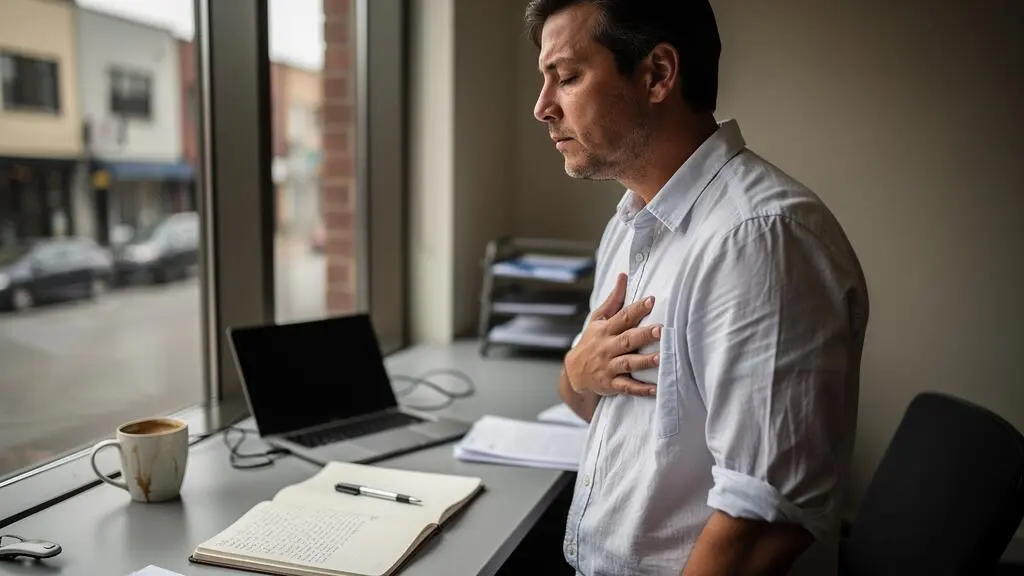
Stress management becomes difficult when the advice itself requires more time, energy and organisation than a busy day allows. Between meetings, family responsibilities, unfinished tasks and unexpected demands, even a sensible wellness routine can feel like another obligation.
For men managing everyday pressure, realistic stress management usually starts smaller. A few minutes of comfortable breathing, a short walk, a clearer boundary between tasks or a more consistent bedtime may be easier to sustain than an elaborate daily programme. The aim is not to eliminate every stressful moment. It is to reduce unnecessary pressure, create opportunities for recovery and recognise when circumstances need to change.
These techniques can fit around ordinary responsibilities without expensive equipment or perfect schedules. Their usefulness depends on the situation, however, and short breaks cannot resolve chronic overload on their own. A workable approach combines immediate coping methods with attention to sleep, workload, relationships and professional support when needed.
Realistic stress management at a glance
- Use short breaks that match the immediate problem: breathing for tension, walking for restlessness or writing for repetitive thoughts.
- Attach recovery habits to existing moments instead of building another demanding routine.
- Protect essential needs, adjust excessive responsibilities and seek professional support when symptoms become persistent, severe or disruptive.
- Why Can Small Daily Pressures Feel More Exhausting Than One Major Challenge?
- How Can You Reduce Everyday Stress in Five Minutes Between Tasks?
- Walking, Breathing or Journalling: Which Stress Technique Fits the Situation?
- The Stress-Relief Mistake That Can Make Your Routine Feel Even More Overwhelming
- When Should Everyday Stress Be Discussed With a Qualified Professional?
- How Can You Create a 60-Minute Focus Block Without Ignoring Important Responsibilities?
- Sleep, Fitness, Social Life or Downtime: What Should You Rebalance First?
- How Can Men Build a Balanced Lifestyle Without Trying to Optimise Every Hour?
Why Can Small Daily Pressures Feel More Exhausting Than One Major Challenge?
Small daily pressures can feel exhausting because they arrive repeatedly, often without a clear opportunity to recover. A difficult conversation, an urgent message or another unexpected decision may seem manageable alone. When these events accumulate, however, they can maintain a sense of alertness and gradually reduce the energy available for concentration, patience and rest.
A major challenge often has an identifiable beginning, a period of intense effort and some form of resolution. Everyday micro-stress is less clearly defined. The inbox refills, domestic tasks continue and new requests arrive before previous concerns have been settled.
This distinction matters because the cumulative effect of small demands is easy to overlook. A man may dismiss an interruption as insignificant, then wonder why he feels irritable or mentally drained at the end of an otherwise ordinary day.
Not every minor stressor produces a measurable physiological response, and people vary in how they react. Nevertheless, repeated demands can contribute to a pattern in which opportunities for recovery become insufficient.
Consider a hypothetical working day: a delayed commute creates urgency, three meetings overrun, a colleague requests an immediate decision and a family matter interrupts the afternoon. None of these events necessarily explains the day’s exhaustion by itself. Their combined demands may be more revealing.
A useful starting point is to record recurring friction rather than measuring how serious each incident seems:
- Interruptions that repeatedly break concentration.
- Decisions made under unnecessary time pressure.
- Responsibilities that remain mentally unfinished.
- Transitions between work and home without recovery time.
Reviewing the pattern can distinguish unavoidable responsibilities from pressures that might be reduced, delegated, postponed or handled differently. It can also reveal whether the problem is simply a difficult day or a workload that regularly exceeds available capacity.
The next step is not necessarily a major lifestyle change. Sometimes the most accessible intervention is a brief recovery period between demands.
How Can You Reduce Everyday Stress in Five Minutes Between Tasks?
Everyday stress can sometimes be reduced in five minutes by selecting a simple reset that matches the previous task. Comfortable breathing may help after a tense conversation, brief movement may ease restlessness after desk work, and a deliberate pause may help close one demanding task before another begins. The purpose is temporary recovery, not complete stress elimination.
A practical five-minute break needs no special setting or equipment. After a difficult phone call, sit comfortably, loosen unnecessary muscular tension and breathe gently without forcing the breath. Following prolonged concentration, walk along a corridor or step outside if circumstances allow.
After an interruption, the useful response may be mental rather than physical: write down the next action needed for the interrupted task, acknowledge that it can wait and turn attention to the new priority.
The NHS breathing exercises for stress describe a calming practice that can be performed sitting, standing or lying down. The NHS suggests breathing gently, allowing air to move comfortably into the abdomen and optionally counting steadily during inhalation and exhalation. Its guidance recommends practising for at least five minutes.
5 minutes daily
In a randomised study published in 2023, participants practised brief structured breathing or mindfulness meditation daily for one month. Breathing exercises, particularly an exhalation-focused technique, showed promising improvements in mood and respiratory rate. This does not establish that a single session eliminates stress.
Balban and colleagues, Cell Reports Medicine, 2023.
That study supports brief breathing as a possible tool, but it does not demonstrate that every breathing pattern produces the same result. Nor does it show that brief exercises compensate for insufficient sleep, excessive responsibilities or persistent mental health symptoms.
The selection principle is straightforward: choose the smallest response that addresses what you are experiencing now. If movement is impossible during a meeting-heavy day, a seated breathing exercise may be more practical. If stillness leaves you restless, walking might suit the moment better.
Most importantly, avoid turning the break into another performance target. Tracking multiple metrics, completing a demanding meditation routine or checking messages while supposedly recovering may defeat its practical purpose.
Once short breaks become available, choosing between different techniques can make them more relevant to the pressure actually being experienced.
Walking, Breathing or Journalling: Which Stress Technique Fits the Situation?
Walking, breathing and journalling serve different practical purposes. Walking may suit physical restlessness or repetitive thinking, breathing may help when immediate tension makes it difficult to settle, and journalling may clarify worries or competing priorities. The most useful choice depends on available time, privacy, the nature of the stress and individual preference rather than a universal ranking.
Walking provides a change of physical activity and environment, which may be welcome after sitting for prolonged periods. It also offers time away from screens and continuous requests. A short walk need not be treated as a fitness workout to be worthwhile.
Breathing is especially accessible when circumstances restrict movement. It can be practised discreetly at a desk or during a quiet moment before a demanding conversation, provided it remains gentle and comfortable.
Journalling addresses a different difficulty: thoughts that keep circulating because they have not been organised. Writing a few lines can help separate what requires action from what is uncertain or outside immediate control.
The following comparison is a practical decision aid, not a scientifically validated prescription for matching techniques to specific situations.
| Consideration | Walking | Breathing | Journalling |
|---|---|---|---|
| Best practical fit | Restlessness or extended desk work | Immediate tension or limited mobility | Recurring thoughts or unclear priorities |
| Time required | A few minutes or longer | A few comfortable minutes | A short writing interval |
| Environment | Needs a safe place to move | Possible while seated or standing | Needs somewhere to record thoughts |
| Main limitation | May not be possible during obligations | Effects vary by exercise and individual | May not suit moments requiring immediate action |
A 2024 systematic review of brief anxiety-management techniques examined twelve studies and reported varied outcomes across different approaches. Breathing-only techniques produced inconsistent results, while body-focused and some combined approaches showed encouraging findings. The review addressed short-term anxiety rather than validating this specific comparison of walking, breathing and journalling.
Instead of repeatedly switching between methods, consider testing one technique in a recurring situation over several days. After using it, note whether tension, mental clarity or readiness for the next responsibility seems different. Personal observations can guide practical choices without becoming proof of a medical benefit.
When a method feels ineffective, the context may be unsuitable, the technique may need adjustment or another approach may simply be preferable. Persistent distress deserves more than endless experimentation with self-help exercises.
The aim is to develop a small repertoire of options, not to perform all three every day. That distinction helps prevent stress management itself from becoming exhausting.
The Stress-Relief Mistake That Can Make Your Routine Feel Even More Overwhelming
A common stress-relief mistake is treating recovery as another obligation that must be completed perfectly. Ambitious meditation schedules, strict exercise plans and detailed wellness trackers can add decisions and pressure to an already crowded day. When these routines become unsustainable, frustration and self-criticism may create further stress instead of helping reduce it.
The problem is rarely the individual activity. Regular movement, relaxation and adequate sleep can all support well-being. The difficulty arises when maintaining the system demands more capacity than the person currently has.
Imagine a man who decides to meditate for half an hour every morning, exercise extensively every evening and write a detailed journal before bed. After a busy week, he misses several sessions and concludes that he lacks discipline. His original workload remains unchanged, but he now has an additional reason to feel dissatisfied.
A simpler approach is to use existing moments as recovery anchors. A short walk can follow lunch. Comfortable breathing can begin when a meeting ends. A brief written note can close the working day before personal responsibilities begin.
The minimum version should be small enough to remain realistic during difficult weeks. A two-minute pause may be preferable to an elaborate exercise that is repeatedly abandoned, even though it should not be presented as equivalent to a studied five-minute protocol.
Build a manageable stress-relief routine in five actions
- Identify one recurring stressful transition and write down when it usually happens.
- Choose one suitable technique and record its simplest practical version.
- Attach that technique to an existing daily event and note the connection.
- Try the approach during ordinary routines and record one brief observation about its usefulness.
- Review what actually happened and write one adjustment that would make the habit easier to repeat.
Consistency is better understood as the ability to return to a useful behaviour than as an uninterrupted streak. Missing a day does not require restarting an entire programme.
It is also important to distinguish individual recovery habits from structural problems. If work demands, caregiving responsibilities or financial worries consistently exceed available capacity, a shorter routine may help with momentary tension but will not remove those pressures. Practical boundary-setting and support may matter more.
Reducing unnecessary obligations is part of the solution. Recognising when personal techniques are insufficient is equally important.
When Should Everyday Stress Be Discussed With a Qualified Professional?
Everyday stress should be discussed with a qualified professional when symptoms become persistent, severe, difficult to manage or disruptive to normal functioning. Ongoing sleep problems, significant irritability, loss of interest, physical complaints or increasing reliance on alcohol or other coping behaviours can signal a need for support. Serious or rapidly worsening symptoms deserve attention without delay.
Stress is not automatically a mental health disorder. Temporary pressure before an important deadline or during an unusually demanding week can be part of ordinary life. However, the distinction becomes less reassuring when distress continues despite opportunities for rest or begins interfering with work, relationships or basic responsibilities.
Warning signs worth discussing include:
- Persistent difficulty falling asleep or staying asleep.
- Trouble concentrating or completing everyday activities.
- Reduced interest in previously enjoyable activities.
- Unusual irritability or emotional reactions that feel difficult to control.
- Recurring physical symptoms or changes in coping habits.
The NIMH recommendations for caring for your mental health advise seeking professional help when severe or distressing symptoms continue for two weeks or longer. This is a useful indicator, not a requirement to wait two weeks before asking for help.
A general practitioner or primary care clinician can assess symptoms, consider potential physical contributors and discuss referral options. A psychologist may provide psychological assessment and evidence-based interventions. A qualified therapist or counsellor may help address stress-related thoughts, emotions and coping patterns, with professional titles and qualifications varying between countries.
For men who prefer to manage problems independently, it can help to view an appointment as another practical step rather than a judgement about resilience. Preparing a few observations about sleep, symptoms, duration and everyday impact can make the discussion more useful.
Professional support also does not mean abandoning ordinary self-care. Sleep, movement, supportive relationships and manageable routines may continue to play a role alongside an appropriate assessment or treatment plan.
Where there is immediate danger, thoughts of self-harm or a medical emergency, contact local emergency services or an appropriate crisis service rather than relying on routine self-help. Access routes differ between English-speaking countries.
For less severe everyday pressure, improving how responsibilities are organised may offer another opportunity to reduce repeated interruptions and mental strain.
How Can You Create a 60-Minute Focus Block Without Ignoring Important Responsibilities?
A 60-minute focus block can be created by choosing one important task, communicating limited availability and establishing a clear route for genuinely urgent matters. It should fit existing obligations rather than require other people to wait without explanation. The objective is to reduce unnecessary task-switching while remaining appropriately responsive to colleagues, family members or dependants.
Frequent interruptions can create a sense that the day is continually being spent catching up. Protecting a defined period for concentrated work may reduce that fragmentation, particularly for tasks requiring sustained attention.
Sixty minutes is a practical scheduling option, not a clinically established stress-reduction threshold. Some responsibilities make shorter blocks more realistic, and the arrangement should reflect the actual environment.
Begin with a task that has a clear outcome, such as drafting a report section or reviewing a specific set of documents. Avoid using the hour as an open-ended opportunity to tackle everything that feels unfinished.
Then choose a period that fits personal energy levels and predictable demands. Someone who concentrates best early in the morning may find a late-afternoon block ineffective, even if the calendar appears empty.
Before starting, briefly check outstanding responsibilities. Deal with urgent matters that cannot reasonably wait, then communicate when normal availability will resume.
An agreed fallback protects responsiveness. For example, colleagues might know which channel to use for genuine emergencies while routine requests wait until the block ends. At home, someone responsible for childcare may need a shorter or more flexible arrangement instead.
Protected focus must not become inaccessible focus. A schedule that ignores essential responsibilities creates anxiety and may increase interruptions rather than reduce them.
When the hour ends, record progress and the next action. This makes it easier to resume the work later without carrying every unfinished detail mentally into the next activity.
Protecting attention is useful, but its benefits may be limited if more fundamental needs, especially sleep and recovery, are consistently neglected.
Sleep, Fitness, Social Life or Downtime: What Should You Rebalance First?
The first area to rebalance should usually be the one whose deterioration is creating the greatest practical problems, rather than the one promoted most heavily in wellness advice. Sleep, physical activity, relationships and downtime all contribute to well-being. Reviewing how each has changed can reveal a manageable priority without demanding improvements across every area simultaneously.
Sleep is an important starting point when persistent tiredness makes ordinary demands harder to handle. Inadequate or irregular sleep may affect attention, emotional regulation and the capacity to manage pressure. However, improving sleep may require addressing work schedules, health concerns or evening responsibilities rather than simply deciding to go to bed earlier.
Physical activity can also support mental well-being. A walk during lunch or after work may be more sustainable than a demanding fitness programme that competes with essential rest.
Social connection serves another purpose: maintaining contact with people who provide companionship, perspective or practical support. Downtime creates room for activities that are not entirely defined by productivity or responsibility.
These areas interact, so a weakness in one can make it harder to maintain the others. Excessive fatigue may reduce motivation for movement and socialising, while a crowded schedule may leave insufficient space for sleep.
A quick personal review can help. Rate each area over a typical week as adequate, strained or seriously neglected, then consider which improvement would most reduce everyday pressure. These categories are for reflection, not a validated diagnostic scale.
Suppose sleep is the clearest problem. An initial change might involve protecting a more consistent bedtime on evenings when circumstances allow. If isolation is more concerning, arranging one achievable social commitment may be the more relevant starting point.
The priority should also reflect constraints. A man working irregular shifts or caring for family members may not have full control over his schedule. In that case, negotiating responsibilities or seeking practical assistance could be more effective than adding another personal target.
Choose one deliberate, sustainable adjustment, observe how it fits and reconsider the other areas once that change becomes manageable.
The purpose of rebalancing is not to perfect every dimension of life. It is to establish enough stability that difficult weeks do not repeatedly undermine basic well-being.
Key takeaways for lasting balance
- Choose a few essential recovery habits that remain feasible during demanding weeks.
- Judge routines by whether they support health and responsibilities, not by how efficiently every hour is used.
- Review what has become difficult and adjust the minimum commitment before introducing new goals.
How Can Men Build a Balanced Lifestyle Without Trying to Optimise Every Hour?
Men can build a balanced lifestyle by establishing a few dependable habits rather than attempting to optimise every hour. Regular opportunities for sleep, movement, connection and unstructured recovery provide a practical foundation. A balanced week does not require perfect consistency or maximum productivity. It requires enough flexibility to meet responsibilities without repeatedly sacrificing basic needs.
Optimisation encourages the question, « How can every available minute be used better? » A more sustainable approach asks, « What is enough to keep daily life manageable? »
This distinction can reduce unnecessary pressure. An evening walk does not need to reach a particular distance, and a social conversation does not need to serve a networking or self-improvement goal. Some activities are valuable precisely because they provide enjoyment, connection or rest.
A balanced-enough routine might have three anchors: a reasonably consistent sleep window, manageable opportunities for movement and a recurring commitment to personal connection or downtime.
These anchors should adapt to real obligations. During a particularly demanding week, movement may become a short walk rather than a full workout. Social connection might mean a brief call instead of an extended evening out. Rest might mean declining a nonessential commitment.
The important distinction is between adjusting an activity and abandoning the underlying need. Flexibility protects continuity without requiring rigid adherence to an ideal schedule.
A periodic review can remain simple. Ask which anchor slipped, what prevented it and whether the original expectation was realistic. If the same problem recurs, consider changing the demand or seeking support rather than repeatedly blaming motivation.
Balance also involves recognising structural limits. Excessive workloads, financial concerns and substantial caregiving demands cannot always be solved through individual habits. Clearer priorities, shared responsibilities and professional advice may be necessary alongside personal recovery techniques.
Realistic stress management therefore combines small immediate responses with longer-term choices about capacity. Breathing, walking and writing can help address particular moments. Sleep, relationships, workable boundaries and access to support determine whether recovery has room to happen consistently.
Choose one recurring source of pressure this week, match it with one manageable response and observe whether the change helps. If the underlying demands remain excessive or symptoms persist, address those circumstances directly rather than adding more techniques to the schedule.
Can stress management work without meditation?
Yes. Comfortable breathing, physical activity, supportive conversations, realistic priorities and adequate rest are all possible parts of stress management. Meditation may suit some people, but it is not a requirement for building a workable routine.
Is it useful to take a break when there is only one or two minutes available?
A brief pause can offer an opportunity to stop, move comfortably or identify the next task. Its effects should not be assumed equivalent to those of longer exercises studied in research. A short break is a practical option when more time is unavailable, not a substitute for sufficient recovery.
What if breathing exercises make someone feel uncomfortable?
Do not force or intensify breathing. Return to comfortable, natural breathing and stop an exercise that causes discomfort. Walking, a change of environment or another gentle activity may be preferable. Persistent or concerning symptoms should be discussed with a qualified healthcare professional.
Can a busy work schedule prevent effective stress management?
A demanding schedule can limit opportunities for recovery, especially when responsibilities are not negotiable. Small techniques may help with immediate tension, but chronic overload may also require workload changes, clearer boundaries, additional support or a review of competing obligations.
How can someone tell whether a simple stress-management habit is worth keeping?
Consider whether the habit is realistic to repeat, whether it feels useful in its intended situation and whether it adds unnecessary pressure. A brief personal review can help decide what to retain or change. Continued or worsening symptoms require appropriate assessment rather than relying solely on habit tracking.