A shirt that feels comfortable when first tried on can become sticky during a crowded commute. A jacket that promises weather protection may feel excessively warm after ten minutes of walking. Meanwhile, a simple cotton overshirt can outperform an expensive technical alternative on a quiet day at the office.
The difference lies in how fabrics manage moisture, release heat, accommodate movement and recover after repeated wear. Functional fabrics can genuinely improve everyday menswear, but only when their properties match the conditions in which the clothing is worn.
For men moving between public transport, offices, airports and unpredictable weather, the most useful materials are not necessarily those with the longest list of technical claims. They are the ones that solve recurring comfort problems while preserving a suitable appearance, reasonable maintenance requirements and acceptable durability.
Choosing well means looking beyond fibre names and considering the complete garment: its weight, construction, fit, finishing treatments and expected use.
What matters most when choosing functional menswear fabrics
- Match the material to the problem: prioritise moisture management for active commuting, appearance retention for office wear and suitable weather protection for exposed journeys.
- Understand the trade-offs: merino helps with odour management, cotton feels comfortable when dry, and technical synthetics often dry quickly, but none excels in every situation.
- Evaluate lasting value: check construction, care requirements and expected wear frequency before paying extra for performance features.
- Why Can Two Similar-Looking Fabrics Feel Completely Different After Eight Hours of Wear?
- How Can You Match Functional Fabrics to Work, Travel, and Everyday Weather?
- Merino, Cotton or Technical Blend: Which Fabric Works Best for Long Days?
- Three Functional Fabric Features That Can Make Everyday Clothing Less Comfortable
- When Is a Functional Fabric Worth the Extra Cost for Everyday Clothing?
- How Can You Check Whether a Technical Fabric Will Actually Work for Daily Commuting?
- One £150 Jacket or Three £50 Jackets: Which Gives Better Long-Term Value?
- How Can Men Layer Clothes Without Adding Unnecessary Bulk?
Why Can Two Similar-Looking Fabrics Feel Completely Different After Eight Hours of Wear?
Two fabrics that look and feel nearly identical in a fitting room can behave very differently after eight hours because comfort depends on moisture transport, heat release and repeated movement. A fabric may feel smooth when dry but become clammy, restrictive or abrasive once sweat, body heat and prolonged sitting affect its interaction with the skin.
The initial softness of a garment reveals only part of its performance. What matters during a full working day is how the fabric responds as conditions change.
Three mechanisms explain much of the difference:
- Moisture management: how perspiration is absorbed, distributed, transported and eventually released through evaporation. A fabric that spreads moisture efficiently may dry faster, provided surrounding conditions allow evaporation.
- Air permeability and heat transfer: how readily air moves through the textile and how effectively heat can escape. A tightly constructed fabric may limit airflow even when its individual fibres are relatively light.
- Mechanical comfort: how weight, drape, surface texture and stretch affect the garment during walking, reaching, bending and sitting.
These characteristics are related but cannot be reduced to a single comfort score. A fabric that dries quickly may still feel uncomfortable if it fits too closely, traps heat within the garment or rubs against the skin.
Laboratory testing helps distinguish measurable textile properties from marketing claims. The ISO 11092:2026 textile thermal and water-vapour resistance standard describes methods for measuring resistance to heat and water-vapour transfer under steady-state conditions.
Those measurements are useful, but they do not establish a universal threshold for comfort. Real clothing is affected by seams, fit, ventilation, activity and changing environmental conditions that a single fabric test cannot fully reproduce.
When comparing garments in a shop, a short practical inspection can reveal potential weaknesses:
- Check the fabric weight in grams per square metre (gsm), when available, and compare it with the intended season and garment construction.
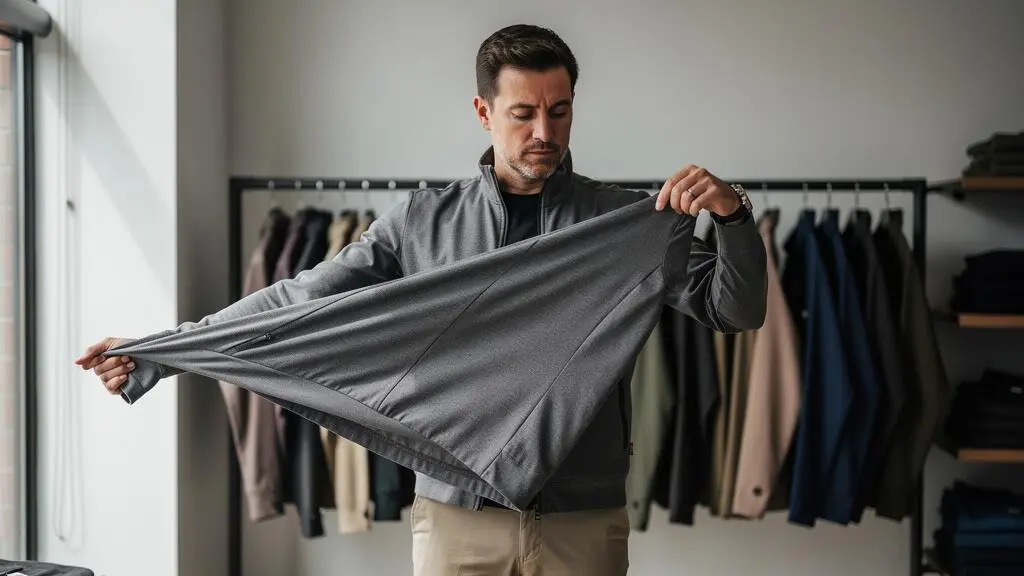
- Gently stretch a suitable section and observe whether it returns promptly without obvious distortion. Avoid forcing fabrics that are not designed to stretch.
- Consider what happens when the material becomes damp: will it retain moisture close to the skin, dry readily or require ventilation?
Gsm describes fabric mass per unit area, not comfort or warmth by itself. A lightweight textile can feel restrictive, while a heavier fabric may drape comfortably if its construction is appropriate.
Once these mechanisms are clear, the next step is matching them to the situations in which discomfort actually occurs.
How Can You Match Functional Fabrics to Work, Travel, and Everyday Weather?
Match functional fabrics to the most demanding part of your routine rather than searching for one material that performs best everywhere. Office clothing usually benefits from shape retention and controlled drape, travel clothing from manageable moisture and odour, and commuting clothing from appropriate protection against rain, wind or overheating.
A fabric’s usefulness depends on the specific inconvenience it prevents. Someone who spends most of the day in a temperature-controlled office has different priorities from someone who walks briskly between train stations and outdoor appointments.
The following decision grid separates these needs without treating any fibre as universally superior.
| Daily situation | Main fabric priority | Practical options to consider | Potential drawback |
|---|---|---|---|
| Office work | Appearance retention, comfortable drape and movement | Cotton blends, structured stretch weaves, wool blends | Excessively technical finishes may look too casual |
| Long-distance travel | Moisture management, odour behaviour and crease recovery | Merino blends, quick-drying synthetic blends | Some synthetics retain odours; fine wool needs care |
| Mixed-weather commuting | Wind and rain protection balanced with ventilation | Lightweight woven shells, treated outer fabrics, ventilated layers | Highly protective constructions may trap warmth |
Consider a hypothetical week involving three office days, a train journey and several short walks in unpredictable weather. A highly waterproof jacket might help during heavy rain, but it may be unnecessary for most of those journeys. A breathable outer layer paired with a compact rain shell could provide greater flexibility.
There is also an aesthetic consideration. Shiny surfaces, conspicuous zips, rigid panels and outdoor-oriented styling can make technically capable clothing look unsuitable in a formal workplace.
Hybrid fabric constructions offer a useful compromise. A technical fibre blended into a natural-looking weave can add flexibility or improve drying characteristics without necessarily creating a sportswear appearance. The result still depends on construction, fibre proportions and finishing.
Before buying, audit a normal week rather than an imagined extreme scenario:
- Identify the two or three moments when your clothing becomes uncomfortable.
- Describe the cause: retained sweat, stiffness, creasing, rain exposure or temperature changes.
- Choose the property that directly addresses each problem.
This approach also exposes unnecessary features. If trousers rarely get wet, a prominent water-repellent claim may matter less than how comfortably they stretch and recover after prolonged sitting.
With those priorities established, comparing individual fibre families becomes more meaningful than simply choosing between natural and synthetic materials.
Merino, Cotton or Technical Blend: Which Fabric Works Best for Long Days?
Merino is often useful for temperature flexibility and odour management, cotton provides familiar softness and comfort in relatively dry conditions, and technical blends can offer quicker drying and better movement. For long days, the strongest choice depends on perspiration, friction, washing habits and the garment’s purpose rather than whether its fibres are natural or synthetic.
Each material family manages water and prolonged wear differently. These differences become particularly important when clothing moves between transport, indoor spaces and outdoor conditions.
| Criterion | Merino wool | Cotton | Technical blends |
|---|---|---|---|
| Moisture behaviour | Absorbs moisture vapour and can help moderate next-to-skin humidity | Absorbs moisture but may feel heavy or clammy when wet | Often designed to move and spread liquid moisture |
| Odour behaviour | Often suitable for repeated wear between washes when appropriate | Varies with wear and drying conditions | Varies substantially by fibre and treatment |
| Drying speed | Generally slower than many lightweight synthetics | Often slow when saturated | Many polyester-rich constructions dry relatively quickly |
| Durability | Fine knits may wear or pill under friction | Depends on yarn, weave and garment quality | Can provide strong abrasion resistance, but performance varies |
| Care | May need gentle washing and careful drying | Usually straightforward, subject to label instructions | Often practical, although finishes may need specific care |
Merino wool is particularly useful in socks and next-to-skin layers. Its moisture-buffering properties and odour behaviour make it attractive for travel or days when frequent clothing changes are inconvenient. However, fine merino can be vulnerable to abrasion, pilling and unsuitable washing methods. Blends may improve durability, although the result depends on their composition.
Cotton remains a sensible option for relaxed office days, casual shirts and low-intensity activities. Its softness and familiar handling are genuine advantages. Problems arise when substantial perspiration or rain saturates the fabric, because retained moisture can become uncomfortable during subsequent cooling.
Technical blends commonly combine polyester, nylon or other fibres with elastane, cotton or wool. They can improve stretch, dimensional stability or moisture handling, but the precise outcome depends on fibre percentages, yarn structure and treatment quality.
Odour performance deserves separate attention from drying speed. A published study comparing odour in polyester and cotton sportswear examined T-shirts worn by 26 people during an intensive indoor cycling session. After a 28-hour incubation period, polyester garments were judged significantly more odorous and less pleasant-smelling than cotton garments under the study conditions.
This finding does not establish that every modern polyester blend performs poorly, nor does it describe ordinary office wear. It demonstrates why moisture-wicking claims alone cannot guarantee satisfactory odour behaviour.
What an experimental clothing-odour comparison actually shows
Researchers collected clothing from 26 participants after an intensive indoor cycling session and assessed differences between polyester and cotton T-shirts following incubation.
Under those specific experimental conditions, polyester garments received less favourable odour assessments. The study supports evaluating fabric odour separately from moisture transport, but it does not provide a universal ranking of all synthetic blends or establish long-term garment performance.
For buying decisions, look beyond labels such as « performance cotton » or « technical wool ». Check the fibre composition and consider which fibre contributes which property. A small amount of elastane, for example, may help a fabric accommodate movement without making its moisture behaviour equivalent to a specialised synthetic base layer.
Even a suitable fibre can become uncomfortable when a garment relies on excessive coatings or specialised treatments, making construction and finishing the next important considerations.
Three Functional Fabric Features That Can Make Everyday Clothing Less Comfortable
Waterproof membranes, antimicrobial treatments and heavily structured technical fabrics can improve specific functions while reducing everyday comfort. Waterproofing may limit ventilation, odour-control finishes may lose effectiveness through use and washing, and rigid laminates can restrict drape or create noise. The important question is what comfort or durability the added feature sacrifices.
Technical performance is rarely an unconditional improvement. Each feature should be assessed against the conditions in which it is genuinely useful.
1. Waterproof constructions that limit ventilation
A waterproof membrane can help prevent external liquid water from penetrating a garment. That does not mean moisture produced by the wearer escapes without restriction.
During brisk walking or crowded commuting, perspiration and heat can accumulate inside a jacket. Even a construction that permits some water-vapour transfer may struggle to keep up with changing activity levels, humidity and temperature differences.
The result can be internal dampness despite the garment successfully keeping rain out.
For short journeys in light rain, a breathable water-resistant outer layer may provide a more comfortable balance than a highly protective shell. For prolonged exposure to heavy rain, stronger weather protection may justify the ventilation trade-off.
2. Anti-odour treatments with uncertain durability
Some garments rely on applied antimicrobial or odour-control treatments rather than the inherent properties of their fibres.
These treatments vary in chemistry, application and durability. Their effectiveness may change with washing, abrasion and use, so a prominent anti-odour label does not establish how well the benefit will persist.
Before paying extra, look for clear information about the treatment and any relevant durability testing. If the manufacturer supplies no evidence about performance after repeated laundering, treat the claim as unverified rather than permanent.
3. Heavy coatings and stiff technical weaves
Protective coatings, laminated constructions and tightly structured fabrics can change how a garment moves and sounds.
A jacket that rustles loudly, resists natural bending or remains visibly rigid when seated may be unpleasant for daily office use despite its weather resistance.
Test the garment while raising your arms, sitting and walking. Notice whether it pulls across the shoulders, bunches at the elbows or produces distracting noise.
These effects are especially relevant for menswear intended to resemble conventional tailoring or understated casual clothing.
A useful reverse-question for every technical claim is: What does this feature cost in breathability, flexibility, maintenance or longevity?
The next decision is whether the benefit that remains is valuable enough to justify paying more.
When Is a Functional Fabric Worth the Extra Cost for Everyday Clothing?
A functional fabric is worth paying extra for when it solves a recurring comfort problem in a garment worn frequently enough to justify the premium. Faster drying, improved movement or reliable weather protection can provide meaningful value, but only when the benefit survives normal use and maintenance. Occasional garments rarely need expensive features that are seldom activated.
Start with two questions: how often will the garment be worn, and how uncomfortable is the situation it is intended to improve?
Someone walking to work in unpredictable rain may value a well-constructed protective jacket throughout much of the year. Someone who rarely spends time outdoors may gain little from paying for the same level of protection.
Price differences also reflect more than textile performance. Branding, distribution, design, garment construction and positioning can all affect the selling price. Two garments with similar fibre compositions may therefore cost very different amounts without delivering proportionately different comfort.
Cost per wear provides a more useful starting point than purchase price alone:
Cost per wear = total purchase and relevant maintenance costs ÷ number of actual wears.
Consider a purely hypothetical comparison. A £120 pair of everyday trousers worn 120 times would have a purchase-price cost of £1 per wear. A £60 alternative worn only 30 times would cost £2 per wear before maintenance.
This example illustrates the calculation; it does not predict the lifespan of either garment.
Durability matters because technical properties may change before the garment becomes visibly unusable. Water-repellent finishes can require maintenance, elastic recovery may deteriorate, and repeated abrasion can affect the surface of some fabrics.
The relevant question is not just how many years the garment might survive, but how long it will continue performing the function that justified its price.
Compare the expected benefit against ordinary alternatives. A highly specialised jacket may be unnecessary for someone whose main inconvenience is a slightly cool office. A comfortable mid layer could solve that problem more directly and at lower cost.
Before committing to a garment for daily use, its construction and claims should also withstand a practical pre-purchase inspection.
How Can You Check Whether a Technical Fabric Will Actually Work for Daily Commuting?
Check a technical commuting garment by examining its weight, fibre composition, care instructions, seams and construction before testing it during a short journey. Look for clear evidence behind weather-protection claims rather than relying on words such as « performance » or « all-weather ». During the first wears, monitor heat build-up, moisture retention and freedom of movement.
Daily commuting combines several challenges: changing temperatures, moderate physical activity, indoor crowding, friction from bags and occasional exposure to rain or wind.
Start by assessing the garment’s fabric weight. Gsm can help compare similar materials, but it must be interpreted alongside weave, layers and intended conditions. A low-gsm fabric is not automatically more breathable, and a high-gsm fabric is not necessarily warmer in every construction.
Next, examine the seams. Needle holes, joining techniques, seam placement and the presence or absence of suitable sealing can influence protection and durability. A weather-resistant fabric does not guarantee that the entire finished garment offers the same protection.
Technical labels should also be separated into three categories:
- Standardised test information: identifies a defined method or measured property, although the result still needs interpretation.
- Marketing descriptions: terms such as « commuter-ready » or « performance comfort » do not inherently establish a measurable threshold.
- Material descriptions: fibre percentages and fabric constructions provide useful information but do not independently prove performance.
A statement that a garment has been tested to a standard is not the same as independent certification, and a named test method alone may not demonstrate that a specified performance level has been achieved.
Care instructions deserve equal attention. In the United States, the FTC’s Care Labeling Rule for clothing requires manufacturers and importers of covered garments to provide appropriate regular-care information.
This is a US-specific regulatory requirement, not a universal rule for all English-speaking countries. In any market, examining the garment’s actual care instructions remains a sensible practical step.
Labels may reveal whether washing, drying or specialist cleaning would make a garment inconvenient to maintain. They cannot, by themselves, establish how many wash cycles a water-repellent or anti-odour treatment will survive.
Once purchased, try the garment on a short errand or moderate-weather commute before relying on it for a long or important journey. Observe whether warmth accumulates, dampness remains against the skin or the fabric restricts movement.
Some weaknesses, including persistent odour and pilling at backpack contact points, only emerge after repeated use. Inspect them as early as possible while keeping the retailer’s return conditions in mind, since worn or washed garments may not qualify for ordinary change-of-mind returns.
Five checks to complete before relying on a commuter garment
- Define the commuting conditions: write down your usual exposure to walking, rain, wind and indoor heat. Deliverable: a short list of the two most important comfort problems.
- Record material information: note fibre composition, available gsm weight and any stated technical test. Deliverable: a basic fabric specification record.
- Inspect garment construction: check shoulder seams, closures, movement and any claimed weather-protection details. Deliverable: a list of observed strengths and weaknesses.
- Read the care instructions: identify permitted washing and drying methods and any special treatment requirements. Deliverable: a realistic maintenance plan.
- Complete a low-risk wear test: use the garment on a suitable short journey and note heat build-up, dampness and restriction. Deliverable: a keep-or-reconsider decision based on observed comfort, subject to return conditions.
This routine does not replace laboratory testing or a long-term durability assessment. It does, however, identify practical mismatches that product descriptions may overlook.
With practical suitability established, it becomes possible to compare whether a single well-chosen garment or several lower-priced alternatives offer better value.
One £150 Jacket or Three £50 Jackets: Which Gives Better Long-Term Value?
One £150 jacket offers better long-term value if it is durable, comfortable across frequent use and suitable for most of your conditions. Three £50 jackets may be more useful when different activities, weather conditions or dress codes require separate garments. Neither strategy automatically saves money: actual wear frequency, replacement needs and construction quality determine the outcome.
The first distinction is between owning clothing that covers multiple situations and owning several pieces that specialise in different ones.
A versatile jacket with appropriate weather protection, comfortable movement and understated styling may serve as a dependable everyday layer. But one relatively expensive jacket can still be a poor investment if it feels uncomfortable indoors or fails to suit most outfits.
Conversely, three inexpensive jackets can provide practical flexibility. A lightweight overshirt, a warmer casual jacket and a rain-resistant outer layer might meet genuinely different needs.
The limitation is that buying multiple pieces does not guarantee useful variety. If their functions overlap, some may remain largely unworn.
| Decision factor | One £150 jacket | Three £50 jackets |
|---|---|---|
| Initial spending | £150 | £150 |
| Wardrobe flexibility | Depends on one garment’s versatility | Potentially broader if the jackets serve different needs |
| Construction quality | Must be verified, not assumed from price | Must be verified separately for each garment |
| Replacement risk | One garment receives concentrated wear | Wear may be distributed, but each piece can still fail |
| Best use case | Consistent routine and frequent wear | Distinct activities, conditions or dress codes |
Consider a hypothetical scenario in which the £150 jacket receives 150 wears before replacement. Its purchase-price cost is £1 per wear.
If three £50 jackets collectively receive the same 150 wears before replacement, their combined purchase-price cost is also £1 per wear. The higher-priced jacket only becomes a better financial choice if its useful lifespan, wear frequency or other benefits justify the investment.
The comparison changes when functionality deteriorates. A lower-priced jacket that rapidly loses an important performance characteristic may need replacing despite remaining visually acceptable. An expensive jacket can suffer the same problem if its materials or finishes do not withstand ordinary use.
Look for evidence of better construction rather than relying on price: secure seams, durable closures, consistent fabric quality, comfortable fit and realistic maintenance requirements.
For most wardrobes, a balanced strategy is worth considering. Concentrate spending on the pieces worn most often, particularly an everyday outer layer or frequently used trousers, while remaining economical with items reserved for occasional situations.
Whatever the chosen budget, the usefulness of an outer layer also depends on how well it works with the garments underneath it.
Key takeaways before building a practical layering system
- Choose layers with distinct functions so each garment contributes to comfort rather than repeating the same insulation or protection.
- Prioritise fabrics that can manage moisture and move comfortably under other clothing without excessive compression.
- Plan for temperature changes: a layer that cannot be removed conveniently may become uncomfortable in heated indoor environments.
How Can Men Layer Clothes Without Adding Unnecessary Bulk?
Men can layer clothing without unnecessary bulk by assigning each layer a specific function: moisture management next to the skin, insulation in the middle and protection from wind or rain on the outside. Thin, well-fitting fabrics with complementary properties usually create a neater silhouette than several heavy garments competing to provide the same warmth.
Effective layering is fundamentally a fabric-management strategy. It works by combining different textile behaviours rather than simply putting more clothes on.
The three functional positions are:
- Base layer: manages moisture near the skin. Lightweight merino or an appropriate synthetic fabric can be useful when perspiration is expected.
- Middle layer: provides insulation by helping retain relatively still air. Fine wool knits, suitable fleece constructions and other lightweight insulating fabrics can serve this role.
- Outer layer: limits exposure to wind or precipitation when necessary, ideally without creating excessive heat build-up during movement.
Thin fabrics are especially useful when moving between cold streets and heated offices. A fine merino layer beneath a lightweight knit and a tailored outer jacket may provide sufficient flexibility without resembling specialist outdoor equipment.
Actual warmth depends on material structure, thickness, fit, trapped air and conditions. Thinness alone does not guarantee insulation, and a bulky textile is not necessarily more efficient.
One common mistake is choosing an excessively insulating base layer. If it causes overheating during walking, perspiration can accumulate and produce discomfort when activity stops or temperatures fall.
Another is relying on a large middle layer that compresses against a close-fitting jacket. Compression may restrict movement and reduce some of the insulating air space within the clothing system.
Instead, aim for enough room to move freely while avoiding unnecessary excess fabric. Test the layers together by sitting, raising your arms and walking, since individually comfortable garments may become restrictive when combined.
For variable days, a practical outfit might consist of a lightweight base shirt, a removable fine knit and an outer jacket appropriate to the forecast. The exact combination should be adjusted to activity and temperature rather than treated as mandatory.
Each visible layer should also work independently with the rest of the outfit. A middle garment that looks appropriate without the jacket makes it easier to adapt to indoor conditions without compromising everyday style.
A layered wardrobe becomes more versatile when its pieces can be combined across seasons. The same breathable shirt may work alone in mild weather, under a knit in cooler conditions or beneath a protective shell when conditions require it.
For the next changeable-weather day, select an outfit by giving every layer one clear purpose, then check how comfortably the complete combination moves and adapts between outdoor and indoor conditions.
Does a higher polyester percentage always mean better moisture-wicking performance?
No. Polyester-rich fabrics can be engineered for efficient moisture transport and quick drying, but actual performance depends on yarn structure, knit or weave, finishes and garment construction. Fibre percentage alone cannot establish how effectively a finished garment handles perspiration.
Can technical menswear still look appropriate in a professional office?
Yes. Technical properties can be incorporated into conventional-looking woven trousers, shirts, knitwear and outerwear. Prioritise suitable drape, restrained surface finishes, comfortable tailoring and fabric constructions that complement the workplace dress code rather than relying on conspicuous sportswear styling.
Does a waterproof jacket eliminate the need for breathable clothing underneath?
No. A waterproof outer layer primarily addresses external rain exposure. Moisture generated inside the clothing system still needs to be managed, and its escape can be limited by the shell, environmental conditions and activity level. Appropriate base layers and adjustable ventilation remain useful.
How can you tell whether a garment’s functional finish is likely to last?
Look for specific information about the finish, its intended function, relevant testing and any evidence of performance after repeated laundering. Follow the care instructions and avoid assuming that an anti-odour or water-repellent claim guarantees permanent effectiveness. If durability evidence is absent, the lifespan of the feature remains uncertain.
Is merino wool suitable for sensitive skin?
Some people find fine merino comfortable against the skin, but tolerance varies with fibre characteristics, garment construction, finishing and individual sensitivity. Merino is not automatically non-irritating. Trying the garment against the skin before committing to extended wear is more reliable than assuming a fibre label guarantees comfort.