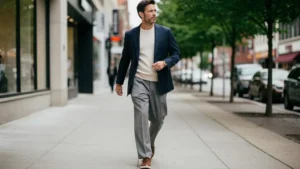
Contemporary menswear offers more freedom than a single fashionable silhouette might suggest. Relaxed trousers, softer tailoring, practical outerwear and expressive accessories can all feel current, but not every direction deserves a permanent place in an everyday wardrobe.
The most worthwhile trends are those that solve a real dressing problem. A slightly roomier trouser might improve comfort during a commute. An unstructured jacket can bridge casual and professional settings. A better-fitting overshirt might make existing clothes easier to combine. None requires replacing an entire wardrobe.
Fashion in 2026 also resists a simple oversized-versus-slim narrative. Different proportions coexist, and runway experimentation does not always translate into ordinary life. The useful question is therefore not which trend dominates, but which change improves the clothes a man already owns.
Judging trends through fit, versatility, personal preference and actual wearing occasions makes modern dressing more consistent. It also leaves room for experimentation without turning every new season into another shopping project.
Contemporary menswear trends worth keeping
- Prioritise relaxed-straight trousers, comfortable tailoring and versatile fabrics over extreme silhouettes.
- Introduce one trend-led element at a time and check that it works with at least three existing garments.
- Replace clothes when they genuinely need updating, and use alterations or new combinations before buying more.
- Why Are Modern Menswear Trends Becoming Softer, Looser, and More Practical?
- How Can You Add Current Menswear Trends Without Making Your Wardrobe Feel Disconnected?
- Lasting Shift or Passing Trend: Which Menswear Changes Deserve Your Attention?
- The Trend Mistake That Makes Modern Clothes Harder to Wear in Real Life
- When Should You Update Your Wardrobe to Reflect Current Menswear Trends?
- How Can You Borrow High-Fashion Ideas Without Looking Like You Are Wearing a Costume?
- Straight, Relaxed or Oversized: Which Fit Works Best for Your Everyday Wardrobe?
- How Can Men Build a Personal Style That Feels Consistent Without Looking Overdone?
Why Are Modern Menswear Trends Becoming Softer, Looser, and More Practical?
Modern menswear has become more accommodating because many men need clothes that move comfortably between casual, professional and social environments. Relaxed tailoring, softer fabrics and less restrictive trousers respond to those practical demands. However, this is not a universal movement toward oversized clothing: sharper, slimmer silhouettes are also reappearing alongside roomier alternatives.
Traditional dress codes often separated office clothing from weekend wardrobes. A structured suit belonged to work, while jeans and casual knitwear occupied other settings. In many contemporary workplaces, those boundaries have become less rigid, creating opportunities for garments that perform across different levels of formality.
Hybrid working provides part of this context. According to the Office for National Statistics research on hybrid working in Great Britain, 28% of working adults followed hybrid arrangements between January and March 2025. This describes working patterns, not fashion preferences, and does not establish that hybrid work caused looser clothing to become fashionable.
28%
Of working adults in Great Britain reported hybrid working between January and March 2025. The figure provides workplace context, not evidence of menswear purchasing behaviour.
Office for National Statistics, June 2025.
The resulting design opportunities are easy to recognise. Unlined blazers reduce stiffness. Cotton twill trousers allow more movement than restrictive cuts. Fine-gauge knitwear can replace a formal shirt in settings where the dress code permits it.
Yet relaxed does not mean shapeless. A soft blazer can retain a clear shoulder line. Roomier trousers can fall cleanly toward the shoe. Volume looks intentional when the garment maintains recognisable proportions rather than merely appearing several sizes too large.
There is also an important countertrend. Autumn/winter 2026 forecasting includes fitted tops and slimmer outerwear, demonstrating that contemporary menswear is not moving in only one direction. Comfort and visual definition can coexist.
Understanding this change helps separate genuinely useful developments from temporary styling extremes. The next consideration is whether a trend fits naturally into the wardrobe already in use.
How Can You Add Current Menswear Trends Without Making Your Wardrobe Feel Disconnected?
Integrate contemporary menswear trends by introducing one new proportion, fabric or styling detail at a time. Before buying, identify at least three existing garments that work with the new piece. Repeating familiar colours, footwear and outerwear creates continuity, allowing modern additions to complement personal style instead of making the wardrobe feel fragmented.
The most common integration problem is not necessarily buying the wrong garment. It is buying something that requires several additional purchases before it feels wearable.
Imagine a man who usually wears navy chinos, neutral knitwear, denim shirts and understated leather shoes. A pair of relaxed charcoal trousers could work with several of those pieces immediately. A brightly patterned, dramatically oversized suit might demand different footwear, outerwear and occasions.
Neither purchase is inherently wrong, but the second introduces more styling constraints.
The three-item compatibility test provides a practical filter:
- Colour: Does the new garment work with existing neutrals or recurring accent colours?
- Proportion: Can it balance the jackets, shirts and knitwear already owned?
- Formality: Does it belong in the same situations as the rest of the wardrobe?
- Footwear: Can the existing shoes support its silhouette without looking disproportionately light or heavy?
A second principle is to change one prominent element per outfit. Relaxed trousers can sit beneath a familiar fitted sweater. A contemporary boxy jacket can accompany conventional straight-leg jeans. Directional footwear can enliven otherwise understated separates.
This approach makes experimentation easier to evaluate. If a new outfit feels uncomfortable or visually unbalanced, there is only one unfamiliar variable to adjust.
Shared basics provide the underlying continuity. A consistent palette of navy, grey, olive, cream and brown, for example, can accommodate different textures and silhouettes without making every outfit identical. Those colours are an illustration, not a required menswear uniform.
A connected wardrobe makes trends easier to test. The more difficult decision is determining whether a fashionable change is likely to remain useful beyond its moment of visibility.
Lasting Shift or Passing Trend: Which Menswear Changes Deserve Your Attention?
Menswear changes deserve attention when they improve comfort, suit recurring occasions and remain useful with several existing outfits. Relaxed-straight trousers and adaptable casual tailoring are practical candidates, while extreme shapes, conspicuous logos and highly specific decorative details carry greater styling risk. Longevity is never guaranteed, so judge actual usefulness before apparent popularity.
Not every trend develops in the same way. Some reflect broader changes in dress codes or garment design. Others depend mainly on the visual impact of a particular season.
A useful distinction is between a gradual shift in everyday preferences and a novelty that gains attention because it looks unfamiliar.
| Criterion | Potentially lasting change | Higher-risk novelty |
|---|---|---|
| Everyday function | Improves comfort or adaptability | Primarily creates visual impact |
| Wardrobe compatibility | Works with familiar basics | Requires several coordinated purchases |
| Silhouette | Provides manageable proportions | Depends on extreme volume or shape |
| Occasions | Fits multiple regular settings | Works mainly for specific events |
| Adoption signal | Appears across seasons and everyday retail | Concentrated in short-lived imagery |
The distinction is especially relevant to trousers. In its September 2026 assessment, British GQ‘s autumn 2026 guide to trouser fits described relaxed-straight silhouettes as a practical middle ground between very slim and extremely baggy cuts. It also identified their availability across mainstream retailers. That is evidence of editorial and retail adoption, not proof of permanent popularity.
Other trend indicators require greater caution. Vogue Business‘s autumn/winter 2026 menswear trend predictions discussed slimmer tops, fitted outerwear, decorative accessories and experimental trouser shapes. Its reporting also cited a 243% year-on-year rise in men’s barrel-leg product arrivals during 2025, based on EDITED data. Product arrivals measure retail supply, not consumer purchases or long-term wardrobe use.
The cost of getting a trend wrong is asymmetric. A versatile purchase can deliver repeated use over several years. A novelty acquired near the end of its popularity may offer only a narrow period when the wearer actively enjoys styling it.
That does not mean experimental fashion is wasteful by definition. Someone with a distinctive personal style may wear an unconventional garment frequently. What matters is the relationship between the purchase and that person’s habits.
Before deciding, look for signs that a trend has survived multiple seasons, appeared beyond runway collections and become adaptable to ordinary clothing combinations. These signals improve judgement but cannot predict fashion with certainty.
Even a trend with lasting potential can fail in practice if its proportions are copied without considering how the complete outfit works.
The Trend Mistake That Makes Modern Clothes Harder to Wear in Real Life
The mistake is copying a fashionable silhouette without adapting the surrounding outfit. Oversized trousers, long jackets and loose layers may look intentional in editorial photography but become awkward when combined without attention to proportions. Everyday wearability depends on balancing garment lengths, fabric volume and footwear while respecting the settings in which the clothes will actually be worn.
Fashion images are constructed for particular visual effects. A runway look might use a dramatic coat, unusually wide trousers and substantial boots to create one continuous silhouette. The composition works in its original context because every element has been selected to reinforce the same idea.
Replicating that combination for an ordinary commute can create practical and visual difficulties. A long coat may overwhelm a shorter frame. Excess trouser fabric may catch beneath the shoes. Multiple oversized layers can obscure the body’s shape without producing useful movement.
The solution is not to reject volume. It is to control where that volume sits.
- With wide trousers, consider a jacket that ends near the hip or has enough definition to distinguish the upper body.
- With a boxy outer layer, use straight trousers or another leg shape that gives the outfit a clear lower boundary.
- With heavier footwear, check whether the trouser opening and hem length sit comfortably over the shoe.
- With several loose layers, vary their lengths so the garments do not form one undifferentiated shape.
These are starting points rather than rigid rules. Balanced oversized dressing can work from head to toe, but it requires deliberate control of fabric, length and silhouette.
A real-life stress test is more revealing than a fitting-room photograph. Wear a proposed outfit while sitting, walking, reaching and putting on outerwear. Consider whether it remains appropriate for the office, public transport, social occasions and the local climate.
A garment that looks excellent only when carefully arranged for a photograph may still be enjoyable for occasional use. It simply should not be mistaken for a versatile everyday staple.
Once fit and context are considered together, the next step becomes easier: update individual garments when the wardrobe actually needs them, rather than following the fashion calendar automatically.
When Should You Update Your Wardrobe to Reflect Current Menswear Trends?
Update a wardrobe when existing garments are worn, uncomfortable, no longer fit properly or fail to meet regular lifestyle needs. A new season alone is not a reason to replace functional clothing. Keeping useful staples, restyling compatible pieces and replacing genuine gaps allows contemporary trends to enter gradually without creating unnecessary purchases.
The most effective starting point is an inventory, not a shopping list. Clothes often appear outdated because familiar combinations have become repetitive, even when the individual garments still fit and remain in good condition.
A change of footwear, a different trouser hem or a new layering combination may be enough to make them feel relevant again.
Divide the current wardrobe into three groups:
- Keep: Clothes that fit, suit daily activities and combine easily with other pieces.
- Restyle: Garments that remain functional but could benefit from different proportions, pairings or simple alterations.
- Replace: Items that have deteriorated, cannot be altered satisfactorily or no longer fulfil a useful role.
This process also helps avoid mistaking a changing trend for a defect in an otherwise good garment. A slim pair of trousers may still be useful with a particular jacket, even if relaxed-straight cuts currently appear more prominent.
Repair and alteration deserve consideration before replacement. In Zhang and Hale’s research on clothing repair and longer garment use, a survey of 300 UK adults examined barriers and enablers associated with repairing and repurposing clothing. The researchers identified limited skills, garment design and repair costs among the barriers. The study addresses general clothing behaviour rather than menswear trends, but it provides a relevant basis for considering alterations as one route to longer garment use.
For example, shortening trousers that otherwise fit properly may make them easier to wear with contemporary footwear. A jacket with an unsuitable silhouette, however, may require alterations too extensive to justify.
A five-step wardrobe update checklist
- Audit ten frequently worn garments. Record which still fit comfortably and identify any recurring problems in a short inventory.
- Sort each garment into keep, restyle or replace. Produce three clearly labelled groups before considering purchases.
- Create three outfits using existing clothes. Photograph each combination and note which proportions already work.
- Identify one genuinely missing function. Write a precise requirement, such as comfortable trousers suitable for both commuting and casual office wear.
- Test one potential replacement. Confirm three compatible existing items and record whether the new garment solves the identified problem.
Staggering changes also creates useful feedback. After introducing one garment, regular wear reveals whether its fabric, fit and versatility meet expectations before other purchases follow.
Once everyday requirements are covered, there is room to experiment with more expressive fashion ideas without allowing them to dictate the entire wardrobe.
How Can You Borrow High-Fashion Ideas Without Looking Like You Are Wearing a Costume?
Borrow one recognisable idea from a high-fashion look rather than reproducing the entire outfit. A distinctive proportion, interesting fabric or unusual combination can be translated into ordinary garments. Keep the remaining pieces familiar and adjust the boldness to the occasion, allowing runway inspiration to become personal expression rather than an attempted imitation of editorial styling.
Runway clothing communicates design ideas through exaggerated shapes, unconventional combinations and concentrated visual detail. Those methods help make collections distinctive, but their complete styling is not always intended as a ready-made template for everyday life.
The useful skill is translation.
Consider a hypothetical runway outfit consisting of dramatically wide pleated trousers, an oversized double-breasted jacket, a decorative brooch and heavy boots. Copying every element creates a highly directional appearance.
Instead, extract one principle. The wide trousers might suggest trying a relaxed pleated cut with a plain knit. The decorative detail could become a modest pin on a familiar blazer. The heavy footwear might inspire choosing a slightly more substantial everyday shoe.
Each interpretation captures part of the original design idea without demanding the same level of visual intensity.
One statement piece is easier to control than a complete statement outfit. A sculptural jacket can work with simple jeans. An unusually textured knit can accompany familiar chinos. A strong accessory can add interest to restrained tailoring.
The appropriate degree of experimentation depends on context. Creative workplaces, informal social occasions and fashion-focused events may accommodate more assertive combinations than conservative professional settings.
Confidence also matters, although it cannot compensate for practical problems. A man comfortable in unusual proportions may wear them naturally; someone constantly adjusting an unfamiliar garment might find a quieter interpretation more useful.
High fashion is valuable as a source of possibilities, not a set of compulsory instructions. Its ideas become more wearable when they are adapted to existing preferences and repeated in situations where they make sense.
Proportion is especially important in that translation, making the choice between straight, relaxed and oversized fits a useful next decision.
Straight, Relaxed or Oversized: Which Fit Works Best for Your Everyday Wardrobe?
Straight fits are a versatile starting point for most everyday wardrobes, while relaxed fits provide additional room without necessarily changing the overall silhouette dramatically. Oversized fits are best treated as deliberate styling choices rather than automatic size upgrades. The right option depends on comfort, body proportions, dress codes and the clothes already available for pairing.
Fit labels are inconsistent across brands. One company’s straight trouser may resemble another’s relaxed cut. Similarly, an oversized jacket is not simply a conventional jacket purchased several sizes larger.
The important distinction is how the garment is designed and where the extra fabric sits.
| Fit | Typical characteristics | Everyday use |
|---|---|---|
| Straight | Consistent leg width, moderate room and a clean outline | An adaptable default for smart-casual and casual outfits |
| Relaxed | More space through the seat, thighs or torso with controlled drape | Comfortable daily dressing and contemporary tailoring |
| Oversized | Deliberately amplified width, dropped shoulders or extended dimensions | Expressive combinations where volume is a central styling feature |
Body shape can influence which cuts feel comfortable, but it should not impose a universal rule. Men with broader thighs may appreciate extra room through the upper leg. Those who prefer a defined silhouette may favour straight trousers with enough space to sit and move comfortably.
Evaluate the actual garment rather than relying solely on its label.
- Shoulders: Conventional jackets generally benefit from a shoulder line that follows the body; dropped shoulders should look intentional in oversized designs.
- Chest: Shirts and jackets should allow natural movement without pulling across the buttons or producing excessive loose fabric.
- Sleeves: Check where the cuffs finish when the arms hang naturally, then repeat the test while reaching forward.
- Trouser break: Observe how the hem meets the shoe. A slight break can be controlled, while repeated bunching may indicate excess length.
- Seat and thighs: Test sitting and walking to confirm that the garment provides sufficient room without uncomfortable tension.
A fitting room provides the clearest way to compare cuts, especially when trouser width and hem length interact.
Clothing combinations matter as much as individual measurements. Wide trousers often work with a comparatively compact top, while a substantial jacket may benefit from enough trouser width to prevent the lower half from looking visually narrow.
However, contrasting volumes are not the only successful approach. A relaxed jacket and relaxed trousers can look coherent when their lengths, fabric weight and overall lines are carefully managed.
The most dependable fit is one that remains comfortable during movement and looks balanced with the rest of the wardrobe. Fashionable terminology should help identify possibilities, not dictate the final choice.
A reliable fit provides the foundation for contemporary dressing. Personal style then determines which of those proportions should appear repeatedly and which can remain occasional experiments.
Key takeaways before defining your personal style
- Choose recurring fit and colour preferences before deciding which new trends to adopt.
- Use familiar combinations to create consistency without making every outfit identical.
- Allow occasional experimentation, but distinguish what feels genuinely personal from what merely looks fashionable in isolation.
How Can Men Build a Personal Style That Feels Consistent Without Looking Overdone?
Build a consistent personal style by identifying a small set of preferred fits, colours, fabrics and levels of formality, then using them to evaluate new clothes. Repeat these elements across different outfits without copying the same combination every day. Limit prominent styling statements so personal expression remains deliberate rather than overloaded.
Personal style is more useful as a decision-making system than as a collection of inspirational photographs. A wardrobe becomes coherent when its garments reflect recurring preferences that suit the wearer’s life.
Those preferences do not need to be unusual. Someone may discover that straight or relaxed trousers, muted colours, textured knitwear and clean casual shoes consistently feel comfortable and appropriate.
Another man may prefer sharper jackets, narrow trousers, polished shoes and occasional expressive accessories. Both approaches can produce recognisable personal style.
The difference lies in repeating decisions that work rather than constantly following whatever appears new.
A simple style filter can contain four components:
- Fit: The silhouettes that feel comfortable and look deliberate on the body.
- Palette: A manageable range of colours that combine easily, with room for occasional accents.
- Texture: Fabrics that suit the climate, typical activities and preferred visual character.
- Formality: The degree of polish required across the person’s actual weekly routine.
Consistency does not require uniformity. Repeated elements act as a foundation from which individual outfits can vary. A familiar navy jacket might be worn with relaxed wool trousers one day and straight denim another. The outerwear remains a recognisable preference while the supporting garments change.
The main danger is turning every styling choice into a statement. Dramatic trousers, a strongly patterned shirt, unusual footwear and several decorative accessories may compete for attention when worn together.
One intentional focal point per outfit is a useful starting rule. Let the other garments provide context, then adjust the amount of detail to personal taste and the occasion. More elaborate combinations can still work, but they demand greater coordination.
A coherent wardrobe is also easier to maintain because each new purchase can be judged against clear preferences. Trends that improve familiar outfits deserve consideration. Those that conflict with everyday needs can be appreciated without being adopted.
Start with one outfit already worn regularly. Identify what works, then make one considered adjustment: a better trouser fit, a softer jacket or a more versatile layer. Wear the revised combination in ordinary settings before deciding whether that change deserves a permanent place in the wardrobe.
Can men still wear slim-fit clothing in 2026?
Yes. Slim-fit clothing remains an option, and autumn/winter 2026 trend forecasting includes slimmer tops and outerwear. The important distinction is between a garment that follows the body’s shape comfortably and one that restricts movement or creates unwanted pulling. A well-fitting slim piece does not need replacing merely because relaxed silhouettes are prominent elsewhere.
Do contemporary menswear trends require expensive designer clothing?
No. Many current styling ideas involve proportions, layering and garment combinations rather than exclusive fabrics or labels. Straight trousers, a softly structured jacket and simple knitwear can communicate a contemporary appearance without designer purchases. Fit, construction and compatibility with existing clothes are more useful considerations than price alone.
How can a man experiment with fashion without buying anything new?
Start by combining garments that are normally worn separately. Try a casual knit beneath a tailored jacket, change the balance between trouser and outerwear volume, or wear familiar shoes with a different level of formality. Minor alterations, where practical, can also refresh proportions without requiring a replacement purchase.
What makes a menswear purchase versatile enough for everyday wear?
A versatile garment fits comfortably, suits several regular occasions and combines with clothes already owned. Testing it with at least three existing pieces is a useful personal shopping rule, not a scientifically established threshold. Consider how it behaves while walking, sitting, layering and adapting to changing temperatures before treating it as an everyday staple.
Should a man follow seasonal colour trends or stick to neutrals?
Neutral colours can make combinations easier, but they are not compulsory. Seasonal colours are worthwhile when they complement the palette a man already enjoys wearing. A distinctive shade may work best as one garment or accessory initially. The goal is to assess whether the colour will continue to feel appealing after its immediate fashion exposure fades.