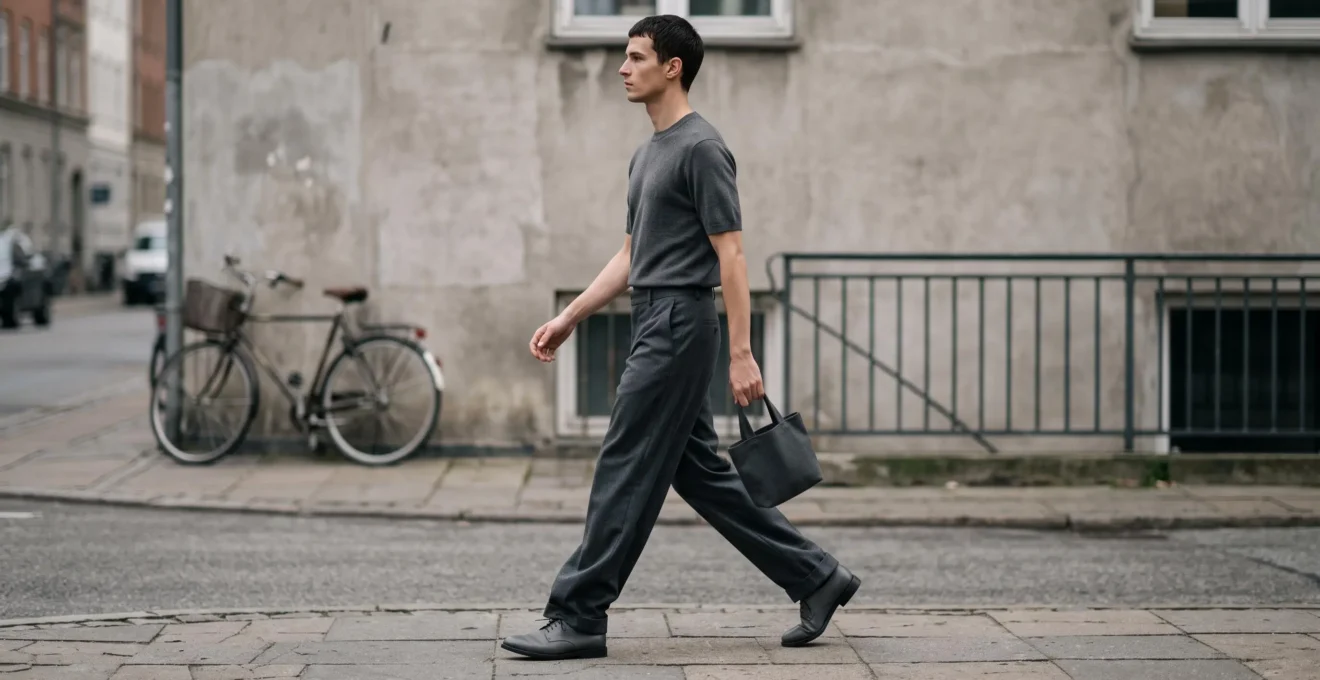
A neutral outfit can be visually striking without a single bright colour. The difference often lies in how its pieces interact: a shorter jacket above fuller trousers, a structured shoulder against soft knitwear, or a clean trouser line interrupted by substantial footwear. These choices give the silhouette rhythm, even when everything is black, grey, beige or navy.
Creating that effect requires more than choosing fashionable cuts. Volume, structure, length and movement must work together, rather than compete for attention. A well-proportioned outfit can look deliberate without appearing excessively styled, while several individually appealing garments may create an awkward shape when combined.
The most useful starting point is to observe the outfit as one composition. Where does the eye settle? Which garment establishes the dominant shape? Does the fabric fall cleanly when walking? Answering those questions makes understated dressing more adaptable, whether the wardrobe leans towards traditional tailoring, contemporary casualwear or a combination of both.
Dynamic neutral outfits: the essentials
- Create a clear relationship between upper-body and lower-body volume instead of relying on colour contrast.
- Choose garment lengths, cuts and fabrics according to how they interact on your body, not simply their size labels.
- Reassess the silhouette when changing footwear or outerwear, because both can significantly alter the overall composition.
- How Can Men Build a Personal Style That Feels Consistent Without Looking Overdone?
- Slim, Tailored or Relaxed: Which Cut Works Best for Your Build?
- Why Do Contrasting Proportions Make Neutral Outfits Look More Interesting?
- How Can You Balance a Relaxed Top With Structured Trousers Without Looking Mismatched?
- Wide Trousers or Oversized Outerwear: Where Should You Add Volume First?
- How Can You Wear an Oversized Jacket Without Making the Rest of the Outfit Look Heavy?
- The Proportion Mistake That Can Flatten an Otherwise Dynamic Outfit
- When Should You Rebalance an Outfit After Changing Shoes or Outerwear?
How Can Men Build a Personal Style That Feels Consistent Without Looking Overdone?
A consistent personal style comes from repeating a few recognisable decisions about silhouette rather than wearing similar outfits every day. Establish a preferred level of volume, a characteristic garment length and a degree of structure. Keep those elements broadly consistent while varying individual pieces, and allow one proportion choice to dominate each outfit.
Neutral clothing makes this approach particularly useful. Without strong colour contrasts, the relationship between garments becomes more noticeable. A cropped jacket, straight trousers and substantial shoes may establish a distinctive personal outline, even when their colours change only slightly from one outfit to another.
Begin by defining three recurring characteristics:
- Usual volume: decide whether your natural preference is streamlined, moderately relaxed or deliberately generous.
- Signature length: identify the jacket, shirt or trouser length that repeatedly gives your outfits the shape you prefer.
- Degree of structure: establish whether your style relies mainly on crisp tailoring, softer draping fabrics or a controlled mixture.
These decisions create two related forms of consistency. Visual consistency means the pieces within one outfit work together. Identity consistency means different outfits retain recognisable characteristics over time. Someone can dress harmoniously every day yet have no recurring silhouette that makes their style distinctive.
For example, a man who regularly wears fuller trousers, relatively compact tops and softly structured jackets can exchange a knitted polo for a T-shirt or a blazer for a short coat without losing his overall direction.
The opposite problem appears when too many styling gestures compete. An oversized coat, dramatically wide trousers, aggressively cropped knitwear and statement footwear can all be interesting individually, but combining them may make the outfit look more constructed than intended.
One strong proportion decision per outfit is a useful starting discipline. Additional contrasts can be introduced once the dominant shape is clear.
Consistency should remain flexible, however. A signature silhouette is a set of useful preferences, not a uniform that prevents experimentation with different cuts or occasions.
Slim, Tailored or Relaxed: Which Cut Works Best for Your Build?
The most suitable cut is the one that creates your intended silhouette while allowing the garment to hang and move comfortably. Rather than choosing slim, tailored or relaxed clothing according to a fixed body-type category, assess your shoulder-to-waist relationship, leg-to-torso proportions and natural posture. Then evaluate how each garment behaves on your body.
Fit labels provide a starting point, but they do not describe every important dimension. Two pairs of trousers labelled relaxed may have different rises, thigh widths, knee shapes and leg openings.
This distinction is central to Permanent Style‘s analysis of trouser measurements and proportions, which examines how several measurements interact with the wearer’s physical proportions. Its garment examples demonstrate why no single leg-opening measurement can define an ideal fit for everyone.
Start with three personal observations:
- Shoulders relative to waist: consider whether a jacket should emphasise your shoulder line, follow its natural shape or soften a pronounced difference in width.
- Legs relative to torso: examine whether trouser rise and jacket length create the vertical balance you want.
- Posture: check whether fabric pulls, collapses or twists when you stand naturally rather than holding an artificial fitting-room pose.
Next, judge the actual garment rather than its label.
| Cut | What to check | Potential styling issue |
|---|---|---|
| Slim | Comfort through the chest and thighs, smooth fabric lines and sufficient freedom of movement | Excessive tightness can create pulling and restrict movement |
| Tailored | Shoulder alignment, controlled waist shaping and a clean trouser line | Over-structuring can make a casual outfit feel unnecessarily formal |
| Relaxed | Intentional ease, balanced garment length and fabric that drapes rather than bunches | Uncontrolled excess fabric can obscure the intended outline |
A slim cut is not automatically the safest option for an understated outfit. It can provide a precise line, but it may also leave little opportunity for volume contrast. Relaxed clothing offers more visual movement, although its success depends on where the additional fabric sits.
Unusually tall, slender builds may benefit from deliberate horizontal emphasis when the goal is to avoid an excessively elongated impression. Shorter, broader builds may instead favour controlled jacket lengths and an uninterrupted trouser line. Neither approach should be treated as compulsory.
Traditional tailoring advice about perceived height and breadth is explored in Permanent Style’s discussion of tailoring for different heights. The recommendations concern particular visual effects in tailored clothing, not universal restrictions on what different bodies can wear.
Once a garment passes the tests of comfort, drape and intended shape, the next consideration is how its volume interacts with the rest of the outfit.
Why Do Contrasting Proportions Make Neutral Outfits Look More Interesting?
Contrasting proportions make neutral outfits visually engaging by creating differences in shape, width and length. A relatively compact top above wider trousers produces one clear silhouette, while a generous jacket over narrower trousers produces another. These relationships introduce visual variety without requiring bright colours, bold prints or conspicuous accessories.
Colour contrast is only one way to distinguish garments. In an understated palette, differences in cut and fabric can perform a similar compositional role. A structured wool jacket against a softer knitted layer creates a visible contrast in shape, even if both are charcoal grey.
One useful styling concept is the upper-to-lower volume relationship. This is not a scientific measurement or a fixed numerical ratio. It is a practical comparison between the space occupied by the upper garments and the outline created by the trousers.
Consider two hypothetical outfits using the same grey knitted polo and stone-coloured wide-leg trousers.
In the first version, the polo hangs loosely below the hips, the sleeves remain long and the trousers pool at the shoes. The silhouette appears continuous and relaxed, with few interruptions.
In the second, the polo is tucked into the waistband, its sleeves are adjusted slightly and the trouser hem is shortened to produce a cleaner break. The garments are unchanged, but the visible waist, altered sleeve line and clearer trouser outline create a different composition.
Neither version is automatically better. The second simply offers more pronounced separation between its visual elements.
Clear contrast is often easier to control than accidental near-matching. A moderately loose sweatshirt above moderately loose trousers may work beautifully when fabric, length and footwear are coordinated. Without that coordination, the outfit can appear shapeless rather than intentionally relaxed.
Movement adds another dimension. Fluid wool or cotton trousers respond differently to walking than structured denim. A firm jacket can frame that movement, allowing the lower half to create variation while the upper half retains its outline.
The aim is not maximum contrast in every outfit. It is enough differentiation to make the intended shape legible, especially where the upper and lower garments meet.
How Can You Balance a Relaxed Top With Structured Trousers Without Looking Mismatched?
Balance a relaxed top with structured trousers by creating a visual connection between their different levels of formality. Use compatible fabric textures, related neutral tones or an intermediate garment to connect the pieces. Pay particular attention to the waist, where the top’s length and the trouser’s structure determine whether the combination feels coherent.
A relaxed sweatshirt and sharply pressed wool trousers are not inherently incompatible. The challenge is managing the transition between them. When the sweatshirt hangs far below the waistband and the trousers have a distinctly formal appearance, the junction can make the outfit feel divided into unrelated halves.
A slightly shorter sweatshirt, a partial tuck where practical, or a lightweight overshirt can make that relationship more deliberate.
Think of each item along a flexible spectrum from structured and formal to soft and casual. A fine-gauge knitted polo generally sits closer to tailored trousers than a heavily distressed hoodie. Nevertheless, the hoodie may still work if the outfit includes another element that connects their shapes or visual weight.
Three practical anchors help:
- Material relationship: choose textures that complement rather than unexpectedly contradict each other, unless the contrast is intentional.
- Tonal relationship: repeat related greys, browns or off-whites to help visually connect different garment categories.
- Transition at the waist: use top length, a visible waistband, a belt or an additional layer to make the change in structure feel considered.
Footwear can reinforce the connection. Clean leather loafers may relate naturally to tailored trousers while still complementing a relaxed knitted top. Minimal trainers can bring the outfit towards a more casual interpretation without changing the trousers.
When the combination remains unconvincing, identify the source of the mismatch. If it is fabric, change one material or finish. If it is proportion, modify the top length or trouser width. If it is context, consider whether the outfit suits the occasion rather than forcing the pieces to work together.
Once that transition is under control, additional volume can become a deliberate styling choice rather than an accidental consequence of oversized clothing.
Wide Trousers or Oversized Outerwear: Where Should You Add Volume First?
Add volume first where you want the silhouette to gain the most emphasis. Wide trousers are often a practical starting point because they can work with existing fitted or moderately relaxed tops. Oversized outerwear places more emphasis on the upper body and requires closer attention to the garments beneath it. The best choice depends on your current wardrobe.
Starting with wide trousers changes the foundation of an outfit. The expanded leg outline establishes a new relationship with the shirt, knitwear or jacket above it. Even familiar tops can appear different when paired with a fuller trouser.
Oversized outerwear works differently. A generous coat or jacket establishes a prominent upper silhouette, but its effect also depends on shoulder construction, fabric stiffness, length and whether it is worn open or closed.
The two options can be compared according to their styling demands.
| Consideration | Wide trousers | Oversized outerwear |
|---|---|---|
| Main visual emphasis | Lower-body width and movement | Shoulder line, upper-body shape and layering |
| Easy starting combination | Compact knitwear or a moderately fitted shirt | Defined inner layers and controlled trouser volume |
| Main adjustment | Rise, length, break and footwear | Jacket length, inner layers and visible lower-body proportions |
| Wardrobe consideration | Compatibility with existing tops and shoes | Compatibility with existing trousers and layers |
A useful contemporary reference is Esquire‘s guide to styling wide-leg trousers. Its examples include both fitted tops and generously cut upper garments, demonstrating that wide trousers do not require a narrow top.
That distinction matters because combining volume above and below is not inherently a mistake. A boxy jacket over wide trousers can create an intentionally expansive silhouette. It simply requires more attention to fabric behaviour, garment lengths and the overall outline.
For someone experimenting with volume for the first time, concentrating it in one area may be easier to manage. Once that proportion feels familiar, adding further fullness becomes a more informed decision.
If your wardrobe consists primarily of structured tops, wider trousers may offer greater variety. If you already own relaxed trousers, a more generous jacket may introduce the missing contrast without requiring a complete wardrobe change.
How Can You Wear an Oversized Jacket Without Making the Rest of the Outfit Look Heavy?
Wear an oversized jacket successfully by preserving some definition beneath or around its generous shape. A visible inner layer, a controlled trouser line or a deliberate difference in fabric weight can prevent the outfit from becoming visually uniform. The goal is not necessarily to wear tight trousers, but to create a readable relationship between upper and lower volume.
An oversized jacket broadens the upper-body outline, especially when it has dropped shoulders, substantial fabric or a boxy construction. Pairing it with equally voluminous trousers can produce a deliberately expansive silhouette, but it may also reduce the distinction between the two halves.
One possible solution is a gradual reduction of volume towards the shoes. This might mean combining a generous coat with straight trousers rather than very wide ones, or choosing a lighter trouser fabric that falls more fluidly.
Another approach is to make the upper body look less dense without reducing the jacket’s width. A structured collar creates a more defined neckline. A slightly shorter jacket exposes more trouser length. Adjusted sleeves can reveal the wrist and introduce another break in the outline.
How the jacket is worn also changes the composition.
- Worn closed: the jacket’s outer shape and hemline dominate, making length and overall volume particularly important.
- Worn open: the inner shirt or knitwear becomes a second visible silhouette, creating an opportunity for narrower lines within the wider outer layer.
For example, an oversized dark-grey overcoat worn open over a slimmer off-white knit can create a clear central vertical line. Straight charcoal trousers continue that relatively narrow inner shape while the coat provides the surrounding volume.
The coat’s length deserves equal attention. A hem that obscures much of the visible trouser line may make the lower body seem shorter, depending on the wearer’s proportions and the intended styling effect. A different coat length, trouser rise or opening at the front may change that impression.
These are compositional choices rather than restrictions based on height or body type. A long oversized coat with wide trousers can be an excellent deliberate look when the fabrics and proportions work together.
Once the outer layer has a clear relationship with the trousers, small changes to hem positions can refine the effect without replacing either garment.
The Proportion Mistake That Can Flatten an Otherwise Dynamic Outfit
One common proportion mistake is allowing garment lengths to divide the silhouette into visually similar, poorly differentiated sections. A jacket ending at an awkward point, an obscured waist and trousers with an unresolved hem can weaken an otherwise interesting combination. Correcting one boundary between garments may restore definition without changing the entire outfit.
The issue is not that equal-looking sections are inherently unattractive. Symmetry can be deliberate and effective. Problems arise when several garment lengths interact without producing the intended rhythm, hierarchy or continuous line.
Imagine a hypothetical outfit with a boxy jacket, loose shirt and straight trousers. Each piece looks attractive individually, yet the jacket and shirt finish close together around the hips, while the trousers create heavy folds above the shoes. The outfit has volume but little visible organisation.
This problem is easily missed when garments are assessed separately. A jacket may look perfectly proportioned in a fitting-room mirror, only to conceal the most flattering part of the trouser silhouette when worn with a particular shirt.
To diagnose the result, photograph the complete outfit from the front and side. Look for a clear focal point, a deliberate shift in width or a continuous line that guides attention through the silhouette.
Then try corrections in a practical order:
- Tuck or shorten the upper layer to reveal more of the trouser rise.
- Adjust the trouser hem if excess fabric creates unwanted folds.
- Introduce a visible intermediate layer when the jacket and trousers feel disconnected.
- Test footwear with a different profile to change the lower silhouette.
Each adjustment addresses a different mechanism. Tucking changes the perceived position of the waist. Hem alterations affect the leg outline. Layering introduces another boundary. Footwear changes the shape and weight of the silhouette’s base.
Five checks for a better-proportioned outfit
- Photograph the complete outfit from the front and side; keep two reference images.
- Identify the dominant area of volume; write down whether it is upper, lower or deliberately balanced.
- Check where the jacket, shirt and trouser lines begin and end; mark the main visual break on a photo.
- Change one variable, such as a tuck or trouser hem; capture a comparison image.
- Choose the version that best matches your intended silhouette; save it as a repeatable outfit reference.
The final test should always involve the complete outfit, including the shoes and outerwear that will actually be worn outside.
Key takeaways before your final outfit check
- A proportion that works with one pair of shoes may look different when the footwear profile changes.
- Outerwear alters the visible silhouette, especially when it covers the waist or adds width around the shoulders.
- Saving a few tested combinations reduces the need to reconsider every detail each time you get dressed.
When Should You Rebalance an Outfit After Changing Shoes or Outerwear?
Rebalance an outfit whenever a change in shoes or outerwear noticeably alters its volume, garment lengths or visual weight. After changing shoes, inspect the trouser hem and the relationship between footwear and leg width. After adding a jacket or coat, reassess upper-body volume and the amount of trouser length that remains visible.
Footwear is particularly influential because it defines the final shape of the trouser line. A slim leather boot, minimal trainer and chunky sneaker interact differently with the same hem, especially when the trousers are relaxed or wide.
A narrow shoe may remain partly concealed beneath a full trouser opening. A substantial sneaker can occupy more of that space, changing the folds at the hem and giving the lower silhouette a heavier visual anchor.
Traditional tailoring treats this relationship as an important fit consideration. Permanent Style’s explanation of trouser breaks and length describes how hem length affects fabric folds and footwear visibility. Its conventional recommendations are useful reference points, although deliberately cropped or stacked contemporary trousers can follow different styling intentions.
Use a quick two-part check whenever the outfit changes:
- After changing shoes: examine the break, the amount of fabric gathering above the shoe and the perceived continuity of the leg.
- After adding outerwear: assess the upper-to-lower volume relationship, where the coat finishes and whether an inner layer provides enough definition.
Not every change requires an adjustment. A new shoe with a similar shape and sole height may preserve the existing proportions. A substantially different shoe is more likely to justify another look in the mirror.
The most convenient approach is to prepare a small number of outfit variations rather than continually improvising.
Practical example: three ways to finish one neutral outfit
Consider a hypothetical base outfit consisting of a tucked stone-coloured knit and relaxed charcoal trousers. For the first variation, add slim black leather boots and check whether the trouser hem falls cleanly. For the second, replace the boots with chunky off-white trainers and assess whether the extra footwear volume creates excessive bunching. For the third, return to the preferred shoes and introduce a long grey overcoat, checking the visible trouser length and upper-body volume.
Photograph each completed combination. The resulting reference images provide a practical record of which proportions achieve the intended look, without assuming that any one variation will suit every wearer.
These comparisons also help distinguish a real proportion problem from a simple change in aesthetic direction. An outfit can become heavier, more relaxed or more dramatic after a footwear change without becoming less successful. What matters is whether the new result matches the intended effect.
Choose one neutral outfit you already enjoy wearing, test it with two different pairs of shoes and one alternative outer layer, then keep photographs of the combinations that work best. A small collection of successful variations is a practical foundation for more dynamic everyday dressing.
Can an all-black outfit look dynamic without accessories?
Yes. An all-black outfit can gain visual interest through contrasting garment widths, different fabric finishes and carefully chosen lengths. A compact knitted top with flowing black trousers creates a different silhouette from an oversized jacket worn over straight trousers. Accessories are optional when the clothing itself provides enough variation in shape and texture.
Do neutral clothes need different textures to avoid looking flat?
Different textures can help, but they are not essential. Smooth cotton, brushed wool, denim and fine knitwear reflect light and drape differently, creating subtle visual distinctions. A successful neutral outfit can also use similar textures throughout if the garment shapes and lengths provide sufficient definition.
Should shorter men avoid wide-leg trousers and oversized jackets?
No. Neither style is automatically unsuitable for shorter men. Trouser rise, jacket length, fabric weight and the intended silhouette matter more than a blanket restriction based on height. Someone seeking a longer-looking leg line may prefer a higher trouser rise or a shorter jacket, while someone aiming for a deliberately expansive silhouette may choose different proportions.
Are matching oversized tops and trousers always too bulky?
No. Coordinated generous cuts can create a successful relaxed silhouette, particularly when the fabrics drape well and the garment lengths are deliberate. The main consideration is whether the overall shape looks intentional. A visible neckline, defined waistband or carefully selected footwear can introduce structure without reducing the clothing’s volume.
What is the easiest way to experiment with proportions without buying new clothes?
Start by changing how existing garments are worn. Tuck or untuck a top, adjust sleeves, wear a jacket open instead of closed, or swap between shoes with different profiles. Compare full-length photographs rather than judging each garment separately. These adjustments reveal which silhouette changes are worth exploring before purchasing anything new.