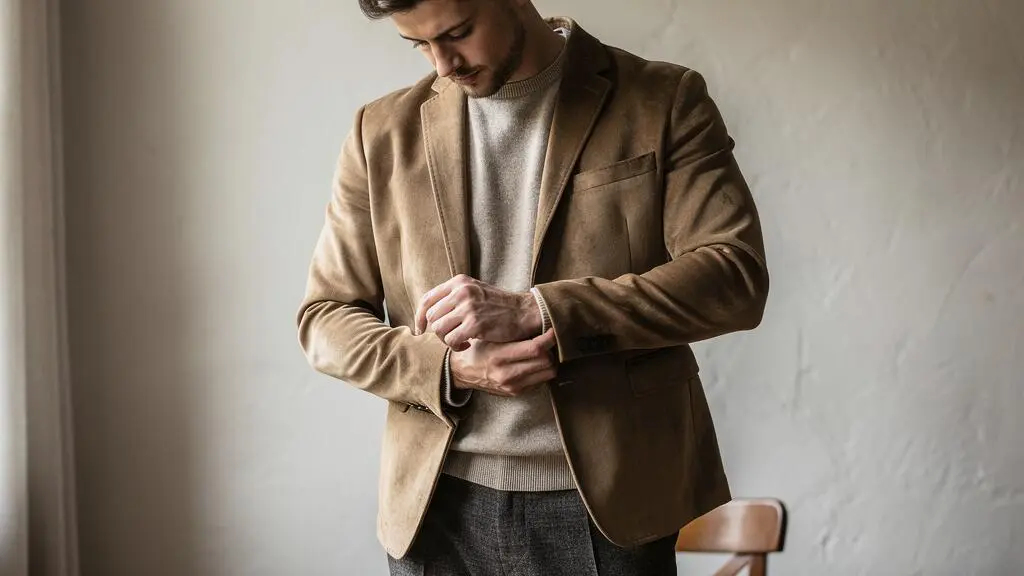
A wardrobe built around navy, charcoal, beige and cream can look quietly sophisticated without a single bright colour or conspicuous pattern. The difference often comes down to the fabrics. A smooth cotton shirt beneath a softly brushed jacket creates a different impression from two equally smooth garments, even when their colours are almost identical.
Texture introduces contrast through the way fabric surfaces interact with light. Linen has an irregular, relaxed appearance; merino knitwear can appear fine and understated; suede introduces a soft, directional nap. These differences give the eye something to notice without disrupting a restrained palette.
The key is to use texture deliberately rather than accumulate as many interesting fabrics as possible. Surface scale, garment placement, formality and practical wearability all matter. A well-balanced combination should still look coherent from across a room and feel comfortable throughout the day.
For men who prefer simple clothing, learning to combine fabrics is therefore a useful alternative to buying more colours, patterns or statement pieces.
Texture essentials for understated menswear
- Combine noticeably different surfaces, such as smooth merino and brushed wool, to create depth within a neutral palette.
- Give one texture the leading role and use quieter fabrics to support it rather than making every garment equally prominent.
- Choose textures for the weather, dress code and frequency of wear—not visual appeal alone.
- Why Do Textured Fabrics Make Plain Outfits Look More Refined?
- How Can You Mix Three Different Textures in One Outfit Without Overdoing It?
- Linen, Brushed Wool or Suede: Which Texture Works Best for the Occasion?
- The Texture Mistake That Can Make an Otherwise Simple Outfit Look Too Busy
- When Should You Add More Texture to a Neutral Wardrobe?
- How Can You Match Functional Fabrics to Work, Travel, and Everyday Weather?
- One £150 Jacket or Three £50 Jackets: Which Gives Better Long-Term Value?
- How Can Men Layer Clothes Without Adding Unnecessary Bulk?
Why Do Textured Fabrics Make Plain Outfits Look More Refined?
Textured fabrics can make plain menswear look more refined because their surfaces create visual depth without requiring bold colours or patterns. Smooth, matte, brushed and slightly lustrous materials reflect and scatter light differently. When these surfaces are combined thoughtfully, even a simple outfit can appear more deliberately composed rather than visually uniform.
Imagine charcoal trousers, a grey crew-neck jumper and a dark overcoat. If every fabric has a similar smooth finish, the outfit relies almost entirely on fit, colour and silhouette for its appearance. Replace the trousers with flannel or the coat with a visibly textured wool, and the relationship between the garments becomes more interesting.
The colour palette has not necessarily changed. Instead, **surface contrast creates definition** between garments that might otherwise merge visually.
Fabric texture comes from several sources, including fibre characteristics, yarn construction, weaving or knitting techniques and finishing treatments. Utah State University’s explanation of clothing texture and design describes how characteristics such as smoothness, roughness, shine and bulk influence a garment’s appearance and contribute visual interest.
That design principle does not mean textured clothing is automatically more elegant. An intentionally smooth outfit can be extremely polished, particularly in formal settings. Texture is simply another design tool, especially useful when colour and pattern are deliberately restrained.
It also changes how individual garments relate to one another. A plain merino jumper beside textured wool trousers gives each piece a distinct visual role. By comparison, two similarly finished fabrics may appear less differentiated, even when both are well made.
Perceived refinement remains subjective. Fit, condition, proportions and appropriateness still determine much of the overall impression. Texture works best when it reinforces these qualities rather than attempting to compensate for poor garment fit.
Once that distinction is clear, the next challenge is deciding how many contrasting surfaces an outfit can comfortably accommodate.
How Can You Mix Three Different Textures in One Outfit Without Overdoing It?
To combine three textures successfully, give them different visual roles: one dominant surface, one supporting surface and one small accent. The dominant texture establishes the outfit’s character, while the others provide contrast without competing for attention. Prioritise noticeable differences between smooth and rough finishes rather than choosing three equally prominent fabrics.
Consider a practical combination of charcoal flannel trousers, an oatmeal merino jumper and a lightly ribbed scarf. The trousers provide a soft matte foundation, the jumper introduces a relatively smooth surface and the scarf supplies a smaller, more defined texture.
The hierarchy can also be reversed. A strongly textured wool overcoat may become the dominant element, supported by smooth trousers and a restrained cotton or merino layer.
The important consideration is not that every outfit must contain precisely three textures. Three is a useful exercise in visual organisation, not a fixed menswear rule.
Contrast direction matters more than texture count. A rough wool jacket over a smooth knit creates a clearer distinction than three fabrics with similarly coarse, irregular surfaces.
A useful styling exercise is to examine the outfit from approximately three paces away. This is a practical viewing test rather than a scientifically established distance. If two neighbouring fabrics appear virtually identical, they may register as one continuous surface.
That is not necessarily a problem, but it may reduce the contrast you intended to create. Replacing one material with a visibly smoother fabric can make the arrangement clearer.
A five-step texture check before leaving home
- Choose the main surface. Identify the jacket, trousers or overshirt that should lead the outfit. The result is one clearly designated dominant garment.
- Select a contrasting fabric. Pair the leading texture with a noticeably smoother or differently finished piece. Record the pairing mentally as rough versus smooth, or matte versus slight sheen.
- Limit the accent. Add one smaller textured detail, such as a scarf or ribbed collar. The result should be one accent rather than another competing focal point.
- Check from a distance. Stand a few paces from a mirror and identify which fabric attracts attention first. Confirm that the intended dominant texture remains visually prominent.
- Make one correction if necessary. Replace or remove the piece that disrupts the balance. The final result is an outfit with a recognisable focal point and supporting surfaces.
This approach also prevents texture from becoming an exercise in accumulation. A simple outfit with two effective surfaces may be more convincing than one with four competing finishes.
Once the hierarchy works, fabric choice can be adjusted to the setting. The same combination that feels natural on a relaxed weekend may not suit an office or a formal event.
Linen, Brushed Wool or Suede: Which Texture Works Best for the Occasion?
Linen generally suits warm, relaxed settings, brushed wool works particularly well in cooler smart-casual or tailored outfits, and suede occupies a versatile but less formal middle ground. The appropriate choice depends on both dress code and temperature. Weather resistance, fabric construction and garment care matter just as much as the visual character of each surface.
Texture communicates formality independently of garment shape. A linen blazer with visible creasing suggests a more relaxed approach than a sharply finished wool blazer of similar cut. Likewise, a suede jacket often feels softer and more casual than a conventional tailored wool jacket.
These are styling conventions rather than fixed rules. A finely woven linen suit can suit a warm-weather occasion requiring tailored dress, while suede shoes may work well with certain smart-casual combinations.
The following decision guide separates the effect of each material from the conditions in which it is easiest to wear.
| Texture | Typical formality | Suitable conditions | Practical limitation |
|---|---|---|---|
| Linen | Relaxed casual to warm-weather tailoring | Warm or hot conditions | Visible creasing may be unsuitable when a crisp finish is expected |
| Brushed wool | Smart-casual to tailored, depending on construction | Cooler conditions | Warmth, drying requirements and fabric weight need consideration |
| Suede | Casual to smart-casual | Primarily dry conditions | Moisture exposure and specialised cleaning |
A garment’s construction can alter these recommendations. Lightweight wool can be suitable across a broader temperature range than a heavy brushed cloth, and linen need not be confined to informal clothing.
Weather introduces another consideration. Suede is particularly sensitive to wet conditions. Leather Naturally’s care recommendations for suede and nubuck advise avoiding wet-weather use even when protective sprays have been applied.
Brushed wool requires a more nuanced assessment. Wool fibres have natural moisture-management and water-resistant characteristics, but wool garments are not automatically waterproof. It would therefore be inaccurate to assume that ordinary humidity rapidly damages every brushed wool garment.
For a dry autumn dinner, suede outerwear or brushed wool tailoring can provide attractive tactile character. For a hot outdoor gathering, linen may be more comfortable. For a rainy commute, a weather-appropriate outer layer may matter more than any of these decorative distinctions.
The right material should look appropriate while remaining practical. Even a well-chosen texture can lose its effect when too many prominent surfaces compete within the same outfit.
The Texture Mistake That Can Make an Otherwise Simple Outfit Look Too Busy
The most common visual mistake is not necessarily wearing too many textures but combining surfaces with competing scales and levels of prominence. A chunky cable knit, heavily patterned tweed and pronounced herringbone can each look attractive independently. Together, they may create several competing focal points that make an otherwise restrained outfit feel visually crowded.
Texture has a visual rhythm. Fine ribbing creates closely spaced lines, large cable patterns form broad raised shapes, and coarse tweed introduces a scattered, irregular surface.
When all these rhythms are pronounced, the viewer’s attention shifts repeatedly between garments rather than settling on the overall silhouette.
Texture scale deserves as much attention as texture type. A fine knit and a softly brushed coat may work together because their surface details operate at different visual intensities. Add an oversized ribbed scarf and the balance may change.
Placement also affects the impression. A textured scarf, substantial collar or raised shoulder fabric sits near the face, an area that naturally attracts attention. The same degree of surface detail on trousers or footwear may feel less dominant in the composition.
Consider an outfit with a charcoal cable-knit jumper, pronounced checked tweed jacket and thick ribbed scarf. The palette may be restrained, but the upper body contains several strong textures concentrated in a relatively small area.
Replacing the scarf with a smoother version—or the jumper with fine-gauge merino—allows the jacket to become the main point of interest.
A simple diagnostic is to stand back from a mirror and look at the outfit as a complete silhouette. Ask whether the garments read as a coordinated whole or whether individual surfaces appear to compete for attention.
If the outfit feels fragmented, change only one component at first. The most effective adjustment is often to replace the smallest but most distracting texture, rather than redesign the entire combination.
There is no universal threshold at which textured clothing becomes excessive. Some deliberately expressive outfits benefit from dense visual detail. For understated menswear, however, **controlled variation** is usually more aligned with the intended effect.
With this principle established, improving a neutral wardrobe becomes less about acquiring unusual fabrics and more about identifying where a new texture would genuinely add value.
When Should You Add More Texture to a Neutral Wardrobe?
Add more texture once a neutral wardrobe has the basic garments needed for everyday dressing and its colour palette feels consistent. At that point, textured clothing can introduce variety without complicating coordination. Buying statement fabrics before establishing versatile, quieter pieces can make the wardrobe less flexible rather than more interesting.
Start by assessing whether the essentials already work together. A few well-fitting shirts, knitwear pieces, trousers and outer layers in compatible neutral shades provide a useful foundation.
These do not all need to be perfectly smooth, but their surfaces should be subdued enough to combine with more pronounced materials.
For example, a navy cotton shirt, charcoal trousers and plain grey knit can support several different outerwear textures. A corduroy overshirt creates a relaxed appearance, while a brushed wool jacket introduces a softer and potentially smarter character.
The advantage of a neutral palette is that **surface detail can become the focal point** without strong colour contrasts competing for attention.
Instead of asking which unusual fabric looks most interesting on its own, consider which garment would improve the largest number of existing combinations.
A textured jacket that works with several shirts and trousers may be more useful than a highly distinctive jumper requiring a particular outfit.
The sequence of purchases also matters. If every new item is heavily ribbed, slubbed or brushed, the wardrobe may accumulate several attractive individual pieces that are difficult to wear together.
One practical approach is to add a single textured item, wear it with existing basics and evaluate how naturally it fits into regular outfits before making another purchase.
Texture also provides an opportunity to experiment without abandoning a familiar personal style. Someone who consistently wears black, grey and navy can introduce corduroy, flannel or subtly textured knitwear while retaining the same overall colour identity.
Once texture becomes a considered part of the wardrobe, its practical performance deserves equal attention. Work, travel and changing weather all place different demands on fabric.
How Can You Match Functional Fabrics to Work, Travel, and Everyday Weather?
Match fabrics to daily conditions by considering surface appearance alongside wrinkle recovery, warmth, breathability and moisture exposure. Smooth or finely textured materials often integrate easily into professional clothing, while travel benefits from fabrics that retain their appearance between wears. Everyday weather should guide fabric weight and construction rather than the season alone.
Office environments frequently favour fabrics with relatively controlled surfaces. Fine-gauge merino, smooth cotton and neatly finished wool flannel can complement tailored garments without introducing conspicuous texture.
Heavily slubbed linen, pronounced bouclé or particularly hairy wool may create a more relaxed impression. Whether that is desirable depends on the workplace dress code rather than any inherent defect in the material.
Travel changes the priorities. A fabric that looks attractive immediately after dressing may be less convenient if it creases heavily during a long journey or requires specialised care.
Merino wool is a useful material to consider because wool fibres have elasticity and moisture-management properties. The Woolmark Company’s explanation of wool fibre properties describes how fibre structure contributes to shape recovery, insulation and moisture handling.
These characteristics can make certain merino garments suitable for repeated wear across changing temperatures. Their performance still depends on fabric construction, weight, finishing and garment design.
Dense cotton twill is another practical option for travel trousers and overshirts when a relatively stable, structured surface is desirable. It does not automatically outperform every linen or wool fabric, but it may be easier to incorporate into a straightforward travel wardrobe.
For everyday weather, the following distinctions help connect appearance with practical use.
| Situation | Useful fabric characteristics | Texture approach |
|---|---|---|
| Office or professional meeting | Controlled finish, appropriate drape and neat appearance | Fine merino, smooth cotton or restrained wool flannel |
| Multi-day travel | Comfort, recovery from creasing and manageable care | Fine wool knitwear or structured cotton twill |
| Dry, cold weather | Suitable insulation and comfortable layering | Brushed wool, heavier knitwear or corduroy |
| Wet or humid weather | Weather-appropriate construction, drying and care requirements | Controlled surface texture beneath suitable protective outerwear |
Winter texture is not a single category. Deep brushed fabrics may feel appropriate in dry cold, while wet winter weather may call for a different outerwear system. A wool overcoat can manage light moisture depending on its construction, but it should not be treated as equivalent to a purpose-built waterproof shell.
Similarly, a smooth fabric is not inherently more weather-resistant than a textured one. Fibre, weave density, finish and garment design determine practical performance.
These practical considerations also influence long-term value. A textured garment that looks impressive but rarely suits the weather or daily routine may contribute less to a wardrobe than a quieter piece worn regularly.
One £150 Jacket or Three £50 Jackets: Which Gives Better Long-Term Value?
One £150 jacket may provide better long-term value than three £50 jackets if it is durable, fits well and works with more outfits. However, price alone does not establish quality or longevity. The stronger purchase is the one that delivers satisfactory construction, regular wear and a useful role within the existing wardrobe.
Textured jackets create a particular buying challenge because their appeal depends heavily on the character of the fabric surface. A brushed finish, pronounced weave or soft nap may be the main reason for choosing the garment.
That makes it important to examine how the texture is achieved and how it behaves in use, rather than assuming that a more expensive jacket necessarily looks or performs better.
Check whether the fabric feels consistent with its intended construction, whether seams are secure, whether the garment sits properly across the shoulders and whether the surface shows unwanted wear from ordinary handling.
Different textures also age differently. Some develop a pleasing worn-in appearance, while others can become flattened, matted or abraded in high-contact areas. These possibilities need to be assessed for the specific fabric rather than inferred from its price.
There is evidence against treating retail price as a straightforward durability indicator. WRAP’s report on clothing price and durability describes research involving 47 T-shirts from UK clothing brands, including higher-priced products.
47 T-shirts
The garment sample described by WRAP in research undertaken with the University of Leeds Institute of Textiles and Colour. The investigation found little relationship between retail price and tested durability. Its findings concern T-shirts, not jackets.
WRAP, reporting research conducted with the University of Leeds, 2025.
The findings are a useful caution, not proof that inexpensive jackets last as long as premium jackets. Different garment categories, materials and construction methods may produce different results.
Cost per wear provides a more practical way to compare hypothetical purchases. Consider two illustrative scenarios:
| Purchase scenario | Assumed wears | Illustrative cost per wear |
|---|---|---|
| One £150 jacket | 150 wears | £1.00 |
| One £50 jacket | 25 wears | £2.00 |
| Three £50 jackets combined | 150 wears in total | £1.00 |
These are hypothetical calculations, not measured garment lifespans. Alter the number of wears and the outcome changes. Maintenance expenses, alterations and repair costs could also affect the comparison.
For a neutral wardrobe, a versatile textured jacket may become a frequently used focal point. A charcoal wool jacket, for example, could work with plain shirts, several knitwear colours and different trouser fabrics.
A reasonable purchasing strategy is therefore to allocate more of the budget to the most frequently worn, visually prominent garment when a meaningful difference in fit, construction or fabric quality is demonstrable. Supporting pieces can remain more affordable, provided their performance is satisfactory.
A valuable jacket should also integrate comfortably into everyday dressing. Knowing how to layer it without unnecessary bulk makes it easier to wear regularly and across changing conditions.
Key takeaways before building layered outfits
- Prioritise complementary surface finishes over additional garment thickness when visual depth is the main objective.
- Leave enough space within each garment for the layers beneath it to sit naturally without bunching.
- Assess warmth and comfort separately from appearance: a more textured surface is not automatically a more insulating one.
How Can Men Layer Clothes Without Adding Unnecessary Bulk?
Men can create depth without excess bulk by combining thin garments with contrasting textures, such as a smooth merino crew neck beneath a lightly textured cotton overshirt. The different surfaces make the layers visually distinct even when neither is thick. Careful fit and a gradual change in fabric weight help preserve a clean silhouette.
The common assumption that layering requires substantial knitwear or heavy outerwear can make simple outfits feel cumbersome. In reality, fabric contrast can provide some of the visual richness associated with layered dressing without requiring several bulky garments.
A fine-gauge wool jumper under a textured overshirt illustrates the principle. The smooth knit provides a restrained base, while the outer layer introduces surface variation.
If the overshirt has enough room across the chest and shoulders, the garments can remain visually separate without creating unnecessary volume.
One useful styling method is to arrange layers from smoother surfaces near the body toward more pronounced textures on the outside:
- Base layer: A smooth cotton T-shirt or lightweight merino top that sits comfortably against the skin.
- Middle layer: A fine knit, plain shirt or subtly structured fabric that adds definition without excessive thickness.
- Outer layer: A corduroy overshirt, textured wool jacket or other weather-appropriate garment that provides the principal surface character.
This is a visual guideline rather than a universal functional rule. Thermal requirements, friction between fabrics, mobility and the construction of the garments may justify a different order.
When warmth is not the main objective, replacing one chunky garment with two thinner layers can provide more styling flexibility. A fine merino top beneath a slubbed cotton overshirt is one possible combination.
It should not be assumed that two thin layers always provide the same warmth as a heavier garment. Insulation depends on fabric structure, trapped air, fit and the conditions in which the clothing is worn.
Garment proportions also need attention. If a jacket is already closely fitted, adding an overshirt underneath may create pulling around the shoulders or excess fabric at the waist.
A cleaner result often comes from choosing a relatively close-fitting base, a comfortable middle layer and an outer garment designed to accommodate what sits beneath it.
The simplest final check is movement. Raise the arms, sit down and turn the shoulders. Layers that look balanced while standing still should also remain comfortable during ordinary activity.
Start with two familiar neutral pieces, introduce one contrasting surface and assess the result in natural light. Keeping the combination that feels comfortable, coherent and useful is a more sustainable next step than adding layers simply for visual effect.
Can black-on-black outfits look interesting without different colours?
Yes. Black garments can vary substantially in surface finish. A matte wool jacket over a smooth black knit, for example, introduces visible contrast while maintaining a monochromatic palette. Fit, fabric weight and lighting influence how clearly that difference appears.
Does a textured fabric always feel rough against the skin?
No. Visible texture and tactile roughness are related but distinct characteristics. A fabric can have a pronounced visual pattern yet feel relatively soft. Fibre fineness, yarn construction, finishing and individual skin sensitivity all affect comfort. Touching the material and trying the garment on are more reliable than judging softness from photographs.
Can textured clothing be worn in a business-casual office?
Yes, provided the fabric suits the workplace’s expectations. Fine merino knitwear, wool flannel trousers and subtly woven jackets can introduce surface variation while maintaining a restrained appearance. Strongly raised or irregular textures may feel more casual, depending on the garment and overall outfit.
How can fabric texture be assessed when shopping online?
Examine close-up photographs, fibre composition, fabric construction, garment weight where supplied and care instructions. Product images under different lighting can help reveal whether a surface is brushed, ribbed, smooth or irregular. However, photographs cannot reliably establish softness, drape or durability, so return conditions are worth checking when those qualities are important.
Does textured menswear require more maintenance than smooth clothing?
Not necessarily. Maintenance depends on the fibre, construction and finish rather than visible texture alone. Suede generally requires particular care around moisture, while some wool garments need specialised cleaning or drying. Always follow the garment’s care label, and evaluate likely maintenance requirements before purchasing.