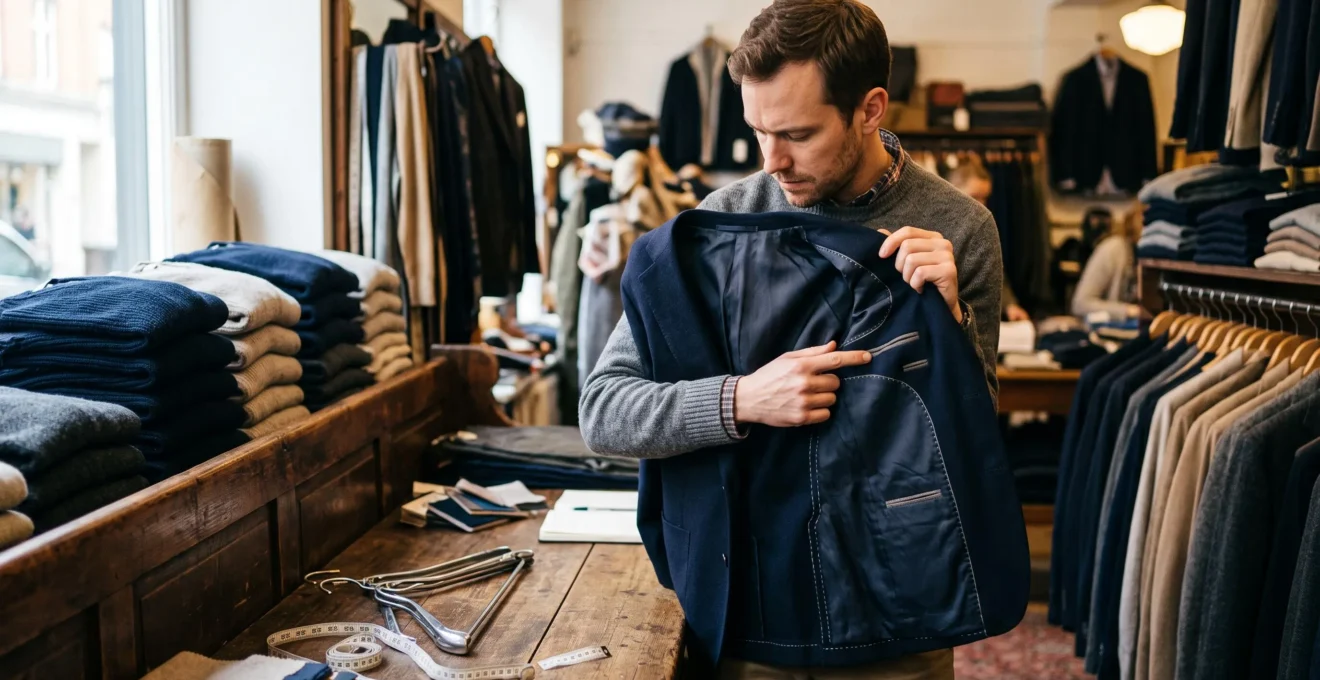
A jacket can look impressive on a hanger and still develop puckered seams, distorted shoulders or troublesome fastenings after relatively little use. Conversely, an unremarkable shirt from a modestly priced retailer might withstand years of regular washing. The difference is not necessarily visible on the price tag.
To assess men’s clothing quality before buying, examine four things: fabric behaviour, construction, fit and expected wear. Check how the material responds to gentle handling, whether the seams and internal finishes are consistent, how the garment moves on your body and how frequently you will realistically wear it.
There is no single test that guarantees durability. A heavy fabric can be poorly made, an expensive label can conceal ordinary construction, and impeccable stitching cannot compensate for uncomfortable fit. The useful approach is to combine several observable indicators rather than trust one impressive detail.
These principles apply whether you are choosing an everyday shirt, a tailored jacket, travel trousers or a winter coat. They also help answer a more financially useful question: not simply whether something is well made, but whether its quality justifies its cost for your particular wardrobe.
Clothing quality: the essential buying rules
- Inspect the garment itself: fabric recovery, smooth seams, finished edges, secure fastenings and appropriate lining are more informative than branding.
- Calculate value using realistic cost per wear, including maintenance and the likelihood that you will continue wearing the item.
- Prioritise fit and construction in frequently worn essentials; avoid paying extra for features that do not improve your comfort or practical use.
- Why Does a Higher Price Not Always Mean a Better-Made Garment?
- How Can You Check Clothing Quality in Five Minutes Inside a Shop?
- One £150 Jacket or Three £50 Jackets: Which Gives Better Long-Term Value?
- The Quality Signal That Looks Impressive but Tells You Very Little About Durability
- When Is It Worth Paying More for Better-Made Clothing?
- How Can You Match Functional Fabrics to Work, Travel, and Everyday Weather?
- Linen, Brushed Wool or Suede: Which Texture Works Best for the Occasion?
- Which Timeless Wardrobe Essentials Give Men the Most Outfit Options?
Why Does a Higher Price Not Always Mean a Better-Made Garment?
A higher clothing price does not automatically indicate better workmanship because customers pay for more than the garment itself. Branding, retail distribution and positioning all influence the final price. Better materials and construction can justify a premium, but only if the garment demonstrates meaningful improvements in durability, comfort or performance.
Consider three expenses that can increase what you pay without necessarily improving the finished product:
- Brand marketing: advertising campaigns, celebrity associations, elaborate packaging and visual identity can contribute to the selling price without changing the stitching or fabric.
- Retail markups: wholesale distribution, retailer operating costs and multiple intermediaries can affect price independently of garment workmanship.
- Origin-based positioning: a country’s manufacturing reputation may command a premium, but a country-of-origin label alone does not establish the quality of an individual item.
Different labels can sometimes use shared manufacturing facilities. That possibility does not make their products equivalent: fabric specifications, trims, production tolerances and quality control may differ. Without verified manufacturing information, it is not possible to establish that two garments came from the same factory merely by examining their labels.
A more useful comparison involves the actual product. Read its fibre composition, inspect the consistency and suitability of its stitching, check the lining material and look for well-finished edges. Stitch density matters in context, but more stitches are not universally better: the correct construction depends on fabric type, seam purpose and thread.
Simplicity can help, too. A straightforward garment may have fewer decorative seams or trims that could fail. However, fewer panels do not inherently guarantee durability, particularly when reinforcement or careful shaping is necessary.
Some convincing quality cues are relatively easy to imitate. A heavy feel, restrained packaging or compelling heritage story can make clothing seem expensive without proving that it will wear well. By contrast, carefully matched checks across seams, controlled stitching and a lining that hangs correctly provide visible evidence of production attention, although none independently guarantees longevity.
The University of Georgia clothing quality and selection resource advises consumers to examine internal construction, seam finishing, buttonholes, hems and pattern alignment rather than judge clothing by outward appearance or price alone.
The practical distinction is between paying for a desirable brand experience and paying for a better physical garment. Once those are separated, the next step is to inspect what you can actually verify in the shop.
How Can You Check Clothing Quality in Five Minutes Inside a Shop?
You can make a useful preliminary assessment of clothing quality in five minutes by handling the fabric, examining seams, checking pattern alignment, looking inside the garment and operating its fastenings. The aim is not to predict an exact lifespan, but to identify defects and weaknesses before paying.
Start with the fabric. Feel whether it is consistent across the garment, particularly at areas such as elbows, knees and shoulders. Look for unexpected thinning, uneven tension, loose yarns or distortion. Softness and thickness are not sufficient evidence of quality on their own.
Two quick fabric checks can reveal useful characteristics:
- Stretch recovery: gently stretch a small section of knit fabric, or woven fabric designed to stretch, and release it. Check whether it returns close to its original shape. Persistent distortion is a warning, although immediate recovery cannot predict long-term elasticity.
- Crumple recovery: lightly compress an inconspicuous section, release it and observe the creasing. Persistent wrinkles indicate how that material responds to compression. They do not necessarily mean poor quality: linen, for example, naturally creases even when well made.
Neither test is a validated universal ranking of garment durability. Both are practical observations that become more useful when comparing fabrics of similar composition and intended function.
Next, turn the garment inside out where practical. Examine whether the seam allowances are securely finished, whether stitching follows a consistent line and whether the fabric puckers around joins. On knitwear, shoulder stabilisation may help control stretching; on tailored jackets, the internal chest construction matters more than decorative external stitching.
Some tailored garments use stitched canvas or partial canvas, while others use fusible interlinings. A stitched construction may offer different drape and alteration possibilities, but adhesive construction is not automatically defective. The presence of canvas or traditional basting should not be assumed without reliable product information or specialist inspection.
Finally, examine the alignment of stripes or checks at prominent seams, the hang of the lining, the neatness of buttonholes and whether zips and buttons operate smoothly. Pattern matching is evidence of attention to finishing, though alignment can be affected by garment shaping and design.
Your five-minute in-store inspection checklist
- Minute 1 — Test the fabric: gently check recovery and creasing; record whether it returns to shape and whether the texture remains consistent.
- Minute 2 — Inspect the seams: turn the garment inside out and identify any open edges, loose threads, puckering or irregular joins.
- Minute 3 — Check alignment: compare stripes, checks, hems and symmetrical details; note any conspicuous mismatch or unevenness.
- Minute 4 — Examine the internals: inspect the lining, shoulder finishing and hem; confirm that internal materials lie comfortably without pulling.
- Minute 5 — Operate and try on: test buttons and zips, move naturally in the garment and identify any restriction, rubbing or distortion.
A quick inspection has limits. Shoes need a proper walking test, attention to heel movement and appropriate sole flex where designed. Outerwear requires consideration of weather protection, seam treatment and the manufacturer’s performance information. Check the retailer’s actual return conditions before assuming a longer home trial is allowed.
These checks help eliminate weak candidates, but they do not determine how much to spend. That decision becomes clearer when the garment’s likely use is measured against its total cost.
One £150 Jacket or Three £50 Jackets: Which Gives Better Long-Term Value?
One £150 jacket offers better value than three £50 jackets when its construction, fit and versatility allow you to wear it substantially more often or for longer without excessive maintenance. Three cheaper jackets may provide better value when you genuinely need different styles or conditions of use. Cost per wear, rather than price alone, is the starting point.
The calculation is straightforward:
Cost per wear = total ownership cost ÷ actual number of wears.
Total ownership cost can include purchase price, necessary alterations, cleaning and repair expenses. The crucial variable is realistic usage, not the number of times you hope to wear something.
Consider the following purely hypothetical comparison. These figures illustrate the calculation; they are not observed durability results or market averages.
| Decision factor | One £150 jacket | Three £50 jackets |
|---|---|---|
| Initial spending | £150 | £150 total |
| Illustrative total wears | 150 | 150 combined |
| Purchase cost per wear | £1.00 | £1.00 |
| Potential advantage | Consistency, versatility, fewer replacements | Variety, rotation, different occasions |
| Main risk | Concentrating spending in one unsuitable item | Buying pieces that receive little use individually |
The calculation deliberately produces the same initial cost per wear. Spending more does not create value unless the garment delivers additional useful wear, improved suitability or a benefit you genuinely appreciate.
The premium jacket becomes more compelling if its extra cost buys a fabric suited to frequent wear, secure and potentially replaceable hardware, and construction that tolerates its recommended cleaning methods. Those benefits must be checked rather than inferred from the price.
A less expensive jacket can be the sensible choice for an occasional event, a short-lived trend or a climate-specific need. Conversely, if the same jacket is part of your weekly uniform, dependable fit and serviceability become more valuable.
Owning three inexpensive jackets also creates potential hidden costs: time spent replacing failed garments, differences in fit between versions, and the inconvenience and waste associated with premature disposal. Yet a costly jacket can fail early through unsuitable use, poor storage or incorrect cleaning.
Before buying, estimate how many times you have actually worn similar jackets in the past year. Then calculate the cost per wear for each option using a conservative expected lifespan. Include any cleaning or alteration expense you can reasonably anticipate.
Cost per wear turns an emotional price comparison into a more useful decision. It also exposes another common mistake: assuming that technical-sounding claims or prestigious labels establish quality without evidence.
The Quality Signal That Looks Impressive but Tells You Very Little About Durability
The most misleading standalone quality signal is branding, including labels that describe clothing as “premium”, “heritage” or “tailored”. These terms may communicate design positioning, but they do not specify seam strength, fabric resilience or expected lifespan. A quality claim is useful only when it can be connected to verifiable garment characteristics.
Designer names and heritage narratives can help communicate a product’s identity, but they cannot replace inspection. A shirt marketed as premium may have ordinary buttonholes; a less prestigious alternative may have cleaner stitching and a more suitable fabric for your needs.
The legal distinction matters. In the United States, the Federal Trade Commission requires specified information on covered textile products, including fibre composition, origin and the responsible business. Its guidance on textile and wool labeling requirements explains these obligations and the conditions for additional claims.
These requirements do not amount to an official durability certification. Nor should US rules be assumed to apply identically in the United Kingdom, Canada, Australia or every other English-speaking market. Marketing terms must be assessed in their particular legal context rather than treated as universally unregulated.
Technical-sounding figures can be misleading too. A high thread count does not necessarily establish stronger fabric, especially when fibre quality, yarn structure and weave are unknown. Likewise, a heavy garment is not automatically durable: extra weight may reflect a dense construction, heavy finishing or simply more material.
More informative specifications include fibre characteristics, yarn structure, appropriate seam construction, hardware durability and finishing quality. Even these require context. Long-staple cotton and particular yarn constructions can support desirable performance characteristics, but no single fibre attribute guarantees that a finished shirt will last longer.
Ask whether a claim can be checked. A named fabric mill may provide a traceable specification. A documented construction method can help establish what is inside a jacket. A stated waterproof performance standard, where independently substantiated, is more useful for rainwear than an undefined promise of all-weather protection.
The replacement rule is simple: judge the garment, not the story attached to it.
Branding is not inherently worthless; it simply needs supporting evidence. The next decision is whether the quality improvements you can verify matter enough to justify a larger investment.
When Is It Worth Paying More for Better-Made Clothing?
Paying more for well-made clothing is generally most worthwhile when an item will be worn frequently, face repeated friction or weather exposure, and remain useful for several seasons. The premium should buy tangible improvements in fit, materials, construction or repairability. Occasional, transitional and trend-led purchases often justify a more restrained budget.
Different categories deserve different spending priorities. The following grid provides a practical starting point rather than fixed price recommendations.
| Garment category | Spending priority | What to verify |
|---|---|---|
| Frequently worn shoes | Higher when fit and construction warrant it | Comfort, sole construction, abrasion resistance, repair options |
| Everyday trousers | Higher for repeated use | Seat and knee recovery, seam finishing, fit during movement |
| Regular-use outerwear | Higher for appropriate protection | Weather performance, closures, lining, serviceability |
| Weekly office shirts | Selective upgrade | Collar construction, fabric comfort, laundering requirements |
| Occasion-specific clothing | Moderate unless repeatedly used | Fit, appropriate appearance, realistic future wear |
| Rapidly changing styles | Conservative | Versatility, comfort, actual use rather than novelty |
Before evaluating fabric or brand, establish whether the item fits. An expensive jacket that pulls across the chest or restricts shoulder movement may deliver less practical value than a moderately priced one with comfortable proportions.
Fit first, construction second, brand last is a sensible decision order. Minor alterations can improve some dimensions, such as trouser length or waist fit, but extensive changes to shoulders or garment balance may be impractical or uneconomical.
Your current circumstances also matter. Investing in an extensive tailored wardrobe makes more sense when your dress code, clothing size and day-to-day needs are reasonably settled. If you are changing jobs, adjusting your wardrobe preferences or experiencing substantial size changes, flexibility may be worth more than maximum construction quality.
Maintenance is another prerequisite. A delicate material is not necessarily a poor purchase, but it may be unsuitable for someone who needs uncomplicated machine washing. The FTC guidance on clothing care-label requirements explains that covered US apparel must carry care instructions supported by a reasonable basis. Read those instructions before deciding whether the garment fits your routine.
Some better-made garments benefit from occasional repairs, proper storage and suitable cleaning. Others are deliberately designed for everyday convenience. A higher price is justified only when the benefits align with what you are realistically prepared to maintain.
Price and construction are only part of suitability. A garment must also perform in the environment where you actually wear it, which makes fabric choice the next important consideration.
How Can You Match Functional Fabrics to Work, Travel, and Everyday Weather?
Choose functional fabrics by identifying the conditions in which you will wear them most often. Office clothing generally benefits from comfort, breathability and an appropriate appearance; travel clothing often benefits from quick drying and crease resistance; variable weather calls for adaptable layers and suitable protection. No fibre is universally best across every environment.
Begin with your primary use case rather than the material’s reputation. The fabric that feels comfortable in an air-conditioned office may perform differently during a humid commute or a rainy trip.
| Use case | Useful fabric options | Main consideration |
|---|---|---|
| Office and business wear | Wool and wool blends, suitable cotton constructions | Comfort, drape, crease behaviour and care |
| Frequent travel | Performance synthetics, suitable blended fabrics, some wool garments | Drying time, packing recovery, comfort and odour management |
| Warm, humid weather | Breathable lightweight constructions, linen, selected technical fabrics | Ventilation and moisture handling |
| Cold, changeable weather | Insulating layers with an appropriate protective outer shell | Warmth, moisture management and weather protection |
Three properties frequently compete for priority: breathability, weather resistance and ease of care. They are not governed by one universal trade-off, but improving one characteristic through coatings, membranes or heavier constructions can affect the others.
For instance, a breathable base layer can move moisture away from the skin, while a separate outer layer provides rain and wind protection. This modular approach is often more adaptable than expecting one shirt or jacket to handle every condition.
Fabric composition matters, but so do knit or weave structure, thickness, finishes and fit. The REI expert advice on choosing base-layer fabrics describes differences between merino wool and synthetic materials, including moisture management, drying and abrasion-related durability.
Merino can offer comfort and odour-management advantages, while suitable synthetics commonly dry faster. Wool layers may wear under repeated backpack friction, and some blended constructions can improve durability. Those observations concern active base layers and should not automatically be extended to every wool suit or technical jacket.
To match fabric to climate, assess your typical temperature range, humidity, rainfall and time spent outdoors. Cotton can be comfortable in many ordinary situations, but moisture-retaining cotton clothing may be a poor choice for prolonged exposure to wet, cold conditions.
Be cautious with all-in-one performance promises. A fabric advertising stretch, water resistance and wrinkle resistance might meet your needs, but its treatments, care instructions and repair options deserve inspection. Some finishes change with use or laundering; their persistence depends on the actual product.
Once the functional requirements are established, appearance becomes easier to manage. Texture, in particular, determines how suitable a garment feels for different settings and how demanding it may be to maintain.
Linen, Brushed Wool or Suede: Which Texture Works Best for the Occasion?
Linen generally suits warm-weather relaxed and smart-casual dressing, brushed wool is useful for cooler-weather outfits ranging from smart-casual to formal, and suede adds depth to casual or refined informal looks. The right texture depends on dress code, climate, how the material wears and how much maintenance you accept.
These three materials create distinctly different visual impressions. Linen has an irregular, relaxed surface; brushed wool provides softness and depth; suede has a fine nap that changes appearance with light and handling.
| Texture | Suitable occasions | Wear and maintenance considerations |
|---|---|---|
| Linen | Summer social events, warm-weather smart-casual clothing | Creases readily; many garments are washable if their care labels permit |
| Brushed wool | Autumn and winter tailoring, smart-casual clothing, selected formal settings | Comfortable drape and warmth; friction may produce pilling |
| Suede | Casual jackets, boots and smart-casual accessories | Can mark or absorb moisture; needs suitable brushing, protection and cleaning |
Linen’s creasing is part of its character. A well-made linen shirt may wrinkle noticeably without being defective. The relevant question is whether that appearance suits the occasion. For a relaxed summer dinner, it may be entirely appropriate; for an environment requiring sharply pressed business clothing, a more crease-resistant alternative may be preferable.
Brushed wool, often seen in flannel trousers and jackets, can offer attractive drape and visual softness. Its raised fibres may be vulnerable to abrasion and pilling, particularly where garments rub against bags, furniture or each other. Rotation and appropriate brushing can help with appearance, but they do not eliminate wear.
Suede works well when you want texture without a conspicuous pattern. However, its behaviour depends on the hide, finishing and protection used. Untreated suede can be vulnerable to moisture and staining, making it less convenient for persistently wet environments than appropriately weather-resistant materials.
Texture mixing is easiest when one garment supplies the visual interest. Consider a suede jacket with a plain cotton shirt and smooth wool trousers. The materials provide contrast without competing for attention.
Combining several pronounced textures can also work, but keep an eye on colour relationships, seasonal weight and overall formality. A heavy brushed-wool jacket with a light linen shirt may be visually interesting yet uncomfortable if the combination is poorly suited to the temperature.
Before buying, imagine how the garment will look after ordinary wear. If visible wrinkles, a changing suede nap or occasional wool pilling will bother you, choose a surface whose ageing characteristics better match your expectations.
A texture is only valuable if it works with the rest of your clothing. That principle leads to the final purchasing test: how many useful outfits will the garment actually create?
Key takeaways before building your wardrobe
- Prioritise garments that combine reliably with clothing you already own, rather than choosing pieces only for their individual appeal.
- Use fit, visible workmanship and realistic wear frequency to determine where additional spending provides value.
- Evaluate the fabric’s care demands and ageing behaviour alongside its appearance, particularly for frequently worn essentials.
Which Timeless Wardrobe Essentials Give Men the Most Outfit Options?
The most versatile men’s wardrobe essentials are garments that work across several outfits and levels of formality. Neutral tailoring, well-fitting trousers, simple shirts, understated knitwear and adaptable outerwear tend to combine more easily than highly distinctive pieces. Their value comes from the number of useful combinations they create, not from being labelled timeless.
Build around colours that work together. Navy, grey, olive, camel and complementary neutral shades can bridge casual and smarter clothing without requiring every garment to match exactly.
A practical core wardrobe might include:
- A navy blazer or similarly versatile tailored jacket, if your lifestyle calls for one.
- Well-fitting grey or navy trousers appropriate to your regular dress code.
- A white or light-blue shirt that works alone or beneath tailoring.
- A simple plain T-shirt for informal combinations.
- Dark jeans or understated casual trousers.
- Neutral knitwear suitable for layering.
- Outerwear and shoes appropriate to your climate and actual activities.
The value appears when the pieces interact. A navy blazer worn with a white shirt and grey trousers creates a business-oriented outfit. The same blazer over a plain T-shirt with dark jeans produces a more relaxed combination, provided its cut and fabric suit both contexts.
Likewise, neutral trousers may work with knitwear, casual shirts and tailored jackets. Each successful pairing increases wardrobe flexibility without requiring another purchase.
Beware of the fake essential: an item described as a universal staple that only works with one specific outfit. A dramatic statement coat, unusually coloured shoes or extreme trend-cut trousers can be enjoyable purchases, but their distinctiveness may limit compatibility.
Before buying anything described as versatile, identify at least three existing garments you could wear with it. Check the combinations for colour, proportion, texture and formality. This is a practical shopping rule, not a scientifically established threshold.
High-use essentials are also where construction quality deserves particular attention. If you wear a shirt weekly, collar stability, seam finishing, fabric comfort and appropriate laundering become important repeatedly. If your outerwear is used throughout the colder months, secure closures and suitable protection are more consequential than decorative details.
Do not interpret timelessness as a reason to ignore your lifestyle. Someone who rarely wears tailoring may gain more from dependable casual trousers and a versatile overshirt than from an expensive blazer. The best essentials are the pieces that support your actual routine.
For your next purchase, choose one item that fills a genuine wardrobe gap, verify that it coordinates with at least three existing pieces, inspect its construction and calculate a realistic cost per wear. That sequence is more likely to produce a useful purchase than starting with a prestigious label or an appealing discount.
Does 100% cotton always mean better quality than a cotton blend?
No. Fibre composition identifies the materials but does not establish overall fabric or garment quality. Cotton blends may offer useful stretch, crease behaviour or other performance characteristics, depending on construction. Examine the weave or knit, comfort, finishing and intended use rather than judging by fibre percentage alone.
Can you reliably judge clothing durability when shopping online?
Only partially. Product descriptions, fibre composition, close-up photographs, construction information and care instructions can help identify promising garments. They cannot fully reveal fabric feel, fit or workmanship consistency. Look for detailed images and check the seller’s return conditions before purchasing.
Are loose threads always a sign of poor garment construction?
Not necessarily. An isolated untrimmed thread may be a minor finishing issue. Repeated loose stitching, opening seams or threads that appear integral to a stressed seam are more concerning. Inspect whether the seam remains secure rather than assuming every visible thread indicates structural failure.
Should a new garment be washed before deciding whether it fits?
Check fit before washing and consult the care instructions first. Some fabrics or constructions may change dimensions during laundering, but the amount cannot be predicted reliably from composition alone. Ask the retailer about expected dimensional changes and confirm return rules before washing, since laundering may affect return eligibility.
Can a garment be high quality even if it needs specialist cleaning?
Yes. Specialist care may be appropriate for certain materials and constructions, but it is neither proof of superior quality nor evidence of poor workmanship. Evaluate the garment’s intended performance, construction and cleaning requirements together, including whether the ongoing care is practical for your lifestyle.