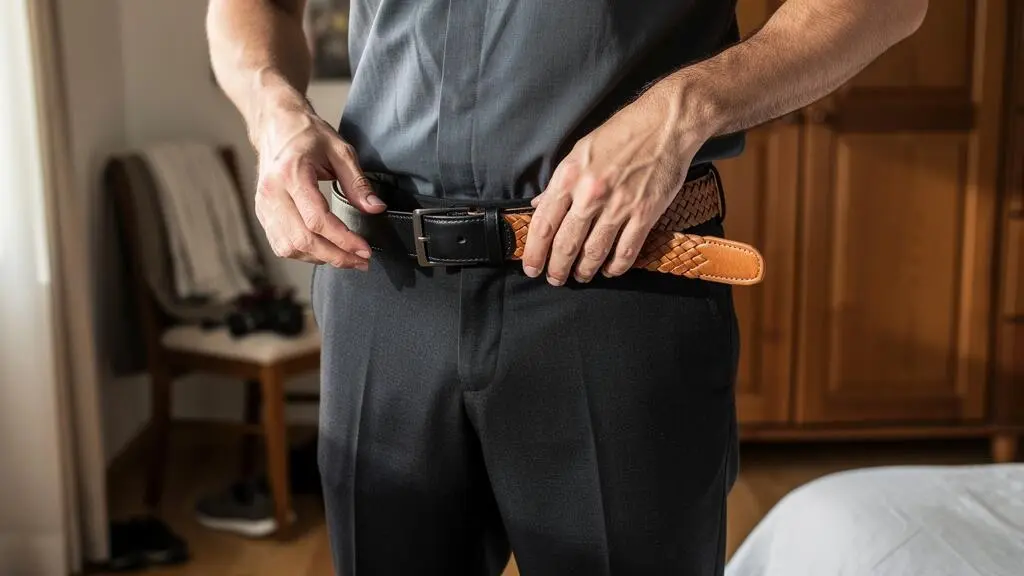
A versatile men’s belt should look appropriate with the trousers, shoes and overall level of formality of an outfit. The most dependable starting point is a relatively narrow leather belt with a simple buckle, restrained stitching and a colour that complements the shoes already in the wardrobe. A second, more textured belt can then cover relaxed outfits without compromising smarter ones.
The important distinction is between a belt that physically fits several pairs of trousers and one that visually belongs with several complete outfits. A substantial leather belt may fit both jeans and tailored trousers, for example, yet look unnecessarily heavy against fine wool. Conversely, an exceptionally slim dress belt can appear out of proportion with robust denim.
Width, construction, surface texture, buckle finish and accurate sizing all contribute to versatility. Choosing carefully also means recognising when no visible belt is the more elegant option, particularly with well-fitting formal tailoring.
The essentials of choosing a versatile men’s belt
- Prioritise a smooth, understated leather belt with a modest buckle for the widest smart-to-smart-casual range.
- Coordinate belt and shoe colours by tone and finish rather than insisting on identical shades.
- Check belt length against a well-fitting belt, inspect construction and use more casual materials selectively.
- Why Can the Wrong Belt Make Otherwise Smart Trousers Look Too Casual?
- How Can You Coordinate a Belt With Shoes Without Making the Outfit Look Overmatched?
- Leather, Suede or Woven Belt: Which Is Most Versatile for Everyday Wear?
- The Belt Sizing Mistake That Can Make a Good Outfit Look Untidy
- When Should You Replace an Everyday Leather Belt?
- How Can You Build a Smart-Casual Outfit for Work and Dinner on the Same Day?
- Lounge Suit, Dinner Suit or Smart Tailoring: Which Does the Occasion Require?
- How Can Men Build Elegant Outfits Without Wearing a Full Suit?
Why Can the Wrong Belt Make Otherwise Smart Trousers Look Too Casual?
The wrong belt can make smart trousers look casual because it introduces a visual detail that conflicts with the refinement of the fabric. A wide canvas strap, oversized buckle or contrasting stitching draws attention to the waist and interrupts an otherwise polished silhouette. Matching the belt’s material and finish to the outfit’s formality matters more than matching its colour alone.
A belt creates a visible horizontal division between the upper and lower body. With tailored trousers, that division usually looks more considered when the belt is proportionate, relatively smooth and visually quiet. Heavy textures and conspicuous hardware make the waist a focal point, potentially competing with the clean lines of the trousers and jacket.
Fabric provides a useful starting point for judging compatibility:
- Fine wool trousers: smooth leather, restrained stitching and a small, simple buckle generally preserve the tailored appearance.
- Cotton chinos: smooth leather, subtly grained leather and some suede belts can work, depending on the shoes and jacket.
- Denim: heavier leather, woven constructions and more noticeable textures can complement the fabric’s casual character.
Width reinforces this distinction. Permanent Style‘s belt capsule guide describes classic belts as generally measuring 1.25–1.5 inches wide, with smarter examples towards the narrower end. These are styling conventions rather than compulsory measurements, and the proportions of the wearer and trousers still matter.
Consider a hypothetical pair of navy chinos. With polished brown derbies, a tucked shirt and a tailored jacket, a smooth brown leather belt supports a polished appearance. The same chinos with canvas trainers and a relaxed overshirt may accommodate a woven belt. Neither choice is inherently wrong; the surrounding pieces determine whether it looks coherent.
The most common mistake is assessing a belt against the trousers alone. Shoes, fabric weight, jacket structure and occasion all affect how formal the belt appears.
A belt should strengthen the visual relationship between garments, not introduce a competing style. Once its formality is established, colour and finish become the next considerations.
How Can You Coordinate a Belt With Shoes Without Making the Outfit Look Overmatched?
Coordinate belts and shoes by choosing compatible colour families, leather textures and levels of formality rather than identical finishes. Dark brown shoes usually work with a similarly dark brown belt, while black dress shoes generally call for black leather. Small shade differences are acceptable when the materials look equally refined and the buckle does not compete with other accessories.
The conventional advice to match belts and shoes is useful for formal dressing but becomes too restrictive when applied literally. A pair of brown leather shoes and a brown belt can complement each other without having exactly the same undertone or sheen.
Three relationships help determine whether a combination works:
- Colour family: keep black with black in conventional formal outfits, while allowing neighbouring shades of brown or tan in less formal combinations.
- Surface finish: polished calf leather generally looks more coherent with a refined leather belt than with rough canvas or heavily distressed leather.
- Visual weight: delicate footwear usually benefits from restrained belt hardware, whereas more robust shoes can accommodate heavier construction.
As a practical example, medium-brown suede loafers can work with a brown suede belt or a subtly textured leather alternative. The textures need not be identical, but a highly polished, very formal belt may appear disconnected from the relaxed footwear.
Metal accessories deserve similar attention. A silver-coloured buckle can create a subtle relationship with a steel watch case, while warmer metal finishes may complement other warm-toned details. Exact coordination is not essential, particularly when the accessories are small and unobtrusive.
When a watch, footwear hardware and jacket fastenings already feature different metals, avoid adding another conspicuous finish. A modest, plain buckle is often more versatile than trying to match every accessory perfectly.
Excessive matching can also make a casual outfit seem overplanned. A belt in a compatible colour and texture often looks more natural than a perfectly coordinated set of accessories with competing levels of polish.
The objective is visual consistency rather than uniformity. Once a belt complements the footwear, its material determines how many different outfits it can realistically support.
Leather, Suede or Woven Belt: Which Is Most Versatile for Everyday Wear?
Smooth leather is generally the most versatile choice for men who regularly alternate between tailored and smart-casual clothing. Suede works particularly well with relaxed tailoring and textured fabrics, while woven belts are better suited to casual outfits. The best choice depends on the wardrobe’s dominant dress code, the belt’s construction and the level of maintenance it requires.
These materials differ not only in appearance but also in how they age, respond to use and interact with clothing. A versatile belt should maintain its shape and appearance while complementing the trousers worn most frequently.
The following comparison summarises practical styling considerations rather than experimentally measured durability rankings.
| Criterion | Smooth leather | Suede | Woven belt |
|---|---|---|---|
| Suitable outfits | Tailoring, chinos and selected denim outfits | Chinos, textured trousers and relaxed tailoring | Chinos, jeans and casual summer clothing |
| Formality | Can reach conventional business dress standards | Primarily smart-casual | Generally casual |
| Visual character | Clean and understated | Soft and textured | Relaxed and visibly patterned |
| Care considerations | Conditioning and inspection of the surface and edges | Careful brushing and protection from staining | Inspection for stretching, fraying and deformation |
| Main compromise | Very polished versions can look formal with casual clothes | Less appropriate with formal business tailoring | Usually unsuitable for highly dressed-up occasions |
For a wardrobe built around suits, wool trousers, chinos and polished leather shoes, a plain smooth-leather belt is the sensible first purchase. Where the wardrobe consists predominantly of denim, cotton trousers and relaxed footwear, textured leather may offer a more natural fit.
Material labels, however, do not tell the whole story. A belt marketed as genuine leather may use different layers, linings or surface coatings. Its construction is therefore worth examining before assuming the material description guarantees quality.
Full-grain leather retains its natural grain surface, while split leather comes from a different layer of the hide. Bonded materials and heavily coated constructions introduce further differences. Leather Naturally‘s leather care and materials FAQ explains these classifications and general maintenance principles, although it does not establish comparative lifespans for men’s belts.
When examining a belt, inspect the edges for exposed layers, the reverse for construction details and the strap for stiffness, cracking or uneven bonding. Flex it gently to assess how naturally it moves, without treating softness or smell as definitive proof of leather quality. Check stitching and buckle attachment as carefully as the leather itself.
A well-made belt with an appropriate finish can be more useful than a superficially luxurious one that does not complement the wardrobe.
Smooth leather has the broadest formal range, but it is not universally superior. A second textured belt may offer more practical versatility than forcing one formal belt into every casual outfit.
The Belt Sizing Mistake That Can Make a Good Outfit Look Untidy
The most common belt-sizing mistake is assuming that the labelled belt size matches the wearer’s trouser size. Brands can use different measuring conventions, so the more reliable approach is to measure a belt that already fits and compare the result with the manufacturer’s instructions. Ideally, the new belt should fasten near its middle hole, leaving a neat, manageable length of strap.
A belt that is too long creates an excessive loose end, which may extend well beyond the first trouser loop or hang awkwardly. A belt that is too short can barely reach the fastening hole, making the waist appear strained even when the trousers fit correctly.
Both problems draw attention to the waist for the wrong reasons. A correctly sized belt should hold its intended position without obvious tension, uncontrolled excess or distorted holes.
One complication is that belt measurements do not always begin at the same point. Some brands measure from a buckle reference point to the middle hole, while others exclude the buckle or measure the strap differently.
For example, The Armoury‘s Anderson’s belt sizing guide describes a size 34 as measuring 34 inches from the beginning of the strap to the middle hole, excluding the buckle. This is specific to that product and should not be treated as a universal sizing convention.
Start with the hole actually used on a comfortable existing belt rather than assuming it is the middle one. Record the distance from a clearly identified buckle reference point to that hole, then convert the measurement if the manufacturer uses a different reference point. The measurement method must match the sizing chart before the numbers can be compared.
A five-step belt-fitting check before buying
- Wear the trousers you intend to use most often and fasten your existing belt comfortably. Record which hole you use.
- Lay that belt flat and measure from a clearly identified buckle reference point to the used hole. Write down the distance and reference point.
- Read the prospective belt’s sizing instructions and note where that brand begins and ends its measurement.
- Compare equivalent measurements and identify the size expected to fasten near the middle hole. Record your selected size.
- Once the belt is available to try on, check its fastening position, remaining strap length and alignment with the trouser loops. Confirm that the loose end lies neatly.
Choosing a middle fastening position provides adjustment room if clothing thickness or waist measurements change. It is a practical fitting objective, not an absolute requirement for every belt design.
Correct sizing makes even a modest belt look more considered. It also helps distribute fastening pressure appropriately, reducing unnecessary stress on the strap and holes during everyday use.
When Should You Replace an Everyday Leather Belt?
Replace an everyday leather belt when its structure or appearance has deteriorated beyond reasonable repair, rather than after a fixed number of years. Cracks developing around fastening holes, splitting leather, failing stitching or a buckle that no longer stays secure are useful warning signs. Minor surface wear or replaceable hardware may justify repair instead of purchasing another belt.
Belt longevity depends on construction, wear frequency, storage and maintenance. There is no reliable universal replacement interval that applies equally to a well-constructed leather belt and an inexpensive coated or bonded alternative.
Regular inspection should focus on four areas:
- Fastening holes: look for tearing, stretching or distortion that prevents the buckle from holding securely.
- Leather around bends: distinguish superficial creasing from deep cracks or splitting under tension.
- Edges and layers: check for crumbling finishes, separation and exposed internal components.
- Buckle and attachment: identify looseness, damaged stitching, failing rivets or an unreliable fastening mechanism.
Some deterioration is primarily cosmetic. A scratched buckle may be replaceable, and a worn edge finish may be repairable by a suitable leatherworker. Localised stitching problems can sometimes be corrected without replacing the strap.
Structural failure is different. If leather is splitting through a stressed area or a fastening hole is tearing into surrounding material, continued use may worsen the damage. Replacing the strap or entire belt is often the more sensible choice unless a qualified repairer can restore it securely.
Routine care can help preserve a belt’s appearance and flexibility. Wipe away surface dirt, allow a damp belt to dry naturally away from direct heat, and use a conditioner appropriate for its leather finish. Suede and coated materials require their own care methods; ordinary leather conditioner is not suitable for every surface.
Alternating between two belts can also give each one time to recover from daily bending and moisture exposure. Avoid folding a belt sharply or storing it under prolonged tension.
A replacement should be driven by observable deterioration, not an arbitrary anniversary. A belt in good condition remains suitable for use; one with compromised fastening or damaged leather may undermine both the outfit and its basic function.
How Can You Build a Smart-Casual Outfit for Work and Dinner on the Same Day?
Build a work-to-dinner outfit around pieces that suit both settings, including a restrained leather belt that does not need changing. A smooth brown or black belt with a simple buckle can complement chinos, tailored separates and smart leather shoes. Adjust the shirt, jacket or footwear for the evening while keeping the belt consistent with the overall outfit.
The challenge is finding the middle ground between looking overly formal in a relaxed restaurant and underdressed in a professional environment. The belt helps because it remains visible when a jacket comes off, making an unsuitable choice more noticeable than it may seem in the morning.
Consider a hypothetical outfit consisting of navy chinos, a pale blue shirt, brown derbies and an unstructured jacket. A medium-to-dark brown smooth-leather belt with discreet hardware can work across an office that permits smart-casual dress and a reasonably polished dinner setting.
For the office, the shirt can remain neatly tucked and the jacket worn throughout meetings. Later, removing a tie if one was worn, relaxing the jacket arrangement or changing an outer layer can soften the presentation without requiring a different belt.
The belt should remain sufficiently refined for work without being excessively glossy or decorative. A very formal dress belt may appear disconnected from relaxed trousers and an unstructured jacket, while a canvas or conspicuously woven belt may be too casual for certain workplaces.
Footwear provides another adjustment point. Smart loafers or derbies often bridge work and evening settings, while more casual shoes may suit the dinner venue but not the office. The belt must remain compatible with whichever pair is selected.
Venue and professional expectations still govern the final choice. A workplace requiring conventional business suits offers less flexibility than an office with a relaxed dress code, and an especially formal evening event may demand a different outfit altogether.
The strongest transitional outfits are not two different looks forced together. They are coherent combinations that can become slightly smarter or more relaxed without changing their basic accessories.
Lounge Suit, Dinner Suit or Smart Tailoring: Which Does the Occasion Require?
A lounge suit usually means conventional business-style tailoring, where a restrained leather belt may be appropriate if the trousers have belt loops. Smart tailoring permits more flexibility, including carefully coordinated separates. A dinner suit, traditionally worn for black-tie occasions, follows different conventions: purpose-made trousers often use side adjusters or braces rather than a visible belt.
Understanding the distinction prevents a versatile everyday accessory from being used in circumstances where it does not belong.
The terminology is especially important across English-speaking countries. A lounge suit is a familiar British dress-code expression for a conventional suit, whereas other markets may use business suit or simply suit. Dinner suit is a traditional British term for a tuxedo.
The following examples describe common conventions rather than inflexible international rules.
| Dress code | Typical clothing | Appropriate belt approach |
|---|---|---|
| Lounge suit | Matching business-style suit, often with shirt and tie | Narrow, restrained leather belt if belt loops are present; match the formality of the shoes |
| Smart tailoring | Tailored trousers and a jacket, potentially as separates | Smooth leather or subtle texture according to the complete outfit |
| Dinner suit / black tie | Formal evening jacket and matching evening trousers | Generally avoid a visible belt; use the trouser’s intended side adjusters or braces where provided |
These distinctions are consistent with the traditional dress-code framework described in Debrett’s explanation of formal and smart-casual dress codes. Interpretations can nevertheless vary by country, profession, venue and the wording of a particular invitation.
The structure of the trousers often answers the belt question before styling begins. Trousers that fit properly at the waist and have side adjusters may not require a belt. Formal evening trousers designed for braces should generally be worn as intended, rather than modified visually with a conspicuous everyday belt.
Even within conventional suits, a belt is not automatically necessary. Some tailored trousers use side tabs or other adjustment systems, creating a cleaner uninterrupted waistline. Where braces are used, they should serve the intended fastening system rather than be combined unnecessarily with a belt.
For an ambiguous invitation, establish whether the host expects business-style clothing, smart separates or formal eveningwear. That distinction matters more than finding a supposedly universal belt.
Versatility includes knowing when to leave an accessory out. A discreet leather belt can work with a lounge suit, but genuine eveningwear may look more correct without any visible belt at all.
Key takeaways before assembling an outfit
- Use the structure and fit of the trousers to decide whether a belt adds anything useful.
- With contrasting jackets and trousers, favour accessories that connect the pieces without attracting disproportionate attention.
- Reserve more expressive belts for relaxed outfits; understated styling generally offers more flexibility with elegant separates.
How Can Men Build Elegant Outfits Without Wearing a Full Suit?
Men can create elegant outfits without a full suit by combining well-fitting trousers, a complementary jacket, considered footwear and restrained accessories. A narrow leather belt can connect these separate pieces when its colour, texture and formality suit the whole outfit. Alternatively, well-fitting trousers with side adjusters can create an even cleaner silhouette without a visible belt.
Elegance in separates depends on coherence rather than identical materials. A navy blazer with grey wool trousers, for example, works because the pieces have complementary levels of refinement despite not being made from the same fabric.
A dark leather belt with modest hardware can help visually anchor this combination, especially when coordinated with formal leather shoes. The aim is not to create a second focal point at the waist but to support the relationship between the trousers and footwear.
Other combinations allow greater flexibility. A textured jacket with chinos and suede loafers can accommodate a suede or subtly grained leather belt. By contrast, polished dress shoes with fine wool trousers usually favour a cleaner, more formal finish.
When the outfit contains several distinct textures, colours or patterns, adding a highly decorative buckle or contrasting belt stitching may make it appear unnecessarily busy. A useful guideline is to keep accessories quieter as the number of visually distinctive garments increases.
Belts are not compulsory components of elegant dressing. Tailored trousers with an accurate waist fit, side adjusters or an appropriate concealed support system can allow the shirt and jacket to create an uninterrupted line. This may be especially effective when wearing refined separates with a tucked shirt.
A practical capsule approach begins with one understated dark leather belt suitable for the wardrobe’s smarter shoes and trousers. If casual clothing dominates outside work, a second textured or less formal belt can handle denim, relaxed chinos and softer footwear.
The two belts need not serve every possible occasion. Their value lies in covering the clothing actually worn, without making each outfit dependent on a different accessory.
Start by laying out two or three regularly worn outfits, comparing the belt with their trousers and shoes, and removing it altogether where the trouser design permits. The most versatile choice is the one that works naturally across those combinations without drawing unnecessary attention.
Is a reversible leather belt a good alternative to owning two belts?
A reversible belt can be practical when both sides share a suitable level of formality and the buckle mechanism is secure. However, its versatility depends on construction, thickness, finish and hardware. A reversible black-and-brown dress belt may cover several smart outfits, but it does not necessarily replace a more casual textured belt.
Can the same brown belt work with navy, grey and beige trousers?
Yes. A restrained brown leather belt can complement navy, grey and beige trousers, particularly when the shoes belong to a compatible brown colour family. The exact shade and finish should reflect the outfit’s level of formality. A dark brown smooth-leather belt is often easier to integrate into tailored combinations than a conspicuously distressed tan belt.
Should a belt buckle match a watch or other metal accessories?
Matching metal finishes can create a coordinated appearance, but it is not essential. A plain silver-coloured buckle can work alongside a watch with warmer metal details if neither accessory is especially conspicuous. Consistent proportions, restrained hardware and compatibility with the overall outfit generally matter more than achieving an exact match.
Is one black leather belt enough for an entire wardrobe?
One black leather belt may be sufficient for a wardrobe dominated by black shoes, dark tailoring and restrained outfits. It is less adaptable where tan or brown footwear, denim and relaxed clothing predominate. In those cases, a brown leather belt or a second casual option can provide more natural combinations without requiring a large collection.
Does an expensive leather belt necessarily last longer?
No. Price alone does not establish durability. Leather quality, internal construction, edge finishing, buckle attachment and maintenance all influence how a belt performs. Inspect the strap, layers, stitching and hardware rather than relying solely on price or marketing terminology. Even a well-made belt needs appropriate care and eventual replacement if structural damage develops.