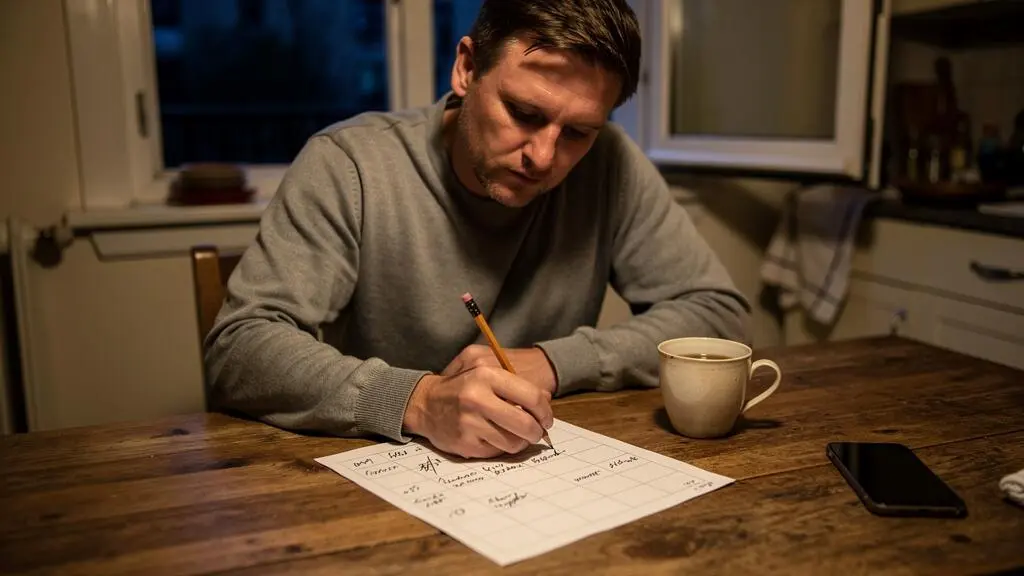
A balanced lifestyle is not a perfectly organised calendar. For men juggling a full-time job, personal responsibilities, fitness, relationships and interests, balance comes from protecting what matters while leaving enough flexibility for ordinary life to happen.
The difficulty is that even healthy habits can become another source of pressure. Exercise turns into a performance target, weekends become productivity projects, and an evening without plans starts to feel wasted. The pursuit of balance then creates precisely the busyness it was supposed to relieve.
A more sustainable approach starts with a few dependable commitments rather than constant optimisation. Sleep and essential responsibilities need a stable foundation. Relationships, movement, recreation and genuine downtime need recurring space, but not necessarily equal amounts of time.
The goal is to build a life that remains workable during demanding weeks, adapts when circumstances change, and offers enough choice and recovery to feel satisfying over the long term.
Balanced Living Without the Pressure to Do Everything
- Judge balance across weeks and changing circumstances, not by whether every day includes work, exercise, socialising and relaxation.
- Protect a few realistic personal priorities, and leave uncommitted space for recovery and unexpected responsibilities.
- Adjust the area causing the greatest strain before adding more habits, activities or scheduling systems.
- Why Does a Balanced Lifestyle Not Mean Giving Everything Equal Time Every Day?
- How Can You Build a Balanced Week Around a Full-Time Job?
- Sleep, Fitness, Social Life or Downtime: What Should You Rebalance First?
- The Balance Mistake That Turns Free Time Into Another To-Do List
- When Should You Reassess Whether Your Lifestyle Is Still Balanced?
- How Can You Structure a Weekday Around Four Habits Without Overplanning It?
- Gym, Home or Outdoor Training: Which Setup Is Easier to Maintain Long Term?
- How Can Men Build a Modern Lifestyle That Feels Balanced Rather Than Constantly Busy?
Why Does a Balanced Lifestyle Not Mean Giving Everything Equal Time Every Day?
A balanced lifestyle does not require equal time for every priority because different parts of life have different demands. Work and sleep occupy substantial, relatively fixed periods, while relationships, hobbies and exercise can often be maintained through smaller recurring commitments. What matters is whether important needs receive enough attention over time, not whether each day looks perfectly divided.
Consider a hypothetical working week. Monday might involve a long commute and an early bedtime. Tuesday could include exercise after work, while Wednesday is spent helping a family member. Friday might be reserved for friends, and Sunday could remain mostly unplanned.
None of these individual days provides an equal share of professional, physical, social and personal activities. Across the week, however, the person may have made meaningful room for each.
This is the distinction between daily balance and structural balance. Daily balance asks whether everything happened today. Structural balance asks whether the overall pattern supports health, responsibilities, relationships and interests without repeatedly sacrificing one area.
A useful way to think about personal time is as a flexible portfolio:
- Essential foundations: sleep, work commitments, meals, household responsibilities and necessary care.
- Recurring investments: physical activity, meaningful social contact and enjoyable interests.
- Flexible capacity: spontaneous activities, unexpected obligations and periods when nothing needs to happen.
These categories do not need equal allocations. Nor do they need precise percentages. A man supporting a new baby, recovering from an injury or completing a demanding project will face a different pattern from someone with predictable working hours and few caring responsibilities.
Attempting to monitor every hour can also make the lifestyle itself harder to maintain. Instead of noticing whether life feels manageable, attention shifts towards completing planned activities and correcting deviations.
Balance therefore works better as a direction to revisit than as a daily score. Temporary imbalance can be reasonable when the circumstances are understood and neglected needs are not allowed to disappear indefinitely.
Once equal daily allocation is no longer the objective, the practical question becomes how to fit meaningful commitments into a working week without filling every available gap.
How Can You Build a Balanced Week Around a Full-Time Job?
Build a balanced week around your existing obligations rather than an ideal schedule. Start with working hours, commuting, sleep and unavoidable responsibilities. Then choose two or three personal commitments that can survive a demanding week. Place them where they realistically fit, and leave some evenings uncommitted so unexpected events do not derail the entire plan.
Many weekly routines fail because they begin with ambitions rather than available capacity. A man might plan several workouts, frequent social evenings, daily reading and elaborate meal preparation before accounting for the journey home, household work or the mental effort of his job.
Start with fixed constraints. Mark the hours already committed to work, travel, sleep and essential responsibilities. This reveals the periods that are genuinely usable rather than merely empty on a calendar.
Next, define a minimum viable week. This is the smallest set of personal commitments that would still make the week feel worthwhile and reasonably supportive of well-being.
For example, a hypothetical minimum viable week might include:
- One planned exercise session that can be shortened if necessary.
- One meaningful conversation or shared activity with someone important.
- One period of uninterrupted personal downtime without work-related demands.
These are not universal targets or substitutes for broader health recommendations. They are practical commitments selected to be achievable even when life becomes unusually busy.
Available hours are only part of the equation. Energy matters as much as time. Someone who spends the day making difficult decisions may have an open evening but little appetite for another demanding activity.
Instead of automatically putting ambitious tasks into every empty slot, consider their energy requirements. A demanding workout may fit a more energetic part of the week, while an evening walk, quiet conversation or relaxed hobby may be more suitable after a difficult day.
Finally, leave one or two evenings relatively unplanned when your circumstances allow. These buffer periods can absorb a late meeting, family request, delayed commute or unexpected need for rest.
This approach also benefits from a clear transition out of work. A systematic review of 159 empirical studies, described in the systematic review of psychological detachment from work, identifies mental disengagement from work as an important recovery experience associated with employee well-being.
Protecting personal time therefore means more than making space in the diary. It also means reducing the extent to which unfinished professional concerns occupy that time.
Build Your Minimum Viable Week in Five Steps
- Mark unavoidable commitments. Create a weekly calendar showing work, commuting, sleep opportunities and essential responsibilities.
- Choose three personal priorities. Write down a realistic commitment for movement, connection and genuine downtime.
- Match each priority to available energy. Assign each commitment to a suitable part of the week, producing three tentative appointments.
- Protect flexible capacity. Identify at least one period that can absorb an interruption, and leave it without a fixed activity.
- Create a fallback version. Write one simpler alternative for each personal priority, so a disrupted week still has a workable plan.
A sustainable weekly structure establishes a few priorities without demanding constant execution. Once that foundation exists, it becomes easier to identify which area of life needs additional attention.
Sleep, Fitness, Social Life or Downtime: What Should You Rebalance First?
Start with the area whose neglect appears to be affecting the rest of your life most strongly. Sleep deserves early attention when it is consistently insufficient, but social isolation, inactivity or lack of genuine recovery may be more pressing in other circumstances. Assess what is missing, distinguish exhaustion from neglect, and make one manageable adjustment rather than rebuilding everything simultaneously.
Not every lifestyle deficit has the same consequences. Some problems influence several areas at once, while others remain more contained. This makes it useful to look for a possible domino effect instead of treating all priorities as equally urgent.
Sleep is a reasonable starting point when someone regularly feels tired, has difficulty concentrating or cannot maintain adequate rest. According to the CDC guidance on sleep duration and quality, adults aged 18–60 are recommended to obtain at least seven hours of sleep per night. The guidance also emphasises sleep quality and the importance of sleep for physical health and emotional well-being.
At least 7 hours
The CDC’s recommended nightly sleep duration for adults aged 18–60. Individual needs may vary, and sleep quality matters alongside duration.
Centers for Disease Control and Prevention, About Sleep.
Sleep should not, however, automatically become the explanation for every difficulty. Irritability and changes in appetite can accompany insufficient sleep, but they are not reliable diagnostic signs by themselves. Persistent fatigue may have several causes and warrants professional assessment when unexplained or concerning.
The following questions provide a practical reflection framework rather than a medical self-diagnosis.
| Area | Possible warning signs | Reasonable first adjustment |
|---|---|---|
| Sleep | Repeated short nights, daytime sleepiness or waking unrefreshed | Review bedtime, wake time and obstacles to sufficient rest |
| Fitness | Little routine movement or repeatedly abandoned exercise plans | Introduce an accessible activity that suits current capacity |
| Relationships | Feeling disconnected or repeatedly postponing meaningful contact | Arrange a manageable conversation or shared activity |
| Downtime | Constant stimulation, difficulty disconnecting or little time without demands | Protect a period free from professional obligations and performance goals |
Another useful distinction is whether a need is being neglected or overburdened. Someone who has stopped exercising because of an overloaded schedule may need to remove commitments before adding a workout. Someone with enough available time but little movement may instead benefit from a simple activity habit.
Similarly, a socially busy person can still lack genuine connection, while someone who spends time alone may be satisfied with their relationships. The appropriate adjustment depends on the experience, not just the calendar.
Choose one change and observe how it fits over the following weeks. A sequence of small corrections is easier to evaluate than simultaneous changes to sleeping, training, working and social routines.
The objective is not to produce a perfect score across every lifestyle category. It is to reduce the strain that matters most, while recognising that recovery itself should not become another demanding project.
The Balance Mistake That Turns Free Time Into Another To-Do List
Free time becomes another to-do list when enjoyable activities are consistently judged by productivity, progress or achievement. Reading becomes a target, exercise becomes a record to beat, and hobbies become projects that must deliver results. A balanced lifestyle needs opportunities for accomplishment, but it also needs experiences that require no measurable outcome.
Modern habits make this shift easy to overlook. Fitness apps record sessions, reading platforms encourage streaks, and recreational interests can be organised around performance targets. None of these tools is inherently harmful. Some people genuinely enjoy the structure and motivation they provide.
The problem begins when enjoyment becomes conditional on achievement. A missed training session feels like failure, a quiet afternoon seems unproductive, or a favourite hobby creates anxiety because progress has stalled.
Possible signs include:
- Feeling guilty whenever an evening has no defined purpose.
- Believing that recreation needs to improve a skill or generate a result.
- Continuing an activity mainly to preserve a streak or maintain a metric.
- Finding that leisure commitments create more pressure than enjoyment.
- Regularly sacrificing sleep or relationships to complete optional personal targets.
One useful distinction is between achievement-oriented activities and recovery-oriented activities. Learning a language, preparing for a sporting event or completing a personal project can provide purpose and satisfaction. Listening to music, taking an unhurried walk or spending time with friends may provide a different kind of value.
These categories are not mutually exclusive. An enjoyable workout can offer both progress and psychological relief. The important question is whether personal activities remain choices or have gradually become obligations.
A practical test is to consider how an activity feels before, during and afterwards. Are you looking forward to it? Can you change or stop it without excessive guilt? Do you generally feel satisfied, refreshed or meaningfully engaged afterwards?
Feeling tired after a demanding hike or focused hobby does not necessarily mean it was poor recovery. Physical fatigue and psychological satisfaction can coexist. But persistent tension around an activity that is supposedly recreational may suggest that expectations need to change.
Try removing measurement from one leisure activity. Take a walk without tracking distance, cook without attempting a new technique, or read without setting a completion target. The experience does not need to produce anything to deserve space in the week.
Rest becomes more sustainable when it is allowed to remain rest. The next challenge is recognising when changing circumstances call for a broader adjustment to the lifestyle supporting it.
When Should You Reassess Whether Your Lifestyle Is Still Balanced?
Reassess your lifestyle when responsibilities, energy levels or personal needs change enough to disrupt previously manageable routines. A new job, family responsibility, relocation, injury or sustained period of overwork can all justify a review. Regular brief check-ins are useful too, especially when sleep, relationships or personal interests have been slipping without an obvious turning point.
A balanced schedule can become unsuitable without anyone making a particularly poor decision. A routine developed around predictable working hours may no longer fit after a promotion, an additional commute or changes in childcare arrangements.
This is why life events are important review triggers. They change the practical conditions on which the original routine depended.
Other warning signs develop gradually:
- Bedtimes repeatedly drift later because other commitments take priority.
- Enjoyable activities are postponed week after week.
- Minor responsibilities increasingly provoke frustration or irritability.
- Time with friends or family becomes difficult to arrange.
- Work occupies personal time long after the formal working day ends.
These signs are reasons to investigate the pattern, not proof of a particular medical or psychological condition. Persistent distress, severe fatigue or substantial changes in functioning may require support beyond lifestyle planning.
A brief monthly or quarterly review can complement event-driven adjustments, although no particular interval is universally established as optimal.
Keep the review simple. Compare the week you expected to have with the one you actually experienced. Identify which commitments happened, which were repeatedly displaced, and whether the routine felt chosen or imposed.
Then ask what one change would have made the largest practical difference. It might mean moving exercise to another day, declining an optional obligation, arranging childcare differently where possible, or protecting an earlier bedtime.
Hypothetical Example: Adjusting After a Change in Working Hours
A man who previously exercised after work begins a position with a longer commute. His weekday training sessions repeatedly disappear, and his evenings feel rushed. Rather than treating this as a failure of motivation, he reviews the new constraints.
He moves one exercise session to the weekend and keeps a shorter home-based option available during the week. The change does not guarantee the same training volume, but it produces a routine that better matches his current circumstances.
Temporary sacrifices can also be reasonable. A demanding project might limit social activities for a short period, provided the person recognises the trade-off and establishes when neglected priorities should receive attention again.
Define a return point rather than relying on the assumption that things will eventually quieten down. That might be the end of a project, a known change in responsibilities or a review date if the situation remains uncertain.
A periodic review should make the routine easier to live with, not create another layer of administration. The same principle applies when building useful habits into individual weekdays.
How Can You Structure a Weekday Around Four Habits Without Overplanning It?
Structure a weekday around four flexible anchors rather than a detailed timetable: a simple morning routine, an opportunity for movement, a moment of meaningful connection and an evening wind-down. Attach these habits to predictable parts of the day, keep their minimum versions manageable, and decide in advance which can be shortened or skipped when circumstances change.
Four anchors offer a useful organising framework, not a scientifically established ideal number of habits. Some men may need fewer, while others can comfortably maintain more. The point is to make daily priorities recognisable without assigning a task to every hour.
A practical structure might look like this:
| Anchor | Existing cue | Low-effort version |
|---|---|---|
| Morning orientation | After waking or breakfast | Review one important priority for the day |
| Movement | Lunch break or return from work | Take a short walk or movement break |
| Personal connection | Dinner or an established evening pause | Have an attentive conversation or check in with someone |
| Evening wind-down | Before the usual bedtime | Put work aside and begin a calming transition towards sleep |
The advantage of an anchor is that it is connected to something already happening. Rather than remembering to exercise at an arbitrary point during the day, a person might associate a walk with finishing lunch or arriving home.
Research on habit formation supports the importance of repeated behaviour associated with consistent cues, although it does not establish that any particular four-habit framework is superior.
In a randomized trial on routine-based and time-based habit formation involving 192 adults, both existing routines and specific time cues were used to support the development of an everyday nutrition habit. The researchers observed no between-condition difference between these two approaches, while repeated performance was an important predictor of automaticity.
These findings support consistency without requiring every habit to occur in exactly the same way each day.
It also helps to establish a hierarchy for disrupted weekdays. Protect necessary sleep and essential care before optional activities. A brief social check-in might replace an extended visit, and a shorter movement break might replace a planned workout. When appropriate, an optional activity can simply be missed without requiring compensation.
Avoid turning the four anchors into four mandatory daily achievements. Their purpose is to make healthy choices easier to remember and maintain, not to create a new standard against which every day must be judged.
These anchors can support consistency, but they should remain subordinate to actual needs. Movement, in particular, becomes easier to maintain when the training environment fits the person rather than the other way around.
Gym, Home or Outdoor Training: Which Setup Is Easier to Maintain Long Term?
The easiest training setup to maintain is usually the one that fits your schedule, preferences, access and practical constraints. A gym can offer equipment and structure, home training can reduce travel, and outdoor exercise can combine movement with a change of environment. Rather than choosing solely for ideal training conditions, consider which option you can realistically repeat.
The distinction matters because a workout that looks excellent on paper may be difficult to maintain when commuting, unpredictable hours or family responsibilities interfere.
Practical friction includes all the steps between deciding to exercise and actually starting: travelling, packing equipment, checking opening times, arranging childcare where necessary, or adapting to weather conditions.
Compare the options across the constraints most likely to influence your own routine.
| Consideration | Gym | Home | Outdoor |
|---|---|---|---|
| Access | Requires reaching the facility and following its opening arrangements | Convenient when suitable space is available | Depends on access to safe and appropriate outdoor spaces |
| Cost | Membership and possible travel expenses | Can start with little equipment, although some activities require purchases | Often possible without paid facilities, depending on the activity |
| Equipment | Usually offers a broad selection | Limited by space, budget and available equipment | Varies substantially by location and activity |
| Weather and scheduling | Generally sheltered but subject to access arrangements | Mostly independent of weather | May require adaptation to conditions and daylight |
| Progression | Equipment may support structured resistance training | Progression is possible within available equipment and space | Depends on the chosen activity and available facilities |
A man with frequent travel and unpredictable working hours may find bodyweight exercises or walking easier to maintain than a fixed gym timetable. Someone who values structured strength training and access to specialised equipment may prefer a gym. Someone who spends most of the working day indoors may find outdoor movement especially enjoyable.
These are practical decision factors, not research-proven rankings of which environment produces the best long-term adherence for every person.
Exercise volume still matters alongside convenience. The World Health Organization recommends that adults aged 18–64 undertake 150–300 minutes of moderate-intensity aerobic activity each week, or 75–150 minutes of vigorous activity, or an equivalent combination. It also recommends muscle-strengthening activity involving major muscle groups on at least two days per week, as set out in its WHO physical activity recommendations.
These are population-level recommendations rather than a requirement to follow a particular gym routine. Activity should be adapted to health, ability and individual circumstances.
A hybrid arrangement can make a routine less dependent on one setting. For example, gym training might be the preferred option, with a simple home session available when travel or work prevents attendance. An outdoor walk might serve as a convenient alternative when a more structured session is impractical.
The fallback does not need to reproduce the primary workout exactly. Its role is to preserve an accessible way to remain active when circumstances change, not to make every session interchangeable.
A sustainable exercise routine contributes to a balanced life when it remains compatible with rest, responsibilities and enjoyment. That same test applies to the broader question of how much activity belongs in a satisfying lifestyle.
Key Takeaways Before Changing Your Routine
- Protect the commitments that support your well-being, but do not mistake a fuller calendar for a better life.
- Use convenience and flexibility to maintain valuable habits instead of relying on ideal circumstances.
- Before adding another activity, consider whether an existing obligation should be reduced, delegated or discontinued.
How Can Men Build a Modern Lifestyle That Feels Balanced Rather Than Constantly Busy?
Men can build a modern lifestyle that feels balanced by choosing fewer meaningful commitments, protecting essential recovery and regularly adjusting priorities as circumstances change. The aim is not to complete more activities in less time. It is to maintain enough control over work, health, relationships and personal interests that life feels manageable rather than permanently rushed.
Busyness can become closely associated with ambition, responsibility and success. A crowded schedule may suggest that someone is productive or in demand, even when its practical effect is a shortage of time for the people and activities they value.
This creates a subtle problem: efforts to improve balance often involve adding more. Another workout, another social commitment, another self-improvement habit or another planning tool is placed on top of an already crowded routine.
Subtraction can be more useful than addition. Reducing an optional obligation, limiting unnecessary work communication, combining compatible errands or declining a recurring commitment may create more meaningful space than learning to manage an even fuller calendar.
Not all responsibilities can be removed, of course. Employment demands, financial pressures, caring roles and health conditions can substantially limit personal choice. Sustainable balance must acknowledge these constraints rather than presenting flexibility as something everyone can achieve through better discipline alone.
Within those limits, it helps to distinguish measured balance from experienced balance. A calendar might show time allocated to work, relationships, exercise and hobbies, yet still feel overwhelming if nearly every activity is compulsory or pursued out of guilt.
Conversely, a busy period may feel manageable when commitments are meaningful, their duration is understood and some recovery remains possible.
Three questions can help reveal the difference:
- Which commitments still reflect my priorities, and which continue mainly through habit or expectation?
- Where do I have genuine freedom to choose how I spend my time?
- What could I simplify without neglecting an essential responsibility or an important relationship?
The answers will differ across stages of life. Career demands may intensify, family roles may change, and health or personal interests may require new attention. Balance is not a permanent arrangement that must survive unchanged through every transition.
A workable lifestyle instead combines a stable foundation with flexible choices. Sleep and essential care deserve protection. Exercise and relationships need appropriate opportunities. Hobbies and downtime need enough freedom to remain enjoyable rather than compulsory.
The final measure is not whether every planned activity happened. It is whether the overall pattern supports responsibilities, health and personal fulfilment without making ordinary disruptions feel like failure.
Choose one commitment to protect and one unnecessary pressure to reduce during the coming week. Observe whether that small adjustment makes daily life more manageable before changing anything else. A balanced lifestyle becomes sustainable when it is simple enough to live, not merely impressive enough to plan.
Can you have a balanced lifestyle while working long hours?
Balance may still be possible during periods of long working hours, but the available choices depend on how demanding and prolonged those hours are. Protecting sufficient sleep, maintaining meaningful contact and preserving opportunities to disconnect are sensible priorities. If work consistently prevents basic recovery or essential personal responsibilities, schedule adjustments alone may not resolve the underlying problem.
Do you need a strict daily routine to maintain healthy habits?
No. Consistent cues and repeated behaviours can support habit formation without requiring a minute-by-minute timetable. Existing routines and specific times are both possible cues. A flexible habit with a realistic minimum version can remain useful when commuting, work or family responsibilities alter the day’s schedule.
Is it healthy to spend an entire evening doing nothing productive?
An unstructured evening can be a legitimate form of downtime. Personal time does not always need to build a skill, improve fitness or produce a measurable outcome. What matters is whether the activity or inactivity fits the person’s needs and provides a welcome opportunity for rest, enjoyment or freedom from demands.
What if your partner or family has different expectations about free time?
Discuss which responsibilities must be shared, which periods are genuinely flexible and what each person needs for personal time. Balance in a household involves coordinating competing needs rather than protecting one person’s leisure at someone else’s expense. Agreeing on realistic arrangements can help make personal commitments more compatible with family responsibilities.
How can you tell whether your lifestyle is improving without tracking everything?
Pay attention to a few practical indicators: whether you usually have adequate opportunities for sleep, whether important relationships receive attention, whether physical activity remains accessible and whether some personal time feels genuinely restorative. A brief reflection on what worked and what repeatedly caused strain can be more useful than logging every hour or activity.