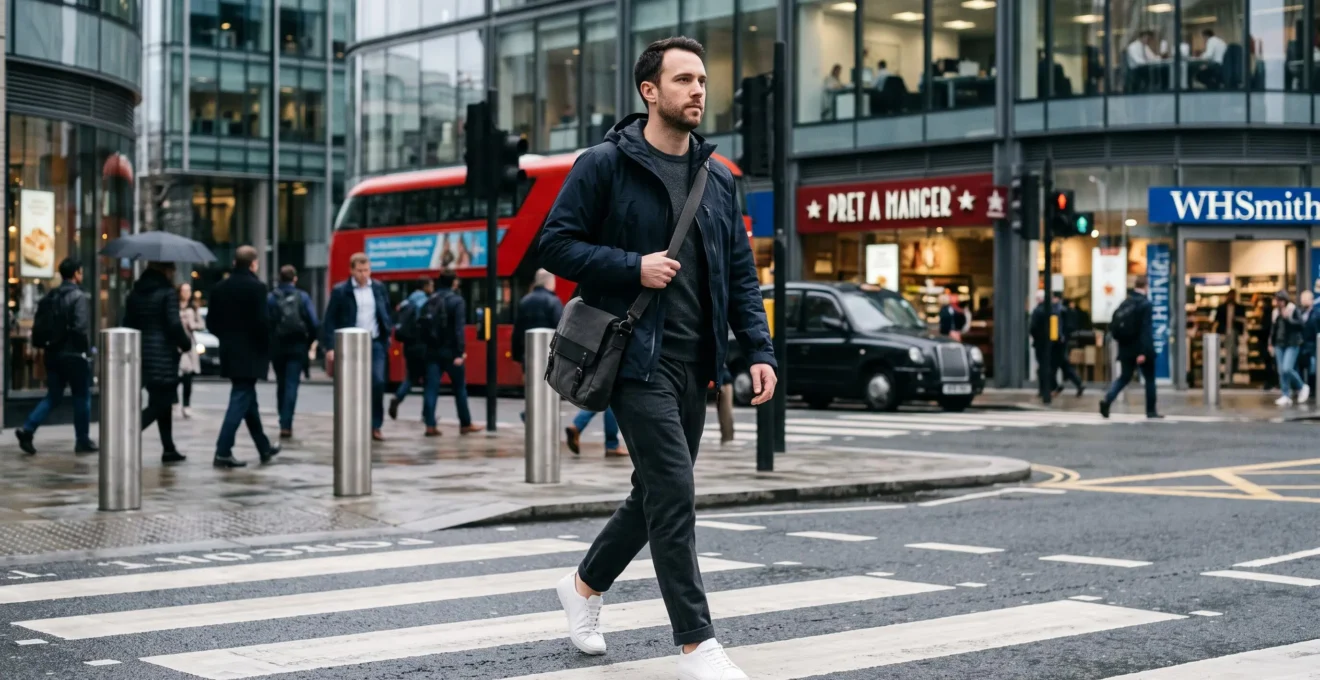
A city wardrobe has to do more than look good in a mirror. It needs to handle crowded trains, unpredictable weather, walking between appointments and an evening out without requiring a complete outfit change.
The most effective modern urban aesthetic combines three elements: practical outerwear, comfortable smart-casual foundations and restrained visual details. A weather-protective jacket can sit over a fine knit and tailored trousers, while versatile footwear bridges the gap between daytime movement and social settings.
The goal is not to dress like a mountaineer in the office or wear formal clothes on a long commute. It is to choose garments whose materials, proportions and functions complement one another.
That requires understanding the difference between genuine utility and decorative utility styling, choosing fabrics according to actual commuting conditions and knowing how to adjust an outfit’s formality with minimal changes. The result is a wardrobe designed around how urban life actually works, rather than a collection of disconnected trends.
The essentials of a functional urban wardrobe
- Build around versatile trousers, understated footwear and comfortable layers that remain presentable without outerwear.
- Choose technical garments for specific commuting problems, rather than purely for their utilitarian appearance.
- Keep one strong visual feature per outfit and use small adjustments to move between work and evening settings.
- Why Has Utility Become Such a Strong Part of the Modern Urban Aesthetic?
- How Can You Mix Technical Outerwear With Smart Clothes for a City Commute?
- Minimalist or Streetwear-Led: Which Urban Style Works Better for Daily Life?
- The Utility-Wear Mistake That Makes an Urban Outfit Look Too Tactical
- When Should You Rethink Your Urban Wardrobe Around a New Commute?
- How Can You Check Whether a Technical Fabric Will Actually Work for Daily Commuting?
- Streetwear Brand or Fashion Label: What Actually Separates the Two?
- How Can Men Build Smart-Casual Outfits Without Looking Too Formal or Too Relaxed?
Why Has Utility Become Such a Strong Part of the Modern Urban Aesthetic?
Utility has become central to modern urban menswear because daily clothing increasingly needs to serve several environments. Walking, public transport, changing weather, flexible workplaces and social appointments create practical demands that purely formal clothing may not address. Technical fabrics, accessible pockets and adaptable layers offer useful responses, while workwear-inspired detailing adds a recognisable visual identity.
Changing working arrangements provide part of the context. According to the U.S. Census Bureau analysis of working-from-home patterns, 13.8% of American workers usually worked from home in 2023, compared with 5.7% in 2019. These figures concern the United States and do not measure hybrid schedules specifically or prove a change in men’s clothing preferences.
13.8%
of U.S. workers usually worked from home in 2023, compared with 5.7% in 2019. This documents a shift in working arrangements, not a measured increase in demand for utility clothing.
U.S. Census Bureau, American Community Survey findings, published January 2025.
Within that broader context, men who divide their time between different locations may value clothing that accommodates movement without looking out of place indoors. A lightweight jacket that blocks wind on a platform but looks restrained over office clothes illustrates the appeal.
However, functional utility and visual utility are not the same thing.
- Functional utility: suitable fabric construction, dependable stitching, accessible pockets, freedom of movement and appropriate weather protection.
- Visual utility: cargo shapes, workwear silhouettes, contrast stitching, visible hardware and military-inspired design references.
An urban outfit may borrow the appearance of workwear without requiring industrial-grade construction. Conversely, a clean-looking coat can have excellent practical features without advertising them visually.
Crowded transport makes mobility important. Long outdoor walks increase exposure to wind and rain. Heated interiors reward layers that can be removed easily. These everyday conditions explain why technical garments can be useful outside their original performance-oriented settings.
The complication is that utility has also become an aesthetic. Decorative pockets, thin fabrics advertised as rugged and elaborate straps can create the impression of functionality without improving the garment’s usefulness.
Ultimately, the strongest utility-inspired wardrobes use practical construction where it matters and visual references sparingly. That balance becomes especially important when technical outerwear meets smart clothing.
How Can You Mix Technical Outerwear With Smart Clothes for a City Commute?
Technical outerwear works with smart clothing when the jacket provides weather protection while the layers underneath remain visually coherent. Choose a restrained shell over a fine knit, clean trousers and versatile shoes. Avoid stacking multiple outdoor-inspired pieces unless the destination calls for them. The outfit should look complete both with and without the jacket.
The simplest starting point is a matte technical jacket in navy, charcoal, black or a muted earth tone. Fabrics with subdued surfaces are generally easier to coordinate with wool trousers, textured knits and leather footwear than glossy, highly reflective materials with prominent performance branding.
A practical combination might include an understated hooded shell, a merino crew-neck sweater, straight-cut wool-blend trousers and minimal leather sneakers. The shell handles the exposed journey, while the remaining garments suit an office or casual dinner.
Keep the outdoor influence concentrated in the outer layer. Technical trousers, a climbing-style backpack, heavily reinforced shoes and a hardware-heavy jacket can make the entire outfit read as expedition clothing instead of urban smart casual.
Proportions are equally important. An oversized shell already introduces substantial volume and visual complexity. Pair it with relatively simple trousers and a plain midlayer. A cleaner, fitted shell can accommodate more texture underneath, such as a brushed overshirt or an unstructured blazer.
Think of this as allowing one dominant visual feature per outfit. It is a styling guideline rather than an absolute rule, but it makes mixing technical and tailored pieces easier.
The real test occurs when entering a building. Once the jacket comes off, a thin sports base layer may look incomplete alongside tailored trousers. A merino overshirt, fine knit or softly constructed blazer preserves the outfit’s shape independently.
For wet journeys, performance still matters. REI‘s technical explanation of rainwear distinguishes waterproof barriers from surface water-repellent treatments and notes that ventilation affects comfort. A stylish shell should therefore be evaluated for its actual construction, not just its appearance.
A successful combination looks deliberate outdoors and indoors. Once that foundation is established, the next decision is whether the wardrobe should lean towards minimalism or streetwear.
Minimalist or Streetwear-Led: Which Urban Style Works Better for Daily Life?
Minimalist urban style generally offers an easier foundation for commuting, work and evening activities because neutral colours and simple silhouettes combine predictably. Streetwear-led dressing provides more room for expression through graphics, footwear and proportions, but often requires greater coordination. A minimalist base with carefully selected streetwear accents offers a practical compromise for men moving between different social environments.
The right choice depends on daily requirements rather than an abstract preference for one aesthetic.
Someone travelling between a relatively conservative workplace and evening appointments may benefit from repeatable combinations of understated trousers, knitwear and outerwear. Someone in a creative environment may have more freedom to wear graphic pieces, relaxed shapes or statement sneakers throughout the day.
The comparison becomes clearer when everyday constraints are considered.
| Daily consideration | Minimalist approach | Streetwear-led approach |
|---|---|---|
| Commuting comfort | Depends on fabric and fit, with fewer decorative elements | Can offer comfortable relaxed silhouettes but may introduce bulky details |
| Office versatility | Usually easier to adapt to conventional smart-casual expectations | Depends more heavily on workplace culture |
| Evening adaptability | Simple changes in footwear or layering | Statement pieces may suit some venues better than others |
| Daily outfit decisions | Fewer combinations to evaluate | More attention to colours, graphics and proportions |
| Long-term wardrobe risk | Poor fit becomes especially noticeable | Trend-led pieces may become less appealing as tastes change |
Minimalism is not automatically more durable or better made. When an outfit has few details, inaccurate trouser length, an awkward shoulder fit or poorly proportioned shoes become obvious.
Streetwear has a different potential drawback: highly distinctive pieces may be harder to combine across changing situations. This is a wardrobe-planning risk, not evidence that every streetwear item has a shorter useful life.
A controlled hybrid avoids committing everything to one direction. Begin with neutral trousers, restrained outerwear and adaptable footwear. Introduce personality through one graphic top, a distinctive sneaker or a carefully chosen accessory.
A useful self-check is to review outfits worn over the previous month. How many would be appropriate for a work meeting, an informal dinner and a weekend outing without major changes?
If fewer than half feel adaptable, consider whether the wardrobe contains too many highly specialised pieces. The threshold is a personal diagnostic, not an industry benchmark.
The best direction is the one that removes unnecessary decisions while preserving individuality. Achieving that balance also means recognising when utility-inspired details have become excessive.
The Utility-Wear Mistake That Makes an Urban Outfit Look Too Tactical
The most common utility-wear styling mistake is combining too many military-inspired details in one outfit. Cargo pockets, webbing, multiple buckles, reinforced panels and heavy footwear can create a tactical appearance even when the individual garments are practical. To keep an urban outfit restrained, use one prominent utilitarian element and balance it with simpler fabrics, cleaner shapes or less militaristic colours.
These details become particularly noticeable when concentrated in the same area. Cargo trousers with large side pockets, a thigh strap and a webbing-equipped belt may create visual clutter around the waist and legs.
Adding a heavily detailed jacket compounds the effect. None of the garments needs to be inherently unsuitable; the issue is how their visual signals accumulate.
Start by identifying the outfit’s functional focal point. If cargo trousers are central, combine them with a simple knit and an understated jacket. If the jacket has several visible utility features, choose plain trousers instead.
Colour contributes to the overall impression. Olive, camouflage and black can work individually, but combining military-associated patterns with numerous technical details strengthens the tactical reference. Replacing one item with stone, navy, cream or a lighter neutral can soften the effect.
Fabric contrast provides another option. Smooth wool trousers or a fine-gauge knit can offset the rugged appearance of a utility jacket without eliminating its functionality.
Footwear and bags often determine whether the outfit remains city-appropriate. A technical shell paired with heavy tactical boots and a MOLLE-style backpack communicates a different intention from the same jacket worn with minimal sneakers and a clean leather or canvas bag.
The simplest practical question is: Does this detail serve a function? An accessible pocket that carries everyday essentials may justify its visibility. Decorative clips and unused straps need a stronger stylistic reason to remain.
Not every visible piece of hardware is a mistake. Some workwear and streetwear aesthetics intentionally celebrate mechanical detail. The question is whether that impression suits the places where the outfit will be worn.
Restraint does not require abandoning functional clothing. It means selecting details with intention, particularly when commuting requirements change and create pressure to buy more specialised equipment.
When Should You Rethink Your Urban Wardrobe Around a New Commute?
Reassess an urban wardrobe when a new job, relocation or changed working schedule significantly alters the journey between home and daily destinations. Longer walks, more public transport transfers, different weather exposure or a stricter office dress code can change which garments work. Audit the new routine before purchasing replacements, prioritising recurring problems over occasional inconveniences.
Four variables deserve attention: time spent outdoors, frequency of transport changes, typical weather exposure and expected workplace formality.
A commute involving a short car journey places different demands on clothing from one involving a lengthy walk followed by a crowded train. The latter may reward breathable layers, practical footwear and a jacket that can be removed or carried easily.
Workplace expectations matter just as much. Moving from a casual office to a client-facing role might require more refined trousers and knitwear without necessarily abandoning technical outerwear.
A simple assessment begins with one representative week of the new journey. Record the situations that repeatedly cause discomfort or make clothing impractical.
Your five-step urban commute wardrobe audit
- Record the journey: note outdoor minutes, transport changes and walking segments for five representative commuting days. Deliverable: a short commute log.
- Identify recurring problems: record overheating, rain exposure, restricted movement or uncomfortable footwear. Deliverable: a ranked list of problems.
- Check existing clothing: identify garments that already solve each problem and those that consistently underperform. Deliverable: a keep, adjust or replace inventory.
- Test complete outfits: wear proposed combinations through the commute and check their suitability after removing outerwear. Deliverable: two documented outfit combinations.
- Prioritise purchases: select the most useful footwear or outerwear improvement before considering additional garments. Deliverable: a purchase shortlist with a spending limit.
The most important mistake to avoid is designing the entire wardrobe around the worst imaginable journey. A heavy waterproof jacket may be indispensable on certain days but unnecessarily warm and visually bulky for many others.
Layering usually offers more flexibility than relying on a single extreme-weather garment. A suitable shell, interchangeable midlayers and comfortable footwear can cover different conditions without requiring a separate outfit for every forecast.
Buying progressively also helps control spending. Outerwear and footwear often deserve early attention because they experience direct exposure to the journey. However, the correct order depends on the problems identified in the audit.
The aim is to improve the weakest parts of a functioning wardrobe, not rebuild it unnecessarily. Once the commuting requirements are clear, evaluating fabric performance becomes much more straightforward.
How Can You Check Whether a Technical Fabric Will Actually Work for Daily Commuting?
Evaluate technical fabric by matching its documented properties to the conditions of the commute. Rain protection, moisture management, freedom of movement and drying behaviour matter differently depending on how you travel. Simple in-store handling can reveal useful comfort and construction clues, but it cannot establish waterproofness, wind resistance or long-term durability without appropriate testing information.
Start by ranking three priorities: breathability, water behaviour and drying speed.
For a lengthy walk, heat and moisture management may deserve particular attention. A rain-heavy journey calls for dependable weather protection. Crowded public transport may make ventilation, flexibility and easy layering more relevant.
These properties involve trade-offs. A highly protective waterproof layer can still feel uncomfortable when internal moisture builds up, especially during exertion. Ventilation and removable layers can help manage that discomfort.
REI’s explanation of waterproof and breathable rainwear describes how waterproof membranes, surface water-repellent finishes and ventilation contribute differently to garment performance. It also explains why dirt, abrasion and deterioration of water-repellent finishes can affect comfort over time.
In-store handling can complement the product information. Four informal checks are useful, provided their limits are understood:
- Scrunch test: compress a small section of fabric and observe whether visible creasing remains. This offers an initial impression of wrinkle recovery, not a prediction of long-term performance.
- Stretch test: gently move the fabric in different directions and assess freedom of movement while wearing the garment. Do not assume that a fabric labelled stretchy offers four-way stretch.
- Light check: hold the fabric towards a window to inspect its apparent density, weave and transparency. Light transmission does not reliably measure wind resistance.
- Rub test: feel the inner surface and lightly move it against a similar fabric to the intended midlayer. This can identify obvious roughness but cannot establish abrasion resistance or pilling performance.
For rain protection, ask more precise questions than whether a garment is described as technical or water-resistant. Check whether the manufacturer supplies test information, whether seams are taped or otherwise protected, and whether the construction matches the claimed level of protection.
The AATCC TM127 hydrostatic-pressure test method measures a fabric’s resistance to water penetration under hydrostatic pressure. The method is useful for understanding laboratory water-resistance claims, but a fabric result alone does not establish the waterproofness of a finished jacket.
Composition labels provide further context. Nylon, polyester and elastane proportions describe fibre content, but they do not independently reveal breathability, drying speed or durability. Fabric construction, finishes and garment design also matter.
Finally, consider maintenance. Water-repellent finishes can lose effectiveness through use and contamination. Check the care label, assess whether regular washing is practical and examine areas exposed to bag straps or repeated friction.
The best fabric is not necessarily the one with the strongest advertised specification. It is the one whose protection, comfort and care requirements fit the journey it will actually experience.
Streetwear Brand or Fashion Label: What Actually Separates the Two?
Streetwear brands and fashion labels are traditionally distinguished by cultural origins, design priorities and product-release strategies. Streetwear often draws on community-based scenes, graphics and distinctive releases, while designer-led labels may organise collections around a broader creative direction. The boundary is increasingly blurred, so construction, fit, usefulness and price deserve more attention than the category attached to a brand.
Three criteria offer a practical starting point when evaluating a label.
- Origins: streetwear may develop around skateboarding, music, art or local communities, while designer-led fashion often emerges from a broader collection-based creative practice.
- Release strategy: limited drops have strong associations with streetwear, although traditional fashion houses also use them.
- Pricing: scarcity, design identity, materials, construction and brand positioning can all influence price, with different weights across individual products.
These distinctions are historical tendencies, not fixed definitions. Luxury labels have adopted streetwear distribution techniques, while streetwear businesses have expanded into sophisticated tailoring and construction.
A notable historical example is Louis Vuitton‘s use of a drop strategy for Virgil Abloh’s Spring/Summer 2019 menswear collection, documented by The Business of Fashion‘s report on Louis Vuitton’s first drop. This illustrates how a release model associated with streetwear crossed into luxury fashion; it does not mean all luxury brands use the same model.
For buyers, the more useful question is what a particular garment contributes to an existing wardrobe.
A distinctive graphic sweatshirt may be worth choosing for its design and personal significance. A plain T-shirt, by contrast, should be evaluated carefully for fabric feel, construction, fit and how well it survives the intended care routine.
Price alone cannot establish superior quality. A premium label may charge more for design identity or exclusivity, while a less expensive garment may perform perfectly well for everyday commuting.
A practical approach is to allocate more attention to the pieces that determine the wardrobe’s structure: trousers that fit correctly, suitable outerwear and footwear that can handle daily movement. Then assess statement pieces individually for the visual interest they add.
This does not require buying structured garments from fashion houses and expressive garments from streetwear brands. Both categories can produce either type.
Once branding is placed in perspective, the final challenge becomes styling: making utility, comfort and modern design work together without drifting towards either excessive formality or an overly casual appearance.
Key takeaways before building your outfits
- Judge every garment in two settings: during the commute and after arriving indoors.
- Use fit, texture and footwear to adjust formality before adding more clothing.
- Keep functional features that solve genuine problems, but simplify decorative details that reduce versatility.
How Can Men Build Smart-Casual Outfits Without Looking Too Formal or Too Relaxed?
Build smart-casual outfits by combining refined shapes with relaxed textures and practical footwear. Start with well-fitting trousers, a knit or understated shirt and a versatile jacket, then adjust one garment according to the setting. Avoid stacking too many formal elements or relying entirely on athletic pieces. The aim is an outfit that feels comfortable while retaining a deliberate, finished appearance.
Two distinct problems can prevent smart casual from working.
An outfit feels too formal when crisp shirting, polished leather, structured tailoring and sharply pressed fabrics reinforce one another. It may look appropriate for a formal meeting but feel unnecessarily rigid during an ordinary city day.
An outfit feels too relaxed when oversized shapes, soft jersey fabrics and athletic footwear dominate without anything providing structure. Comfort remains, but the result may not suit an office or evening appointment.
Correct one element at a time. An entire wardrobe does not need replacing to shift its level of formality.
For example, a structured blazer, formal shirt and tailored trousers can be made more relaxed by exchanging the shirt for a fine knit. Conversely, wide casual trousers, a sweatshirt and running shoes can become more considered by replacing the footwear with clean leather sneakers or switching to better-defined trousers.
Texture is particularly effective because it changes the impression of an outfit without necessarily changing garment categories. An unstructured blazer feels less formal than a heavily constructed one. A wool knit introduces visual depth, while suede footwear can offer a softer alternative to polished dress shoes.
Consider three hypothetical outfit combinations for different daily situations:
- Creative office and evening drinks: matte technical jacket, textured knit, straight-cut trousers and minimal sneakers.
- Client meeting with a walking commute: restrained weather-resistant coat, unstructured blazer, fine-gauge knit, tailored trousers and comfortable leather footwear.
- Casual workplace and dinner: simple overshirt, plain T-shirt, dark straight-cut denim and low-profile leather sneakers.
Each combination uses a different balance of structure and relaxation. The actual suitability depends on the workplace, weather conditions, venue and personal comfort requirements.
The technical garments discussed earlier provide continuity between settings. A protective outer layer handles exposure during travel, comfortable fabrics reduce friction throughout the day, and carefully selected shoes remain appropriate after work.
Instead of changing the entire outfit, a small adjustment may be enough: remove the shell, exchange a casual top for a knit or simplify an accessory. The foundation remains consistent.
A final evaluation should include the complete day. Can the outfit accommodate walking and sitting comfortably? Does it remain coherent once the jacket is removed? Are the shoes appropriate for both the journey and the destination?
Begin with two outfits that already feel comfortable, test them across a normal commute and an evening setting, and change only the elements that consistently fall short. A polished urban wardrobe develops through practical refinements, not constant reinvention.
How many jackets does a man need for a practical urban wardrobe?
There is no universal number. One versatile weather-protective jacket may be sufficient in a mild climate, while more variable conditions may justify an additional insulated layer or smarter coat. Prioritise coverage of actual weather and dress-code needs over collecting different jacket styles.
Can technical clothing be worn in a business-casual office?
Often, provided the workplace permits it and the garment has a restrained appearance. Matte outerwear over tailored trousers and a fine knit can work particularly well. More conservative environments may require removing the technical jacket indoors or choosing a smarter outer layer for client-facing situations.
Which colours make an urban wardrobe easier to coordinate?
Navy, charcoal, black, grey, stone and muted earth tones are useful foundations because they can be combined without strong visual competition. A limited palette can simplify dressing, but it need not exclude colour. Introduce stronger tones through a single garment or accessory when they suit the setting.
Are water-resistant jackets enough for a rainy city commute?
That depends on rainfall, exposure time and garment construction. A water-repellent finish may help with light precipitation, but prolonged or heavy rain can require a waterproof barrier and appropriately protected seams. Check the manufacturer’s performance information rather than relying on the term water-resistant alone.
How can a man make one outfit work for both the office and dinner?
Choose trousers and footwear suitable for both settings, then use a fine knit, overshirt or unstructured jacket as the main visible layer. Keep weather protection removable and accessories understated. A small change in outerwear or layering can adjust the impression without requiring a second outfit.