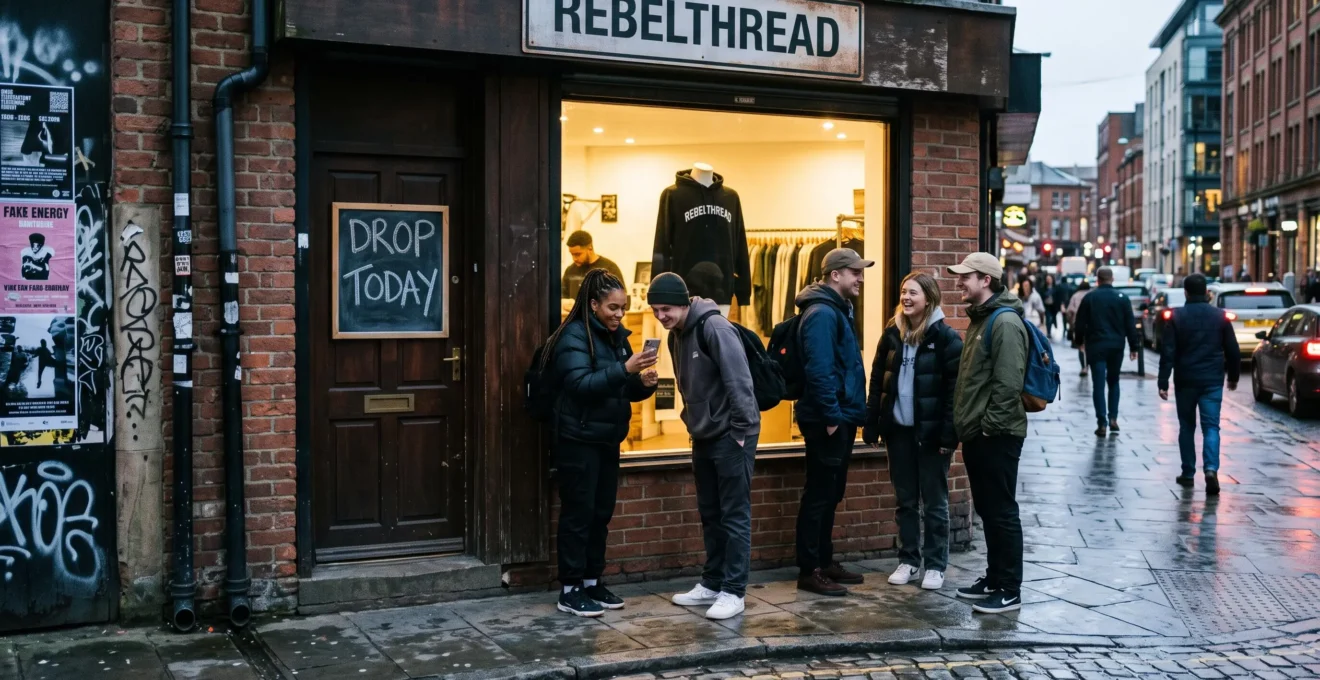
Streetwear became global fashion because the cultural codes developed within local communities eventually acquired value far beyond those communities. Skateboarding, hip-hop, surf culture and other urban scenes shaped ways of dressing that communicated belonging, knowledge and personal identity. Fashion brands later adopted these visual languages, distribution practices and relationships with cultural influence.
That transition was never simply a matter of oversized T-shirts becoming popular. A garment that once identified participation in a particular scene could eventually appear in luxury collections, international retail stores and everyday wardrobes. Its appearance might remain similar while its social meaning changed.
The central tension is that streetwear gains cultural value through community recognition, yet commercial expansion makes its codes accessible to people outside the communities that developed them. Understanding that tension explains why authenticity matters, how scarcity influences demand, why resale prices can be misleading and how streetwear continues to evolve after entering the mainstream.
Streetwear’s journey from local culture to global fashion
- Streetwear developed cultural credibility through communities, shared references and social relationships rather than clothing aesthetics alone.
- Luxury fashion adopted streetwear’s design language and commercial practices, creating hybrid brands and changing how garments are valued.
- The most enduring streetwear pieces retain personal, practical or cultural meaning even when trends fade and resale prices decline.
- Why Has Authenticity Always Mattered So Much in Streetwear Culture?
- How Can You Read the Cultural References Behind a Streetwear Collection?
- Streetwear Brand or Fashion Label: What Actually Separates the Two?
- Why Treating Streetwear as Hype Alone Misses Its Most Important Cultural Value
- When Does a Streetwear Trend Stop Being Subcultural and Become Mainstream Fashion?
- How Can You Style a Bold Graphic T-Shirt With Simple Trousers and Layers?
- Wear, Keep or Resell: What Should You Do With a Limited Sneaker Release?
- How Can Men Build an Urban Aesthetic That Works From Commute to Evening?
Why Has Authenticity Always Mattered So Much in Streetwear Culture?
Authenticity matters in streetwear because clothing often communicates a relationship with a community, not merely an aesthetic preference. A brand gains credibility when people recognize meaningful connections to the culture it references. Those connections may involve participation, shared experiences, creative contribution or sustained support for a particular scene, rather than an established name alone.
Streetwear’s development through underground skate and surf cultures illustrates why those relationships matter. As discussed in Andie Bain‘s academic article on streetwear customs and reworked fashion, the practice of adapting, borrowing and recontextualizing existing visual elements has long formed part of streetwear’s creative identity.
A graphic referencing a neighborhood skate spot can carry meaning beyond its artwork. For someone who knows the location, its people and its history, the graphic may express a shared experience. For someone unfamiliar with those connections, it may simply look appealing. Neither response automatically invalidates the garment, but the difference explains why cultural credibility cannot be established through appearance alone.
Scarcity can reinforce that distinction. A limited release might reward people who follow a local shop, recognize a collaborator or participate in a particular community. Waiting in line and knowing when a release happens can become social practices surrounding ownership. However, scarcity does not automatically establish authenticity: a product can be difficult to purchase without having a meaningful cultural foundation.
Research on consumer demand for limited footwear demonstrates that rarity can affect monetary valuation, but it does not establish that rare products necessarily possess greater cultural credibility.
The deeper paradox emerges when outside recognition increases. A community-specific design becomes commercially attractive because it carries associations that mass-produced fashion may struggle to reproduce. Once widely distributed, that same design may lose some of its power to distinguish insiders from outsiders.
Age is not a reliable substitute for authenticity either. A recent label with meaningful community involvement may have stronger connections than an established brand relying exclusively on its archive. Credibility requires continuing relationships rather than permanent ownership of a cultural identity.
Authenticity therefore operates less like a fixed certificate and more like an ongoing conversation between creators, wearers and communities. Reading that conversation begins with understanding the references embedded in clothing.
How Can You Read the Cultural References Behind a Streetwear Collection?
Reading a streetwear collection means identifying where its visual language comes from, how the designer has transformed that language and which audience the result addresses. Rather than stopping at logos or recognizable silhouettes, examine the garment’s historical influences, construction and cultural context. This method helps distinguish thoughtful reinterpretation from superficial borrowing.
A useful approach begins with three questions:
- What is the source scene? Look for influences from skateboarding, hip-hop, workwear, rave culture or regional dress. Identify the specific practice or community where possible rather than assigning every oversized silhouette to the same broad category.
- What has changed? Examine the cut, fabric, stitching, graphics and proportions. A traditional work jacket reconstructed in technical fabric may communicate a different design intention from a direct reproduction.
- Who is being addressed? Consider whether the collection speaks to an existing community, a fashion-focused audience or people encountering the references for the first time.
Imagine a hypothetical collection featuring cropped work jackets, loose trousers and graphics inspired by local music flyers. Its workwear construction suggests functionality; the graphic treatment suggests a particular cultural setting. The relevant question is whether the designer has created a coherent connection between these references or merely assembled recognizable symbols.
This approach also helps examine the difference between cultural quotation and appropriation. Fashion frequently borrows from existing practices, but the relationship between a creator and the source culture deserves scrutiny.
Useful indicators include transparent attribution, meaningful collaboration, accurate historical references and the participation of people connected to the scene. Community casting or collaboration alone does not guarantee an ethical outcome. Conversely, the absence of a formal collaboration does not automatically prove exploitation. Context, representation and the nature of the creative relationship all matter.
Reference literacy can also improve purchasing decisions. Understanding the origin of a workwear silhouette helps assess whether its utility and construction justify a place in a wardrobe. Recognizing a graphic’s relationship to a local scene may make its significance clearer even after its visual style becomes unfashionable.
These interpretive skills are relevant to streetwear’s global expansion. Fashion houses that engage designers associated with streetwear are not simply acquiring new silhouettes. They may also be seeking familiarity with communities, visual histories and ways of creating cultural relevance.
A five-step method for decoding a streetwear piece
- Identify one probable source scene and write down the specific visual clue supporting that interpretation.
- Compare the garment with a relevant historical or functional reference and record two construction differences.
- Check the collection’s published description or credits and note which cultural influences are explicitly acknowledged.
- Identify any documented collaboration or community involvement and record what can actually be verified.
- Write a one-sentence buying rationale explaining what the garment offers beyond its logo, scarcity or current popularity.
Once those references become legible, another distinction emerges: the difference between a label primarily organized around community relationships and one validated through conventional fashion institutions.
Streetwear Brand or Fashion Label: What Actually Separates the Two?
A streetwear brand and a conventional fashion label are not separated by hoodies, prices or logos. Their differences are better understood through distribution, cultural validation, production practices and control over brand identity. Streetwear has historically drawn legitimacy from communities and shared cultural references, while established fashion systems rely more heavily on institutional recognition and organized seasonal distribution.
Those distinctions are tendencies rather than rigid categories. A fashion house can release limited products, and an independent streetwear label can present seasonal collections. The more useful question is which mechanisms create value for a particular brand.
The following framework provides a practical comparison.
| Criterion | Streetwear-oriented model | Conventional fashion-label model |
|---|---|---|
| Distribution | Selected retailers, direct releases and limited drops | Seasonal collections, wholesale accounts and established retail networks |
| Validation | Community recognition, peer influence and cultural participation | Fashion institutions, buyers, editors and established brand positioning |
| Production rhythm | Potentially flexible releases tied to projects or cultural moments | More structured collection and buying calendars |
| Cultural narrative | Often developed through scene relationships and direct communication | Frequently developed through institutional presentation and brand direction |
| Primary value proposition | Community meaning, creative identity, desirability and sometimes scarcity | Design, craftsmanship, positioning and institutional prestige |
The boundaries between these models have become increasingly porous. Pierre-Yann Dolbec‘s research on streetwear’s integration into high fashion identifies successive stages of commercial and cultural transformation, including stylistic cooptation during the 1990s, hybridization during the early 2010s and the integration of luxury streetwear into high fashion during the mid-to-late 2010s.
Approximately 5% to 25%
In Dolbec’s study, the presence of luxury streetwear brands at major fashion shows, including Paris Fashion Week, increased from approximately 5% in 2010 to approximately 25% in 2015. These figures apply to the researcher’s defined luxury streetwear category and fashion-show presence, not to all streetwear brands or fashion collections.
Pierre-Yann Dolbec, Journal of Marketing Research, published in 2025.
Hybrid brands complicate pricing as well. A hoodie may command a premium because of material quality, distinctive design, brand prestige, cultural credibility or anticipated scarcity. These factors can overlap, but they should not be treated as interchangeable.
For buyers, the risk is assuming that a brand using streetwear’s visual and commercial codes necessarily possesses the same community relationships as an established scene-based label. A limited drop is not evidence of enduring demand, and a high retail price does not guarantee a resale market.
Assess the garment’s construction, the brand’s documented connections and the reason for its price separately. A product can be worthwhile without a strong resale market, just as a culturally credible label can sell broadly available garments.
That distinction leads to a broader question about value: what remains important when media attention and resale premiums disappear?
Why Treating Streetwear as Hype Alone Misses Its Most Important Cultural Value
Treating streetwear exclusively as hype confuses market attention with cultural significance. Resale prices measure what buyers may pay under particular conditions, while cultural value concerns the meanings that garments acquire through communities, personal identity and shared experiences. A piece can lose its resale premium without losing its usefulness or significance to the person wearing it.
Hype-based coverage tends to emphasize waiting lists, limited quantities, celebrity visibility and secondary-market prices. Those signals are visible and relatively easy to discuss. The social relationships surrounding clothing are harder to measure, but they may explain why particular garments matter long after a release ends.
Streetwear has helped make affiliations with skateboarding, music and urban communities visible through everyday clothing. A T-shirt purchased at a local event, for example, may remain meaningful because of the experience attached to it rather than the price another buyer would offer.
This distinction between exchange value and cultural value is particularly clear when communities assign their own meanings to commercial products.
Real case: How a winter parka acquired local meaning in Harlem
In multi-year ethnographic research conducted in Harlem, New York, sociologist Jeffrey Lane examined how young people developed social meanings around the Marmot Mammoth parka, locally known as the “biggie.”
The study describes how the garment became involved in friendships, rivalries and dating relationships. Its significance developed through neighborhood interactions rather than simply reflecting the manufacturer’s intended brand identity. The findings concern a specific community and should not be generalized to every streetwear product.
The example is documented in Jeffrey Lane‘s ethnographic study of clothing and community in Harlem. It illustrates how people can create meanings around clothing that cannot be reduced to marketing campaigns or resale data.
The practical implication is straightforward: consider whether a garment would remain desirable if nobody else wanted to buy it. Fabric, fit, comfort, memories and personal associations can all provide reasons to keep wearing something.
A hype-driven purchase, by contrast, can become difficult to justify when demand falls. If the primary attraction was the expectation of future resale profit or public recognition, a change in market attention may remove much of the original motivation for ownership.
This does not mean resale value is irrelevant. Collectors and buyers may reasonably consider it. The mistake is allowing one market indicator to replace every other dimension of value.
As streetwear reaches larger audiences, the balance between social recognition and commercial value changes again. The point at which this happens helps explain when a subcultural style becomes mainstream.
When Does a Streetwear Trend Stop Being Subcultural and Become Mainstream Fashion?
A streetwear trend becomes mainstream when its appearance and availability no longer depend on knowledge of the community that developed it. Luxury adoption, broad retail distribution, repeated restocks and mass-market interpretations are useful indicators. The transition is gradual, and mainstream popularity does not necessarily eliminate the original scene or its continuing cultural relevance.
Rather than assigning a universal date to crossover, look for observable changes in how the trend circulates:
- Luxury houses incorporate the silhouette, graphic treatment or styling language into widely publicized collections.
- Multi-brand retailers distribute similar products beyond specialist stores, often with more predictable availability.
- Customers can recognize and purchase the look without understanding its original cultural context.
- Mass-market retailers offer accessible interpretations, making the visual code familiar across different audiences.
These indicators describe a movement from relatively restricted cultural circulation toward broad fashion consumption. They are not formal industry thresholds, and a single indicator does not prove that a trend has completed the transition.
Consider the hypothetical example of a jacket style first associated with a local creative scene. Within that community, its cut or styling may communicate specific shared references. Once visually similar jackets become available across mainstream retailers, the silhouette can signify contemporary fashion awareness without necessarily indicating participation in the original scene.
Greater accessibility increases a trend’s reach while potentially reducing its exclusivity as a social signal. However, these effects do not have to cancel each other out. Wider recognition can create opportunities for designers, collaborators and communities, even as commercialization introduces new tensions over credit and control.
Dolbec’s historical analysis provides a useful example of this complexity. Streetwear producers adopted fashion-industry practices, while high fashion increasingly integrated streetwear designers and cultural elements. The transformation involved interaction between different systems, rather than a simple replacement of one by another.
Local communities may respond to broader adoption by experimenting with new proportions, references or ways of wearing familiar pieces. Yet innovation is not always a deliberate rejection of mainstream fashion. Scenes continue developing because their participants have evolving interests, needs and creative relationships.
Streetwear’s global expansion is therefore better understood as a recurring exchange. Local practices influence global fashion; global visibility changes the conditions around those practices; new cultural expressions continue to emerge.
Once a style becomes widely accessible, wearing it thoughtfully depends less on proving insider status and more on understanding how its references can work within a personal wardrobe.
How Can You Style a Bold Graphic T-Shirt With Simple Trousers and Layers?
Style a bold graphic T-shirt by allowing its cultural reference and visual weight to guide the rest of the outfit. Pair it with simple trousers, restrained colors and an adaptable outer layer. The aim is not to reproduce a complete subcultural uniform, but to give the graphic enough space to communicate without competing elements.
Start by identifying the graphic’s visual language. A skate-related print may work naturally with relaxed trousers, canvas footwear and an unstructured overshirt. A music-inspired graphic can also sit effectively beneath a more tailored jacket, particularly when the graphic’s scale and the garment’s fit create a deliberate contrast.
These are styling possibilities, not rigid cultural rules. Different music and skate communities contain many distinct approaches to dress. The point is to make choices based on the actual reference rather than assuming that every graphic T-shirt should be styled identically.
A useful layering hierarchy is to treat the graphic as the primary visual element and keep supporting pieces quieter:
- Foundation: Choose plain straight-leg, relaxed or gently tapered trousers in a color that complements the graphic.
- Middle layer: Add a solid-color overshirt, chore jacket or open hoodie without another dominant print.
- Outer layer: When needed, use a functional coat whose cut and texture support the outfit without introducing a competing statement.
- Footwear: Select a pair that works with the trouser proportions rather than automatically matching the loudest color in the print.
Fit changes how the same graphic reads. On an oversized T-shirt, a large print becomes part of a relaxed silhouette associated with various streetwear traditions. On a fitted or shorter T-shirt, the graphic may create a sharper contrast with tailored trousers or structured outerwear.
The proportions of the full outfit matter more than choosing one supposedly authentic silhouette. Wider trousers can balance a boxy tee, while straighter trousers may give a voluminous upper layer more definition.
A common styling failure is allowing several strong elements to compete. A large chest print, prominent trouser branding and heavily patterned outerwear can create a fragmented result. When combining references from different scenes, establish a common thread through color, period, fabric or silhouette.
For example, a faded graphic tee, dark straight-leg trousers and a plain cotton overshirt can work together because their textures and restrained palette create continuity. Removing the overshirt leaves an outfit that still feels complete.
Thoughtful styling is ultimately about giving a garment a practical role. The same principle becomes especially important when deciding whether limited-release footwear belongs in a wardrobe or a collection.
Wear, Keep or Resell: What Should You Do With a Limited Sneaker Release?
Whether to wear, keep or resell limited sneakers depends on your reason for buying them. Wear a pair when its practical and personal value matters most. Preserve it when collecting is an intentional goal. Consider reselling only after accounting for transaction costs, market uncertainty and the possibility that demand may change before a sale.
The decision should ideally happen before purchase. Ask whether the sneakers would still interest you if their resale price fell to the original retail price or below it. Then consider whether they fill a genuine gap in your footwear rotation.
A clear distinction between the three choices helps avoid conflicting expectations.
| Decision | Primary benefit | Main trade-off |
|---|---|---|
| Wear | Comfort, personal expression and everyday use | Wear and condition changes may reduce collector resale value |
| Keep | Preservation for an intentional collection | Storage demands and uncertain future value |
| Resell | Potential monetary return or recovery of spending | Platform costs, price changes, disputes and transaction risk |
Limited supply can affect the monetary value buyers assign to footwear, although the relationship depends on the product and market conditions.
Approximately 8% lower bids
In an empirical analysis of a particular customized-footwear auction on StockX, doubling the quantity offered was associated with approximately 8% lower bids after controlling for color. This result concerns the studied auction and model; it does not predict resale prices for all limited sneaker releases.
Caoui and colleagues, Management Science, 2025.
The result comes from Caoui and colleagues’ research on consumer demand and limited-edition footwear. It supports the idea that rarity can influence bids under particular conditions, but it should not be interpreted as a reliable formula for predicting an individual sneaker’s future price.
Reselling also involves costs that headline resale prices do not reveal. Depending on the platform and transaction, these may include seller fees, shipping, payment charges, authentication or condition disputes, and the consequences of a return. A profitable-looking sale can become less attractive after those expenses.
For illustration, consider a hypothetical pair purchased for $180 and sold for $220. The apparent $40 difference is not necessarily profit. Any purchasing costs, selling fees, shipping charges and other expenses must be deducted before calculating the actual result. These figures are illustrative, not market data.
Holding a pair in unused condition may help preserve its appeal to certain collectors, but it does not guarantee future demand. Materials can also age during storage, and the timing of a market peak is difficult to predict.
Wearing the sneakers reverses the priorities. Condition changes, but the owner receives direct use, comfort and experiences associated with the product. For someone whose interest comes from the design or the community around the release, those benefits may outweigh a possible resale premium.
The strongest personal decision rule is to separate enjoyment from speculation. A sneaker can have cultural significance without becoming a profitable asset, and a profitable resale does not establish cultural importance.
Choosing footwear for use rather than predicted attention creates a stronger foundation for everyday style, especially when building outfits that must work across different settings.
What to carry into an everyday wardrobe
- Choose core garments for their fit, comfort and relevance to your own life before considering their potential social or resale value.
- Keep the most expressive cultural references concentrated in a small number of pieces that work with neutral foundations.
- Build adaptability into proportions, layers and footwear so different settings require adjustments rather than an entirely new outfit.
How Can Men Build an Urban Aesthetic That Works From Commute to Evening?
Men can build a commute-to-evening urban aesthetic by combining comfortable foundational clothing with a small number of culturally meaningful statement pieces. Neutral trousers, adaptable outerwear and simple layers provide continuity between settings. One outer-layer change and one footwear change can adjust the outfit’s presentation without requiring a complete wardrobe switch.
The foundation should be practical enough for regular use. Well-cut trousers, a mid-weight jacket or overshirt, and a plain knit or T-shirt can create several combinations without relying on matching sets or prominent branding.
For example, begin with straight or gently tapered trousers, a graphic T-shirt and comfortable sneakers. During the commute, an unstructured hoodie or functional jacket provides warmth and movement. For an evening setting, replace that outer layer with a structured overshirt, simple bomber or light coat.
Switching from heavily worn everyday shoes to clean, understated footwear can further change the outfit’s overall impression. The aim is not to make every evening outfit formal. It is to adjust the degree of structure and visual polish while keeping the original aesthetic intact.
Comfort and presentation also depend on proportion. Relaxed trousers and wider upper layers can accommodate movement during the day, while slightly more defined shapes may suit settings where a neater appearance is preferred.
Adjustable details help bridge these expectations. A jacket with a practical zip, trousers with a controlled drawcord or sleeves that roll cleanly can alter the silhouette without changing garments. These features are useful only when they suit the actual design and fit rather than adding unnecessary complexity.
A small urban capsule might include two versatile trouser silhouettes, several plain base layers, one functional jacket, one structured outer layer and footwear suited to regular walking. A favorite graphic tee or culturally relevant accessory can then become the personal focal point.
This approach also makes trends easier to accommodate. A new silhouette or limited release does not require replacing the whole wardrobe if existing foundations remain useful. Instead, each addition can be judged by how well it connects with garments already owned.
The most resilient urban aesthetic is built around personal relevance, not constant novelty. Cultural awareness can inform the choice of a statement piece without forcing every garment to demonstrate insider knowledge.
Start by choosing one outfit already in regular rotation. Identify which pieces you would still wear without their branding, trend status or resale value. Keep those as the foundation, then experiment with one culturally meaningful statement and one adaptable layer. That simple exercise turns the history of streetwear into a practical way of dressing with greater intention.
Did streetwear originate in one city or country?
Streetwear developed through multiple overlapping cultural influences rather than one universally agreed birthplace. Skate and surf communities, hip-hop, and creative scenes associated with places including California, New York and Tokyo contributed to its development. Different histories emphasize different communities and periods, so claiming a single exclusive origin would oversimplify its evolution.
Can a mainstream streetwear brand still be authentic?
Yes. Wider distribution does not automatically erase a brand’s cultural connections. Credibility depends on continuing creative involvement, meaningful relationships and how the brand represents its influences. Commercial scale may change how certain products function as insider signals, but accessibility and authenticity are not mutually exclusive.
Does cultural appropriation always involve copying a design?
No. Cultural appropriation concerns broader questions about the use, context and representation of cultural elements, particularly when there are imbalances in recognition or influence. Direct copying may raise related concerns, but stylistic borrowing, reinterpretation and collaboration require attention to their specific circumstances. Cultural and legal evaluations are not necessarily identical.
Why can two similar streetwear garments have very different prices?
Pricing may reflect differences in materials, manufacturing, design, distribution and brand positioning. Community recognition, perceived scarcity and demand can also influence willingness to pay. A higher price does not necessarily mean better construction, greater cultural relevance or stronger resale performance, so the reasons for the premium should be evaluated separately.
How can someone participate in streetwear culture without buying limited releases?
Participation can involve learning about cultural histories, supporting local creative communities, attending public events, experimenting with personal styling and engaging with music, art or skate scenes where there is genuine interest. Limited products are one part of streetwear’s commercial ecosystem, not a requirement for meaningful cultural engagement.