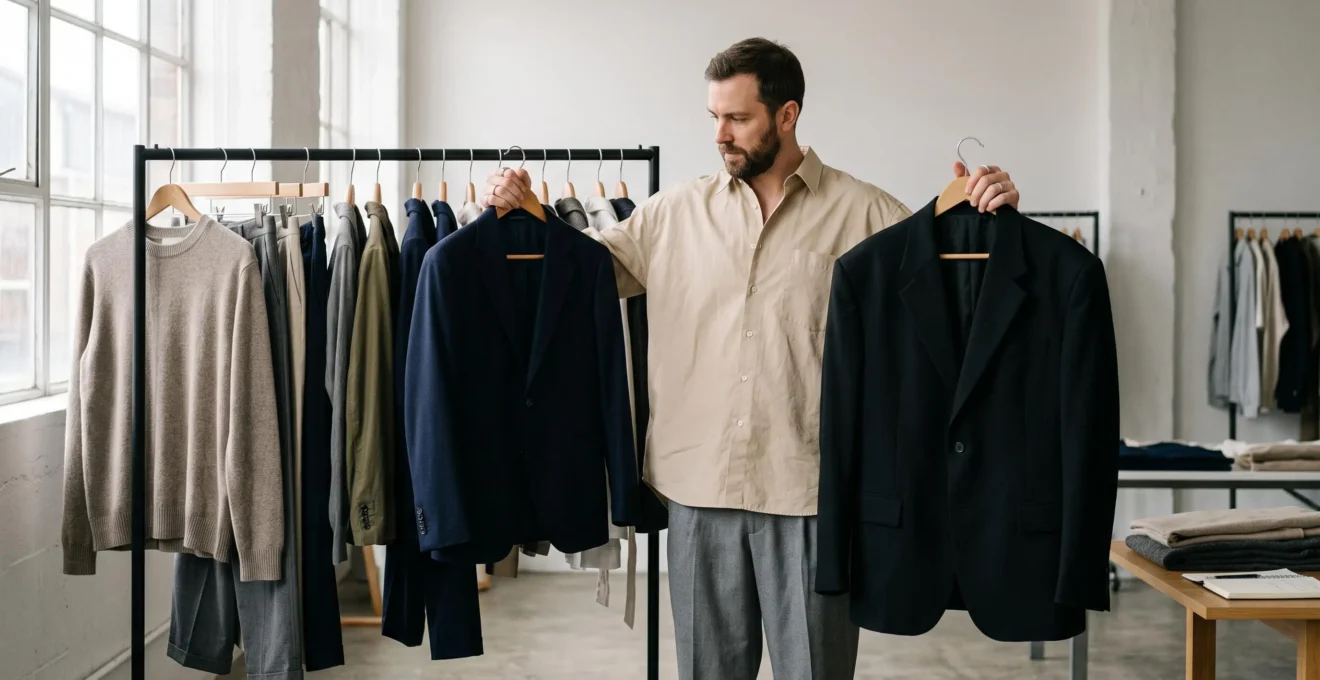
The clothes men wear every day often reflect fashion ideas that once seemed impractical, exaggerated or unfamiliar. Wider trousers, relaxed tailoring, dropped shoulders and unconventional layering can all appear in experimental collections before finding more restrained expressions in ordinary wardrobes. Yet contemporary high fashion does not simply dictate what everyone eventually wears.
Influence moves in several directions. Luxury designers introduce new interpretations of familiar garments, retailers adapt selected elements, and street culture can inspire designers in return. Social media, personal styling and changing expectations about comfort also affect which ideas gain traction.
For someone interested in contemporary menswear, the useful question is not whether an outfit looks fashionable on a runway. It is which parts of that outfit improve real clothing choices: proportion, construction, material, colour or the relationship between garments.
Understanding that distinction makes it easier to recognise emerging silhouettes, evaluate designer prices and incorporate new ideas without surrendering a consistent personal style.
High fashion and everyday menswear: the essentials
- Runway influence usually appears through selected proportions, fabrics and styling details rather than complete copied outfits.
- A single experimental element, adjusted to your body and routine, is often easier to integrate than an entire runway look.
- Wardrobe value depends on fit, construction, compatibility and expected use—not simply whether a garment carries a designer label.
- Why Do Extreme Runway Silhouettes Eventually Become Normal Everyday Shapes?
- How Can You Borrow High-Fashion Ideas Without Looking Like You Are Wearing a Costume?
- Designer Original or High-Street Interpretation: Which Gives Better Wardrobe Value?
- The High-Fashion Purchase That Looks Exciting but Rarely Leaves the Wardrobe
- When Is a Runway Trend Ready for an Everyday Wardrobe?
- How Can You Add Current Menswear Trends Without Making Your Wardrobe Feel Disconnected?
- Oversized Shirt, Trousers or Jacket: Which Is Easiest to Wear First?
- How Can Men Build a Personal Style That Feels Consistent Without Looking Overdone?
Why Do Extreme Runway Silhouettes Eventually Become Normal Everyday Shapes?
Extreme runway silhouettes can become everyday clothing shapes because their most adaptable features survive repeated reinterpretation. Retail designers may reduce exaggerated volume, adjust garment lengths or simplify construction while preserving a recognisable proportion. As these variations become familiar, previously unusual cuts can feel ordinary. However, fashion influence also travels from street culture towards luxury design, not exclusively from runway to retail.
A runway collection often uses proportion to communicate an idea immediately. Exceptionally broad shoulders, elongated sleeves or dramatically wide trousers create visual impact, but those exact dimensions may be inconvenient outside a presentation.
Commercial adaptations can preserve the original design intention while making the garment easier to move in, layer and combine with existing clothes.
Consider a hypothetical runway jacket with dramatically extended shoulders. A more wearable interpretation might keep a relatively broad upper body but reduce the extension, shorten the sleeves and soften the structure. The resulting garment still looks contemporary without requiring the wearer to reproduce the complete runway silhouette.
This is the distinction between silhouette adoption and detail adoption. A man may never wear an extremely sculptural coat, but he might adopt its longer hemline, roomier sleeves or relaxed shoulder treatment.
Research comparing runway collections, fashion influencers and online retail products found similarities in silhouette characteristics across these channels. However, popular retail items were more closely associated with influencer outfits than with runway collections in the relationships studied. The research on fashion trend diffusion across runways, influencers and retailers therefore supports a more interconnected model than a simple designer-to-consumer pipeline.
The historical relationship between slim and oversized menswear also resists a single explanation. The Museum at FIT documents how hip-hop artists and young people in New York helped popularise oversized clothing during the late 1980s, demonstrating that influential proportions can originate outside luxury fashion.
For a practical diffusion test, compare a dramatic designer garment with similar offerings from mid-market retailers. Look for recurring changes in shoulder width, trouser volume and garment length. If restrained versions appear across different collections, the idea may be entering a more accessible phase.
That observation is a signal of broader availability, not a guarantee of universal acceptance.
The useful skill is learning to recognise a transferable design feature rather than assuming every dramatic runway shape will become the next mainstream standard.
How Can You Borrow High-Fashion Ideas Without Looking Like You Are Wearing a Costume?
You can borrow high-fashion ideas without creating a costume effect by introducing one visually distinctive element at a time, adjusting its fit to your proportions and keeping the surrounding outfit familiar. The aim is to translate a design principle rather than reproduce a complete editorial look. Your everyday setting should determine how dramatic that translation becomes.
Runway styling is designed to make clothing legible under unusual conditions. Lighting, models, footwear, accessories and deliberate combinations can amplify the impact of an otherwise simple garment.
Everyday clothing must operate without those supporting conditions.
One practical editorial method is the one statement element rule. Choose a single experimental feature—perhaps an exaggerated jacket, unusual fabric, strong colour or unconventional layer—and combine it with garments whose shape and purpose are already familiar.
For example, a sharply oversized blazer can work with a plain T-shirt, straight trousers and understated shoes. Adding equally dramatic trousers, sculptural footwear and several statement accessories may make the outfit harder to integrate into ordinary surroundings.
This is a styling guideline rather than an evidence-based limit on how many unusual garments someone should wear. More experimental combinations can work when they suit the wearer and setting.
Fit requires a separate decision. A piece photographed on a runway model may have been selected or adjusted for a particular presentation. Reproducing its dimensions without considering your own height, shoulders and preferred movement can distort the intended silhouette.
Stand several steps from a full-length mirror and assess the complete outline rather than focusing on one appealing detail. Check whether the garment frames your body, whether the sleeves and hem look purposeful, and whether the outfit still feels recognisably yours.
Context provides the final calibration. A striking textured jacket may feel appropriate at an exhibition opening but conspicuous in a conservative workplace. The same influence could be expressed at the office through a slightly fuller shoulder or subtler fabric texture.
A useful question is whether the borrowed element adds personality without disrupting the occasion. If it does not, reduce its intensity instead of necessarily abandoning the idea.
Once a fashion idea works with familiar pieces and realistic settings, it becomes a genuine wardrobe option rather than a look that only makes sense in photographs.
Designer Original or High-Street Interpretation: Which Gives Better Wardrobe Value?
A designer original offers better wardrobe value when its specific cut, material or construction provides a meaningful advantage that you will use repeatedly. A high-street interpretation can be the better purchase when it delivers a convincing silhouette at a lower price, particularly for experimental trends. Neither category guarantees superior value: the decisive measures are quality, compatibility and realistic cost per wear.
Designer pricing can reflect creative development, specialised construction, materials, branding and other costs. Not every premium produces a corresponding improvement in durability or everyday performance.
Likewise, a high-street garment can reproduce the broad visual idea of an expensive original while differing substantially in its pattern and construction.
When comparing two versions of relaxed trousers, inspect the rise, waistband, fabric weight, leg shape and how the material hangs from the hip. A simplified interpretation might look similar on a hanger but behave differently when worn.
Cost per wear provides a more useful financial comparison than price alone. Divide the purchase price by the number of times you realistically expect to wear the garment.
For illustration only, imagine a designer jacket costing £600 and worn 120 times, compared with a £120 alternative worn 15 times. Their hypothetical costs per wear would be £5 and £8 respectively. The more expensive jacket performs better on this single measure only because of the assumed usage—not because designer clothing is inherently superior.
Six preregistered experiments discussed in experimental research on clothing cost per wear found that presenting cost-per-wear information could increase consumer preference for higher-quality clothing when it offered a lower indicated cost per wear. The effect was weaker in certain conditions, including special-occasion purchasing.
For garments intended to remain in regular use—such as coats, tailored jackets or versatile trousers—it can therefore be sensible to examine whether paying more produces an actual advantage. For striking seasonal prints or very unconventional cuts, an affordable version may limit financial exposure.
The categories are only starting points. A poorly fitting expensive coat may represent worse value than a well-made inexpensive one.
The following comparison helps separate aesthetic similarity from practical value.
| Criterion | Designer original | High-street interpretation |
|---|---|---|
| Silhouette | May preserve more specialised patternmaking | May simplify proportions or construction |
| Materials | Assess composition and performance individually | Assess composition and performance individually |
| Purchase price | Often carries a substantial premium | Usually offers a lower entry cost |
| Trend experimentation | Greater financial commitment | Can make experimentation less costly |
| Wardrobe value | Depends on actual use and garment quality | Depends on actual use and garment quality |
A designer purchase becomes defensible when its advantages matter in use. A successful high-street interpretation deserves equal consideration when it preserves the elements that made the original appealing.
The High-Fashion Purchase That Looks Exciting but Rarely Leaves the Wardrobe
The high-fashion purchase most likely to remain unworn is a striking garment that appeals more as an object than as something you can realistically use. It may require unfamiliar styling, occasions that rarely occur or a level of visual experimentation you do not enjoy in daily life. The problem is often a mismatch between purchasing excitement and actual wardrobe habits.
An unusual coat, heavily embellished shirt or sculptural pair of trousers can look compelling in a carefully styled image. The same garment may feel difficult once removed from the setting that made it attractive.
This creates an excitement gap: the difference between enjoying a garment’s visual identity and wanting to wear it repeatedly.
To identify that gap, imagine three specific occasions from your actual routine. For each, assemble a complete outfit using clothes you already own.
If fewer than two combinations feel convincing, treat that as a warning to reconsider. This two-out-of-three threshold is a practical buying heuristic, not a scientifically validated prediction of future use.
The distinction matters because garments can be visually interesting without being personally useful. Appreciating a runway-inspired design does not require owning it.
There is also a financial dimension. An infrequently worn purchase has a high realised cost per wear. Attempting to resell it may recover some expenditure, but the outcome depends on brand demand, condition, size, desirability and market timing.
Highly trend-specific pieces can be harder to match with prospective buyers, although some rare designer garments retain value or become collectible. Neither a predictable resale loss nor a reliable resale premium should be assumed.
A more productive approach is to test the garment against your habits before allowing the novelty of the design to dominate the decision.
A five-step test before buying a statement piece
- Identify its appeal. Write down the one feature you genuinely want: silhouette, colour, texture or construction. Deliverable: a one-sentence purchase reason.
- Build three outfits. Name existing garments that could accompany it. Deliverable: three complete outfit combinations.
- Assign real occasions. Match each outfit to somewhere you actually go. Deliverable: three specific situations.
- Check the practical fit. Assess movement, comfort, care requirements and visual balance. Deliverable: a short list of acceptable compromises.
- Make the wear decision. Keep the purchase under consideration only if at least two realistic combinations work, then assess the expected cost per wear. Deliverable: a written buy, postpone or reject decision.
The most successful statement purchase is not necessarily the most memorable item in a shop. It is the one that remains desirable after the novelty has faded and becomes part of real outfits.
When Is a Runway Trend Ready for an Everyday Wardrobe?
A runway trend is ready for your everyday wardrobe when it is available in a wearable form, fits your existing clothes and suits the situations in which you dress. Wider retail availability, more realistic sizing and examples of ordinary styling can indicate that experimentation has become easier. These signals are useful, but they do not guarantee that a trend will last.
Fashion adoption is not a single moment. A silhouette may be introduced in a highly experimental form, circulate through fashion communities and eventually appear across more accessible retail categories.
However, not every style follows that sequence, and some fashions originate outside designer collections altogether.
The University of Minnesota textbook chapter on fashion trend lifecycles describes multiple diffusion patterns, including top-down, horizontal and bottom-up influence. It also discusses adoption stages such as awareness, evaluation, trial and eventual adoption.
For a practical wardrobe decision, look for three indicators:
- Commercial interpretation: a designer idea has become available in a less theatrical form.
- Accessible choice: retailers offer versions with workable sizes, fabrics and proportions.
- Everyday compatibility: the style can be worn with ordinary garments rather than relying on an entire specialised outfit.
The timing depends on your appetite for experimentation. An early adopter may enjoy distinctive styling despite limited options and higher uncertainty. Someone seeking a stable wardrobe may prefer a later phase, when alternative cuts and real-world combinations are easier to evaluate.
Waiting indefinitely has disadvantages too. A garment purchased after interest has already declined may offer fewer opportunities to enjoy the look while it still feels relevant.
It also helps to distinguish recurring silhouettes from isolated experiments. Relaxed tailoring and variations in trouser width have historical precedents, while a highly specific decorative treatment may be closely associated with one collection.
Look for examples across different periods rather than relying solely on recent social-media visibility. Historical recurrence can suggest broader stylistic possibilities, but it cannot guarantee that a particular shape will return again.
The ideal adoption point is personal rather than universal: a trend becomes worth trying when it expands what you can wear without creating unnecessary compromise.
How Can You Add Current Menswear Trends Without Making Your Wardrobe Feel Disconnected?
To introduce current menswear trends without fragmenting your wardrobe, first identify its dominant colours, usual proportions and typical level of formality. Choose new pieces that connect with at least two of those three characteristics, then use familiar garments to bridge any remaining difference. A trend should expand your outfit combinations rather than require an entirely separate wardrobe.
New clothing often feels disconnected because it was selected in isolation. A garment may look excellent in a retailer’s styling but conflict with the shoes, trousers or outerwear someone already owns.
A brief wardrobe coherence audit makes those conflicts easier to anticipate.
Start with colour. Are most of your garments navy, grey, black and white, or do you regularly wear warmer earthy tones? A striking new piece may integrate more easily if it shares a familiar base colour, even when its silhouette is unfamiliar.
Next, assess fit. A wardrobe built around slim trousers and close-fitting tops may accommodate an oversized shirt immediately, but a dramatic wide-legged trouser can require more thought about shoes and upper-body proportions.
Finally, consider formality. Tailored clothing, workwear and sportswear can be mixed deliberately, yet not every combination feels equally natural in every environment.
Use a two-out-of-three compatibility test as a practical filter: a new garment should ideally connect with two existing wardrobe characteristics. This is an editorial decision tool rather than a validated numerical rule.
The bridging-piece technique provides another solution. A plain T-shirt, understated shoes or familiar neutral jacket can connect an experimental garment with the rest of an outfit.
For example, dark wide-leg trousers may feel less unfamiliar when paired with a simple knit and shoes already worn regularly. Their volume becomes the change, while the rest of the outfit retains recognisable continuity.
Wardrobe coherence also requires subtraction. Repeatedly adding trends without reviewing older garments can create storage problems and make it harder to identify useful combinations.
A one-in, one-out rule may help someone managing limited space. Others may prefer a periodic review that separates frequently worn pieces from items awaiting alteration, resale, donation or renewed use.
Successful trend adoption is less about keeping pace with every collection and more about choosing changes that make your wardrobe progressively more useful and expressive.
Oversized Shirt, Trousers or Jacket: Which Is Easiest to Wear First?
An oversized shirt is generally the easiest starting point for experimenting with volume because it can be worn over familiar trousers and adjusted through sleeve styling or layering. An oversized jacket introduces more visible structure, while oversized trousers change the lower-body silhouette and its relationship with footwear. This progression is a practical styling recommendation, not a universal rule for every body type.
The shirt offers considerable flexibility. A slightly dropped shoulder, fuller body and longer hem can communicate a relaxed silhouette while the rest of the outfit remains conventional.
For a first experiment, consider a shirt that ends above or around mid-thigh rather than extending far below it. The exact length depends on your height, preferred layering and whether you intend to wear the shirt tucked or untucked.
Rolled sleeves can also reveal the wrists and reduce the impression of excess fabric. The objective is intentional volume, not simply buying a standard shirt several sizes too large.
An oversized jacket adds structure and makes proportion more prominent. Its shoulder treatment matters especially because major shoulder alterations can be difficult, expensive or impractical.
A deliberately dropped shoulder should be evaluated differently from a tailored shoulder that simply fits badly. Check the intended design, sleeve movement and how the jacket layers over your usual shirts or knitwear.
Oversized trousers require attention to two practical measurements: waist fit and trouser break. The waistband should sit securely at the intended height, while the hem should interact with footwear as intended rather than dragging unintentionally.
A longer, wider leg can create a continuous drape, but its appearance changes considerably with different shoes. Trying the trousers with footwear you actually own is therefore more informative than evaluating them alone.
The following comparison captures the typical challenges for someone beginning to explore oversized clothing.
| Garment | Main advantage | Primary fitting concern |
|---|---|---|
| Oversized shirt | Easy to combine with familiar bottoms | Length and sleeve volume |
| Oversized jacket | Adds a distinctive outer silhouette | Shoulder construction and layering |
| Oversized trousers | Changes the outfit’s overall proportions | Waist position, hem and footwear |
Progressing from shirt to jacket to trousers allows you to experiment with increasing amounts of volume. It also makes it easier to identify which proportions genuinely suit your preferences.
Someone who already enjoys wide trousers may reasonably reverse this sequence. Personal comfort and existing clothing matter more than following a rigid hierarchy.
Once a preferred oversized silhouette becomes familiar, it can shift from occasional experimentation into a recurring feature of personal style.
What to carry into your personal style
- Identify the proportion, texture or construction feature you genuinely enjoy instead of treating an entire runway look as one indivisible idea.
- Repeat compatible choices across different outfits so experimental pieces become familiar rather than isolated purchases.
- Retain enough flexibility to change your preferences without replacing your entire wardrobe whenever fashion shifts.
How Can Men Build a Personal Style That Feels Consistent Without Looking Overdone?
Men can build a consistent personal style by repeating a few recognisable choices across different outfits: a preferred colour palette, familiar proportions and one or two distinctive design elements. Consistency does not require wearing the same clothes every day. It comes from making related decisions often enough that new trends begin to feel like extensions of your taste rather than separate identities.
Think of personal style as a system of recurring preferences rather than a strict uniform.
A man might regularly choose relaxed tailoring, muted colours and substantial shoes. Within that framework, he can experiment with contemporary jackets, technical fabrics or unusual knitwear without abandoning the general character of his wardrobe.
The important distinction is between repetition and rigidity. Repetition creates recognition; rigidity prevents experimentation.
Runway fashion becomes especially useful when it supplies new variations on existing preferences. Someone already drawn to structured clothing might adopt an unusual shoulder shape. Someone who favours casual dressing might explore relaxed proportions or a different layering technique.
Overstyling often occurs when several attention-grabbing decisions compete for the same visual emphasis. A statement jacket, highly patterned trousers, dramatic shoes and multiple prominent accessories may all be appealing individually, yet create an outfit without a clear focal point.
As a practical editing method, identify one or two deliberate elements and allow the remaining clothes to support them. This is not a universal aesthetic law; maximalist dressing can be coherent when its contrasts are intentional.
To audit an outfit, assess its silhouette first. Then consider the colours, textures and accessories. Ask which element you notice immediately and whether the other choices reinforce it or compete with it.
Personal style also becomes more credible through real use. A runway-inspired shirt worn regularly with different trousers can become a recognisable signature. The same shirt worn once as part of an elaborate themed outfit may remain only an experiment.
That is the difference between following a trend and incorporating an idea into your own visual language.
No individual styling formula guarantees consistency. Body proportions, professional environments, climate, comfort and changing tastes all influence which decisions remain useful over time.
Choose one existing outfit you already enjoy wearing. Identify its strongest recurring feature, introduce one compatible runway-inspired variation, and wear the combination in a normal setting before deciding whether that change deserves a permanent place in your wardrobe.
Does every major menswear trend begin with luxury designers?
No. Fashion influence can move from luxury brands towards mainstream retailers, between social groups or from street culture into designer collections. The history of oversized clothing and hip-hop illustrates why runway innovation should not be treated as the sole origin of modern menswear trends.
Can a man follow high fashion without buying designer labels?
Yes. High-fashion influence can be expressed through proportion, garment length, fabric texture, layering or colour. Second-hand clothing, existing wardrobe pieces and thoughtfully selected high-street garments can provide opportunities to experiment without purchasing luxury labels.
How can you tell whether an oversized garment fits intentionally?
Look for deliberate relationships between the garment’s volume and its functional details. A roomy shirt should still have a workable length, a jacket should allow comfortable movement, and trousers should fit securely at the waist with an intentional hem. Oversized design does not eliminate the need for appropriate fit.
Is an expensive designer garment always a better long-term investment?
No. A higher purchase price does not guarantee better durability, more frequent wear or stronger resale value. Assess fabric, construction, alterations, care requirements and realistic use. Financial value depends on the garment’s actual role in your wardrobe rather than its label alone.
How often should a man update his wardrobe to remain contemporary?
There is no necessary seasonal replacement schedule. Reviewing your wardrobe when your needs, preferences or existing garments change is more useful than following every collection. Small adjustments to proportions, styling or individual pieces can make familiar clothing feel current without creating a disconnected wardrobe.