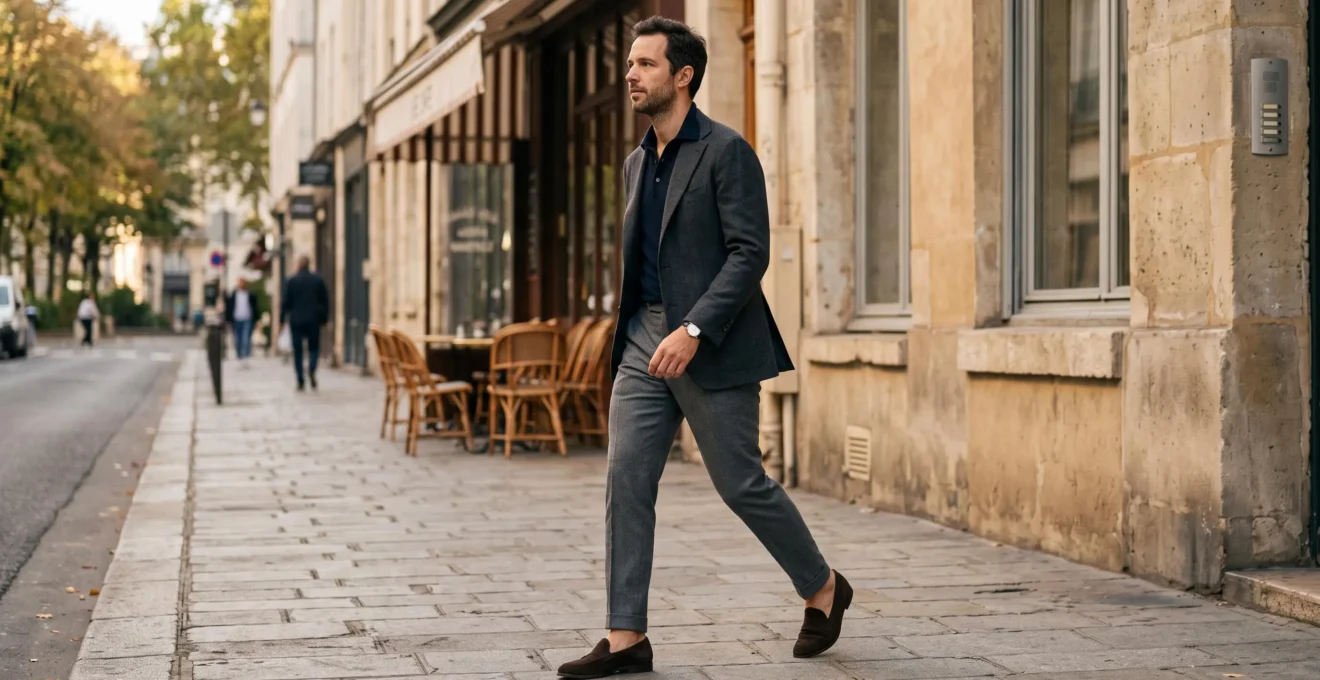
An elegant outfit does not need matching suit trousers and a jacket, a tie, or highly polished dress shoes. It needs a coherent silhouette, appropriate fabrics, and enough restraint to make each garment feel deliberately chosen. A fine-knit polo with tailored trousers, for example, can communicate refinement without looking like conventional office attire.
The difficulty lies in balancing those elements. A beautifully cut blazer can look awkward with excessively casual trousers. A coordinated outfit can appear rigid when every accessory matches perfectly. Even expensive clothing can lose its impact when proportions or textures compete.
The solution is to build around a small number of reliable decisions: choose one refined anchor, keep the remaining garments compatible in formality, and use colour, texture, and footwear to control the overall impression.
Whether dressing for a restaurant, a date, a workplace, or a social event, the objective remains the same: appear considered without looking as though the outfit demands attention.
The essentials of understated men’s elegance
- Start with fit and proportion, then introduce one deliberate point of visual interest.
- Use tonal colours, complementary textures, and compatible levels of formality rather than excessive matching.
- Adjust the outfit to the setting through small substitutions, particularly footwear, knitwear, and jacket construction.
- Why Do Simple Outfits Often Look More Elegant Than Complicated Ones?
- How Can You Dress Elegantly for Dinner Without Looking Overdressed?
- Tonal or Contrasting Colours: Which Creates a More Elegant Outfit?
- The Coordination Mistake That Can Make a Smart Outfit Look Too Calculated
- When Should You Add a Blazer to Make an Outfit More Elegant?
- How Can You Wear an Unstructured Blazer With Casual Trousers and Still Look Polished?
- Wool, Cotton or Technical Dress Trousers: Which Are Best for Everyday Wear?
- How Can Men Build Smart-Casual Outfits Without Looking Too Formal or Too Relaxed?
Why Do Simple Outfits Often Look More Elegant Than Complicated Ones?
Simple outfits often look more elegant because they allow the eye to follow a clear silhouette without distractions from competing colours, patterns, and accessories. When garments fit properly and share compatible proportions, the result feels cohesive. Simplicity does not mean removing every interesting detail; it means allowing a few carefully chosen elements to carry the outfit.
Consider a navy merino sweater, charcoal trousers, and dark brown suede loafers. Each element contributes something specific: the knit adds softness, the trousers establish a clean line, and the shoes introduce a subtle textural contrast. Nothing needs to compete for attention.
Now imagine adding a patterned scarf, brightly coloured belt, contrasting socks, prominent watch, and heavily textured jacket. None of these pieces is necessarily unattractive individually, but together they introduce several competing focal points.
Visual restraint is a practical editing process, not a requirement to wear identical neutral garments every day.
One useful styling heuristic is the three-element rule. Identify the three strongest visual statements in an outfit, such as its dominant colour relationship, principal texture, and standout accessory. If additional features demand equal attention, consider removing or simplifying one.
This is not a scientifically established threshold. It is a convenient way to evaluate whether an outfit feels unnecessarily busy.
Minimalism also exposes shortcomings. In an outfit consisting of a plain sweater and trousers, poor shoulder fit, trousers that bunch at the ankle, or excessively thin fabric become particularly noticeable. With fewer distractions, fabric, fit, and maintenance matter more.
Complete visual uniformity can also become bland. An otherwise restrained outfit often benefits from one distinctive feature: brushed wool, suede shoes, a textured knitted polo, or an understated watch.
Once the outfit has a clear visual foundation, the next decision is how much formality the occasion actually requires.
How Can You Dress Elegantly for Dinner Without Looking Overdressed?
To dress elegantly for dinner without looking overdressed, begin with the restaurant’s atmosphere, the time of the reservation, and the expectations of the people attending. Aim slightly above the anticipated level of dress rather than substantially beyond it. Well-fitting trousers, refined knitwear, and appropriate leather shoes usually provide an adaptable starting point.
A neighbourhood restaurant, a formal anniversary dinner, and a business meal may all require different interpretations of elegance. Dressing well means responding to that context, not automatically selecting the most formal garments available.
Three signals are particularly useful:
- Venue: Look at the restaurant’s stated dress code, service style, and general atmosphere.
- Time: An informal lunch may call for a lighter, more relaxed outfit than an evening reservation at an upscale restaurant.
- Company: A first date, client dinner, and relaxed meal with friends create different expectations, even at the same venue.
When the dress code is unclear, make one element more refined rather than elevating everything simultaneously. Swap casual trainers for suede loafers, replace an ordinary T-shirt with a fine-gauge knit, or choose tailored trousers instead of distressed denim.
For example, dark trousers, a navy knitted polo, and leather loafers provide a polished foundation without introducing the ceremony associated with a suit and tie.
A blazer can remain an optional finishing layer. This makes the outfit adaptable if the room proves more formal than expected.
Fashion retailer MR PORTER offers examples of this approach in MR PORTER‘s article on looking smart without a suit, including combinations of dark denim, knitted polos, and informal tailoring. These are editorial styling examples rather than universal dress-code rules.
The final question is social rather than purely aesthetic: would the outfit look appropriate among the other guests, or would it make the wearer seem determined to be the most formally dressed person in the room?
Being slightly better dressed than expected can communicate care. Being dramatically more formally dressed may instead suggest that the occasion has been misunderstood.
For uncertain venues, the most flexible solution is a dark, well-fitting outfit that looks complete without its jacket and can be dressed up when needed.
Tonal or Contrasting Colours: Which Creates a More Elegant Outfit?
Neither tonal dressing nor contrasting colours is inherently more elegant. Tonal combinations create a continuous, restrained appearance by using related shades, while contrasting combinations introduce stronger visual definition. The better choice depends on the setting, garment proportions, and desired impression. Texture and colour balance usually matter more than following either approach rigidly.
Tonal dressing works particularly well when shades are close but not identical. Charcoal trousers, a mid-grey wool sweater, and an off-white shirt create depth without requiring bright accents.
The key is varying texture alongside colour. A smooth shirt, softly knitted sweater, and brushed-wool trousers reflect light differently, preventing the outfit from becoming visually flat.
Alternatively, a white shirt with navy trousers creates a sharper distinction between upper and lower body. That contrast may suit a professional dinner or a business-casual environment where a more defined appearance is desirable.
Contrast is therefore a useful styling dial rather than a binary rule. Strong contrasts often produce a more graphic or crisp appearance, while closely related shades tend to look softer. Neither effect guarantees greater formality in every context.
The menswear publication Permanent Style discusses these relationships in Permanent Style‘s discussion of colour theory in clothing, highlighting neutral palettes, texture, and the different impressions created by colour combinations.
For everyday use, a practical palette heuristic is two dominant colours plus one neutral accent. This is a styling guideline, not a fixed aesthetic law.
| Consideration | Tonal dressing | Contrasting dressing |
|---|---|---|
| Typical visual effect | Continuous, restrained and subtle | Defined, crisp and noticeable |
| Example | Charcoal trousers with a mid-grey knit | Navy trousers with an off-white shirt |
| What makes it work | Variation in shade and texture | Controlled placement of light and dark |
| Common mistake | Every item appears almost identical | Too many unrelated accent colours |
| Useful context | Relaxed dinners and understated styling | Occasions calling for sharper definition |
With tonal outfits, avoid matching every garment so closely that the result resembles an accidental uniform. With contrasting outfits, avoid introducing another dominant colour without considering the existing palette.
Once colour relationships are controlled, the next risk is coordinating individual accessories so precisely that the outfit loses its natural ease.
The Coordination Mistake That Can Make a Smart Outfit Look Too Calculated
The most common coordination mistake is trying to make every visible element match another one exactly. Identical accessory colours, repeated patterns, and highly deliberate combinations can make an outfit feel overly arranged. Refined coordination usually works better when garments share compatible tones, textures, or formality without reproducing every detail.
Matching and coordinating are related but different ideas. Matching focuses on similarity. Coordination considers whether the pieces work together as a whole.
Dark brown suede loafers and a medium-brown leather belt, for instance, can form a coherent combination without being identical. The colours belong to a compatible family, while their different textures help the outfit feel less rigid.
There is no need to avoid matching shoes and belts altogether. In formal business dress, close coordination remains a familiar and useful convention. The issue arises when every accessory becomes another deliberate colour repetition.
A traditional illustration involves ties and pocket squares. In Put This On‘s advice on coordinating pocket squares, menswear writer Derek Guy recommends complementary combinations rather than simply reproducing the same colours or patterns.
That guidance concerns classic tailored accessories, but it illustrates a broader styling consideration: visual relationships can be clear without being identical.
To assess an outfit, identify its obvious connections. Perhaps the shoes match the belt, the watch strap matches the bag, and the shirt repeats the colour of an accessory. If each detail visibly points toward another, experiment with relaxing one connection.
The result might be as simple as wearing a textured neutral belt instead of one that precisely matches the shoes.
Excessive coordination can also make the outfit feel less forgiving. When everything appears meticulously planned, a single awkward element may stand out more clearly. This is an aesthetic observation, not an empirically established psychological effect.
This balance becomes especially relevant when introducing a blazer, whose construction and formality can either unify the look or make it seem excessively dressed up.
When Should You Add a Blazer to Make an Outfit More Elegant?
Add a blazer when the rest of the outfit looks slightly too casual for the occasion and needs more shape or visual definition. A well-chosen jacket sharpens the shoulder line and introduces tailored structure without requiring a complete suit. However, if the shirt, trousers, and shoes are already highly formal, adding a structured blazer may create an unnecessarily businesslike appearance.
The blazer works as a formality multiplier. It changes how the whole outfit is perceived, even when the garments underneath remain unchanged.
Consider two combinations:
- Blazer with a T-shirt and jeans: A soft-shouldered, unstructured jacket usually makes more sense than a stiff business-style blazer. Clean dark denim, a substantial plain T-shirt, and restrained footwear help bridge the formality difference.
- Blazer with knitwear and tailored trousers: A fine-gauge sweater or knitted polo creates a natural transition between a tailored jacket and smarter trousers, making this a particularly adaptable combination.
The jacket’s construction matters as much as its colour. A heavily padded shoulder, rigid fabric, and sharply defined lapels create a different impression from soft wool, cotton, linen, or knitted construction.
Likewise, the trousers need to feel compatible with the blazer. A relaxed linen jacket paired with highly polished formal trousers may look less coherent than the same jacket worn with matte cotton twill.
Before adding a blazer, ask whether it improves an existing outfit or attempts to rescue a combination that does not work on its own.
Practical comfort also matters. In hot weather, crowded restaurants, or long events, a blazer may spend more time over a chair than on the shoulders.
If removing it reveals a badly proportioned shirt or an unfinished-looking base, the outfit is relying too heavily on the jacket.
A successful blazer should enhance an already coherent outfit, not become the only reason that outfit appears considered.
How Can You Wear an Unstructured Blazer With Casual Trousers and Still Look Polished?
Wear an unstructured blazer with casual trousers by keeping the fabrics, proportions, and overall level of formality compatible. The jacket’s soft construction should be echoed by trousers with a relaxed but clean drape, such as cotton twill or suitable wool flannel. Correct shoulder fit, a tapered or otherwise controlled trouser silhouette, and a clean hem are especially important.
Unlike a heavily structured suit jacket, an unstructured blazer typically contains less shoulder padding and may use reduced lining. This gives it a softer silhouette that can work naturally with knitwear, chinos, and relaxed tailoring.
However, an unstructured jacket does not automatically make every casual combination elegant. The fabrics still need to belong to a similar visual category.
A matte cotton blazer with cotton-twill trousers, for example, tends to create a more consistent appearance than the same jacket paired with highly reflective synthetic trousers.
Likewise, a soft wool jacket may sit comfortably alongside brushed wool trousers, provided the textures are sufficiently distinct to avoid looking like a mismatched suit.
The following combinations offer a useful starting point.
| Blazer fabric | Suitable casual trousers | Combination to assess carefully |
|---|---|---|
| Linen | Lightweight cotton chinos or textured linen-blend trousers | Very shiny, sharply pressed formal trousers |
| Cotton twill | Matte cotton chinos or clean dark denim | Glossy technical trousers with a sportswear finish |
| Soft wool or jersey knit | Wool flannel or refined cotton trousers | Very rigid, heavily structured suiting trousers |
These combinations are stylistic starting points rather than rigid restrictions. Fabric finish, weight, colour, and tailoring can make an unconventional pairing work.
Fit becomes especially visible when padding is reduced. The shoulder seam should sit naturally, without excessive pulling or collapsing. The jacket should follow the torso without clinging, and the shirt or knit underneath should remain smooth rather than creating bulky folds.
For trousers, a tapered leg is often the easiest option, although a well-proportioned straight cut can also work. Excess fabric collecting around the shoes is usually more distracting than the particular width of the leg.
A slight trouser break, where the hem just touches the shoe, can preserve a tidy line. No break can also work, particularly with lightweight trousers and loafers. The ideal length depends on leg shape, shoe profile, and the desired silhouette.
For a practical fitting check, stand naturally in front of a mirror and inspect the shoulders, jacket hem, trouser line, and footwear together. The outfit should appear cohesive without requiring constant adjustments.
Once the jacket and trouser proportions are correct, fabric selection becomes the next consideration, particularly for clothing intended to be worn regularly.
Wool, Cotton or Technical Dress Trousers: Which Are Best for Everyday Wear?
Wool, cotton, and technical dress trousers each suit different everyday priorities. Wool is attractive for its drape, natural elasticity, and moisture-management properties. Cotton offers a familiar casual appearance and often straightforward maintenance, while technical fabrics may provide useful wrinkle resistance for travel. The best choice depends on climate, wearing frequency, garment construction, and care requirements.
There is no universally superior trouser fabric. Fibre composition is only one factor: weave, weight, finishing treatments, blends, and tailoring all influence how the finished garment behaves.
Wool is particularly useful for refined trousers because many wool fabrics hang smoothly and recover well from ordinary movement. Its natural fibre structure contributes to elasticity and moisture management.
These characteristics are discussed in Woolmark‘s technical explanation of wool fibre properties. As an industry organisation, Woolmark provides relevant material information, but this does not establish that every finished wool trouser performs better than cotton or synthetic alternatives.
Wool flannel has a soft surface that works well with knitwear and relaxed tailoring, particularly in cooler conditions. However, its suitability for frequent wearing depends on weight, construction, and the garment’s care instructions.
Cotton trousers, especially chinos, are often easier to integrate into everyday smart-casual outfits. Their matte appearance pairs naturally with knitted polos, casual shirts, and unstructured jackets.
Cotton can crease noticeably, however, and may lose a sharp pressed line during extended wear. That is not necessarily a disadvantage when the intended look is relaxed rather than business-formal.
Technical dress trousers require more careful evaluation. Some fabrics are designed for easy movement, packing, and wrinkle resistance, which can be valuable for commuting or travelling. Others have a shiny or stretch-heavy finish that creates a distinctly athletic appearance.
| Criterion | Wool | Cotton | Technical fabrics |
|---|---|---|---|
| Wrinkle behaviour | Natural recovery can be good, depending on the fabric | Often develops visible creases | Frequently engineered for wrinkle resistance, but varies |
| Temperature comfort | Moisture management; weight and weave influence warmth | Lightweight versions can suit warm weather | Highly dependent on fibre, weave and finish |
| Drape | Often fluid and refined | Typically more structured or casual | Ranges from tailored to sporty |
| Care | Check cleaning instructions and fabric finish | Many styles are washable, subject to the label | Often designed for convenience, but check the label |
| Visual formality | Often suitable for refined tailoring | Generally smart-casual | Depends heavily on surface finish and cut |
For trousers worn several times a week, consider how the fabric looks after a full day rather than judging only the initial fit. Crease recovery, comfort, and maintenance may matter more than a particularly sharp appearance on the hanger.
For occasional dinners or formal social events, visual drape and fabric texture can take priority. For frequent travel, the ability to unpack trousers with minimal creasing may be more valuable.
The fabric should support the outfit’s intended level of refinement without creating practical demands that make the garment difficult to use regularly.
Key takeaways before building your outfit
- Choose the garment that will establish the outfit’s visual identity before selecting complementary pieces.
- Look for consistency in structure, fabric finish, and silhouette rather than identical colours or rigid matching.
- Assess each outfit in its actual context, including comfort, movement, and whether the footwear supports the intended impression.
How Can Men Build Smart-Casual Outfits Without Looking Too Formal or Too Relaxed?
Build a balanced smart-casual outfit around one refined anchor, such as tailored trousers, an unstructured blazer, or quality knitwear. Keep the other garments close to its level of formality, then adjust the impression through footwear and accessories. The result should contain enough structure to look intentional without borrowing every convention of formal business dress.
The most repeatable approach is to work with three main outfit components: an upper-body garment, trousers, and shoes. A blazer can act as an additional layer or become the anchor itself.
Start by selecting the strongest piece. If that is a pair of charcoal wool trousers, a knitted polo and suede loafers can provide a coherent supporting combination.
If the anchor is an unstructured navy blazer, dark denim or cotton trousers may create the desired balance, provided the underlying knit or shirt is similarly relaxed.
The key is to keep the pieces within approximately one informal step of each other. This is a practical styling framework, not an objectively measurable formality scale.
When an outfit looks excessively formal, it often contains several strong formal signals at once: a structured jacket, crisp dress shirt, pressed trousers, and Oxford shoes.
Replacing one component can change the result. A knitted polo softens the upper half; suede loafers make the footwear less businesslike; an unstructured jacket reduces the rigidity of traditional tailoring.
Conversely, a combination of a loose T-shirt, distressed jeans, and heavily worn trainers may lack the refinement required for a smart-casual event. Upgrading the trousers or shoes can introduce a clear anchor without demanding a complete outfit change.
Footwear is one of the easiest elements to adjust because it changes the character of an outfit without altering its main silhouette.
Minimal leather trainers may suit a relaxed dinner or creative workplace, while suede loafers create a slightly more dressed-up impression. Polished Oxford shoes tend to signal more conventional business or formal dress, especially when combined with tailored trousers.
The impact depends on the complete outfit, not on footwear alone. A pair of loafers cannot automatically make poorly fitting clothes elegant.
Before leaving, the following five-step routine can turn these principles into a practical decision.
Your five-step smart-casual outfit audit
- Identify the anchor: Name the single garment that defines the outfit, such as a blazer, fine-knit sweater, or tailored trousers. Your result should be one clear anchor rather than several competing statement pieces.
- Check formality balance: Review the upper garment, trousers, and footwear. Identify any piece that appears dramatically more formal or casual than the others, and choose one substitution if necessary.
- Review the colour palette: Identify the dominant colours and any accents. Remove or replace a distracting colour so the remaining palette reads as intentional.
- Inspect the fit: Check shoulder placement, fabric pulling, trouser shape, and hem length in a full-length mirror. The result should be a clean silhouette when standing naturally.
- Test the complete outfit: Walk, sit, and remove the outer layer if wearing one. Confirm that the outfit remains comfortable and visually finished in each situation.
For a final visual check, ask three questions: Does one element clearly anchor the outfit? Are the main pieces compatible in formality? Is there one point of deliberate interest?
If the answers are yes, there is rarely a need to add more clothing or accessories simply to make the outfit appear more sophisticated.
For the next dinner, workday, or date, begin with three familiar garments rather than buying an entirely new outfit. Adjust one element at a time, evaluate the result in a mirror, and keep the combination that feels both appropriate and comfortable.
Can men look elegant without wearing a collared shirt?
Yes. A fine-gauge crew-neck sweater, refined knitted polo, or substantial plain T-shirt can look elegant when the fit is clean and the surrounding garments provide appropriate structure. A knitted sweater with tailored trousers and loafers is especially adaptable. The main exception is an event with a specific dress code requiring a collared shirt.
Are clean white trainers appropriate for an elegant outfit?
Minimal white leather trainers can work in relaxed smart-casual settings, particularly with well-fitting trousers and refined knitwear. Avoid assuming they suit every occasion: restaurants, workplaces, and formal events may have different expectations. Their shape, condition, and the rest of the outfit determine whether they appear understated or overly casual.
Do elegant outfits require expensive clothing?
No. Appropriate fit, fabric condition, garment care, and coherent styling often have more practical value than conspicuous branding or a high price tag. Affordable trousers that sit properly at the waist and fall cleanly over the shoes can form a more polished outfit than expensive trousers with unsuitable proportions.
Can jeans be part of an elegant men’s outfit?
Yes, particularly dark denim with a clean finish and controlled silhouette. Jeans can work with a knitted polo, unstructured blazer, and suede loafers for informal dinners or relaxed workplaces. Distressing, excessive stacking, and unsuitable jacket construction may undermine the overall balance, and some occasions remain too formal for denim.
How can an elegant outfit stay comfortable throughout the day?
Prioritise freedom of movement, suitable fabric weight, appropriate footwear, and layers that can be removed without leaving the outfit unfinished. Consider the climate and duration of wear when choosing wool, cotton, or technical materials. An outfit that maintains its shape while allowing natural movement is generally more practical than one requiring constant adjustment.