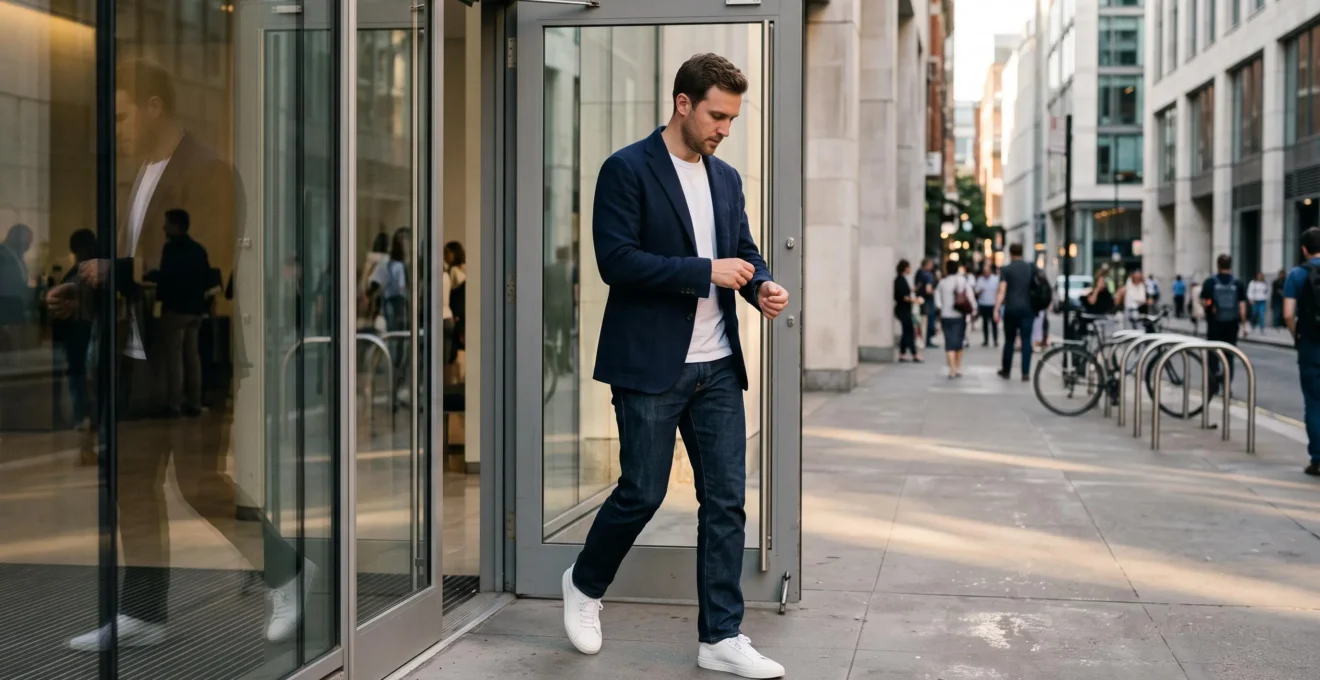
A tailored blazer does not have to make an outfit look like business attire. The difference between an effortlessly dressed man and someone who appears to have forgotten half his suit often comes down to the jacket’s construction, fabric and relationship with everything worn beneath it.
The most versatile approach is to treat a blazer as a structured finishing layer rather than the formal centrepiece of every outfit. A soft navy jacket can sharpen dark denim and a T-shirt, complement chinos and a polo, or work with tailored trousers for a professional occasion. The jacket stays the same; the surrounding pieces determine the mood.
That flexibility depends on more than swapping a shirt for knitwear. Shoulder shape, fabric sheen, trouser proportions and footwear all contribute to how formal an outfit appears. Understanding those signals makes it easier to wear a blazer regularly without looking overdressed, underdressed or awkwardly caught between the two.
How to make a tailored blazer work beyond formal occasions
- Choose a blazer with soft construction, a matte finish and enough texture to complement casual clothing.
- Match the formality of the jacket to the trousers, shoes and top rather than relying on colour coordination alone.
- Prioritise shoulder fit and build outfits around versatile separates instead of trying to dress down an obviously formal suit jacket.
- Why Does One Blazer Work With Jeans While Another Only Looks Right With Trousers?
- How Can You Wear a Tailored Blazer With Jeans and Trainers Without Looking Mismatched?
- Structured, Unstructured or Knitted Blazer: Which Is Most Versatile?
- The Blazer Fit Error That Makes an Expensive Jacket Look Wrong
- When Should You Add a Blazer to a Casual Outfit?
- How Can You Wear an Unstructured Blazer With Casual Trousers and Still Look Polished?
- Chinos, Tailored Trousers or Dark Jeans: Which Works Best for Smart-Casual Dressing?
- How Can Men Build Elegant Outfits Without Wearing a Full Suit?
Why Does One Blazer Work With Jeans While Another Only Looks Right With Trousers?
A blazer works with jeans when its fabric, construction and visual weight feel compatible with denim. Soft shoulders, matte textures and a relaxed drape create an easier transition between tailoring and casual clothing. A stiff, shiny jacket with pronounced padding often looks disconnected because it introduces a level of formality the jeans cannot visually support.
The underlying principle is visual weight matching. Denim usually has a substantial weave, visible texture and relatively informal finish. A blazer in hopsack wool, brushed cotton or another textured cloth can share some of those qualities, making the combination feel intentional.
Fine worsted wool with a smooth, slightly lustrous finish behaves differently. Combined with sharp shoulders and a rigid chest, it can resemble the upper half of a business suit. That is not necessarily wrong, but it makes pairing the jacket with faded or relaxed jeans more demanding.
Construction matters because shoulder padding, chest canvassing and lining influence how the jacket holds its shape. In Permanent Style‘s analysis of structured jackets with jeans, both structured and softer jackets are shown as workable options, although the sharper jacket requires more deliberate coordination with denim, knitwear and footwear.
Before choosing trousers, perform a simple jacket assessment:
- Pinch the cloth: notice whether it feels substantial and textured or exceptionally smooth and fine.
- Check the shoulders: look for a natural slope versus a pronounced, padded outline.
- Inspect the surface: matte weaves usually feel more compatible with casual denim than fabrics with a noticeable sheen.
- Look at the lapels: particularly sharp, formal lapels can reinforce a businesswear impression.
A useful personal styling scale places knitted jackets and relaxed denim toward the casual end, followed by unstructured linen or cotton jackets, textured hopsack, wool flannel and finally smooth, sharply tailored worsted wool. This is a practical comparison, not a universally established ranking: weight, colour and finish can change the position of any garment.
As a starting heuristic, combine pieces relatively close on that scale. A textured blazer with dark jeans often creates less contrast than a sharply structured worsted jacket with heavily faded denim.
If the combination looks wrong, the jeans may not be responsible. Changing the shoes or top, or recognising that the blazer is simply too formal for the intended outfit, is often a more useful first step.
How Can You Wear a Tailored Blazer With Jeans and Trainers Without Looking Mismatched?
To wear a tailored blazer with jeans and trainers successfully, align three things: fabric texture, colour and fit. Choose trainers that complement the jacket’s finish, keep the palette restrained, and wear jeans with a clean, balanced silhouette. The result should look deliberately relaxed rather than like formal clothing combined with unrelated sportswear.
Start with footwear because trainers can dramatically change the perceived formality of an outfit.
| Trainer style | Best blazer pairing | Styling consideration |
|---|---|---|
| Minimal leather low-tops | Unstructured or moderately tailored blazers | Clean lines and subdued colours make them relatively easy to dress up. |
| Retro runners | Textured wool, cotton or relaxed jackets | Their casual shape benefits from softer tailoring and straightforward denim. |
| Technical running trainers | Very casual or deliberately contemporary styling | Bulky soles and performance details can overwhelm a conventional tailored jacket. |
Next, use a three-point alignment method to judge any outfit quickly.
- Texture echo: smooth leather trainers tend to complement cleaner jacket weaves, while suede or canvas footwear can harmonise with more visibly textured tailoring.
- Colour discipline: choose one neutral anchor, such as navy, charcoal, white or beige, and avoid introducing several unrelated accent colours.
- Fit bridge: select straight or gently tapered jeans that move naturally into the footwear, with little or no excessive fabric pooling at the ankle.
Consider a hypothetical office-to-evening outfit: a navy hopsack blazer, a fine grey crew-neck, dark indigo jeans and white leather trainers. The jacket looks sufficiently refined for a relaxed workplace while the knitwear and footwear prevent it from resembling a suit.
Contrast that with a heavily padded black jacket, distressed jeans and brightly coloured technical trainers. Each piece communicates a different style intention, producing a disjointed overall silhouette.
The popular suggestion that every casual outfit should contain only one formal item is too simplistic. What matters is the relationship between elements. A blazer can work with a collared shirt and trainers if the fabrics and shapes are compatible. Equally, a T-shirt does not automatically make an extremely formal jacket casual.
Small details matter: understated socks, a simple belt and a clean neckline usually help maintain continuity between the upper and lower halves.
For an outfit that moves between work and evening plans, begin with the shoes you intend to keep wearing and select the blazer around them. This avoids building an outfit that only works after a footwear change.
Structured, Unstructured or Knitted Blazer: Which Is Most Versatile?
An unstructured blazer is often the most versatile choice for men who want one jacket for professional and social occasions. It retains a recognisably tailored appearance while pairing comfortably with jeans, chinos and knitwear. Structured blazers suit more formal environments, while knitted versions favour relaxed settings, making their overall usefulness dependent on where they will actually be worn.
The three constructions differ in more than appearance. Traditional structured jackets use varying degrees of canvassing, padding and lining to create shape. Unstructured jackets reduce or remove much of that support, allowing the fabric to drape more naturally. Knitted blazers rely on the flexibility and texture of their knitted material.
Permanent Style’s comparison of unstructured jackets explains how reduced canvassing, shoulder padding and lining create a softer garment without necessarily removing its tailored character.
Versatility is therefore better understood as the range of situations a jacket can cover, rather than the quality or expense of its construction.
| Construction | Where it excels | Main limitation |
|---|---|---|
| Structured | Formal meetings, conservative offices and dressier occasions | Can feel too severe beside casual denim and trainers |
| Unstructured | Smart-casual workplaces, travel, dinners and everyday social use | May lack the authority expected in highly formal environments |
| Knitted | Relaxed offices, weekends and casual gatherings | Often appears too informal for traditional business settings |
For a first blazer, a mid-weight, matte, softly constructed navy or charcoal jacket is a practical starting point. It can move between dark jeans, cotton chinos and contrasting wool trousers without requiring an entirely different wardrobe.
A second jacket should extend that range rather than duplicate it. Someone attending frequent formal meetings might add a more structured wool blazer. Someone whose week is largely casual could benefit more from a knitted or lightweight cotton version.
Long-term practicality also matters. Unstructured does not automatically mean more prone to wrinkles, and knitted does not automatically mean less durable. Fibre composition, construction, fabric recovery and care habits influence performance. Knitted elbows or cuffs can stretch with wear, while certain lightweight fabrics crease more readily. Structured jackets can retain their shape well but may be costly to reshape substantially.
The right blazer is the one that works with clothes you already wear, not simply the one that looks most impressive on a hanger. Once that choice is made, fit becomes the next priority.
The Blazer Fit Error That Makes an Expensive Jacket Look Wrong
Excess shoulder width is one of the most consequential blazer fit errors because it can make even a beautifully made jacket look borrowed or disproportionate. Unlike modest sleeve or waist adjustments, changing shoulder width often requires extensive reconstruction. Prioritising a convincing shoulder fit when purchasing a blazer usually saves more trouble than trying to correct it later.
Start by checking where the shoulder ends. On a conventional tailored blazer, the shoulder line should follow your natural frame without creating an obvious overhang or collapsing into a crease at the upper arm.
This is a visual assessment, not a universal measurement. Soft tailoring, extended shoulders and deliberately oversized silhouettes have different design intentions. What looks appropriate in an unstructured contemporary jacket may appear awkward in a formal, heavily padded one.
Next, examine the collar. It should sit comfortably against the back of the neck without a persistent gap when standing naturally. A collar that lifts away can indicate a mismatch between the jacket’s shape and the wearer’s posture, shoulders or upper body.
Button the jacket in a relaxed stance. The front should close without prominent X-shaped pulling lines or excessive tension. A small amount of natural movement is expected, particularly when sitting or turning.
Finally, look at sleeve length. With a shirt underneath, a modest glimpse of cuff can provide visual balance, although the exact amount depends on personal preference and the jacket’s intended styling. With a T-shirt or knitwear, focus instead on a clean sleeve ending near the wrist.
The distinction between fixable and difficult alterations is particularly important when buying an expensive jacket. Gentleman’s Gazette‘s explanation of suit alterations identifies shoulder reconstruction as generally impractical while describing more achievable changes to the waist, sides and sleeves.
The five-step blazer fitting-room checklist
- Stand naturally in front of a mirror and photograph the shoulder line from the front and side. Check for unintended overhang or distortion.
- Take a photograph of the collar from behind while standing upright. Confirm that it rests against your neck without an obvious gap.
- Fasten the appropriate front button and photograph the jacket front. Check for tension lines and excessive loose fabric.
- Put your arms at your sides and record where both sleeves end. Note whether your preferred shirt cuff is visible.
- Sit, walk and raise your arms moderately, then note any persistent pulling or restriction. Keep a short list of alterations to discuss with a tailor.
Sleeve adjustments can be constrained by working buttonholes, lining or insufficient fabric. Jacket length is also difficult to change substantially without disturbing pocket positions and overall proportions.
For casual wear, the fit must make sense alongside the trousers. A severely oversized, rigid blazer can overwhelm slim jeans, whereas a softly constructed jacket with intentional room through the body can create an attractive, relaxed silhouette.
A jacket with slightly imperfect sleeves may be worth altering. One with badly positioned shoulders or fundamentally unsuitable proportions is usually better left on the rail, regardless of its price or label.
When Should You Add a Blazer to a Casual Outfit?
Add a blazer when an otherwise coherent casual outfit needs to communicate greater intention, care or social awareness. Meeting someone new, attending a dinner or moving between relaxed professional and social settings are common opportunities. The blazer should elevate an existing outfit without creating an uncomfortable contrast with the occasion or the clothes underneath it.
Think of a blazer as a signal of deliberate effort, not merely another layer for warmth. A fine cardigan may provide similar insulation but communicates a different visual message from a well-fitting tailored jacket.
Three questions can help decide whether the blazer belongs:
- Is there a social stake? A first meeting, dinner invitation, presentation or celebration may reward a slightly more considered appearance.
- Is the base outfit coherent? Trousers, top and footwear should already work together before adding the jacket.
- Which mistake matters more? Consider whether the setting is likely to make slight overdressing or obvious underdressing more uncomfortable.
For example, dark jeans, a fitted knitted polo and clean loafers create a sound foundation for a casual restaurant. Adding a soft blazer can make the outfit appropriate for a somewhat dressier dinner without transforming it into formalwear.
By contrast, creased joggers, worn running shoes and a poorly fitting printed T-shirt do not become smart-casual simply because a tailored jacket is added. The blazer draws attention to the difference in formality rather than disguising it.
In ambiguous social settings, a restrained blazer can be a sensible option because it is easy to remove once the atmosphere becomes clear. But the social risk is contextual. A relaxed gathering with a deliberately informal dress culture may make a tailored jacket feel unnecessarily conspicuous.
It also helps to distinguish between formal requirements and social expectations. A blazer is not a substitute for a specified suit, and a casual dress code does not automatically require one.
Once a blazer is justified, the challenge becomes maintaining that sense of care without making the whole outfit stiff. Soft tailoring with casual trousers offers a particularly useful solution.
How Can You Wear an Unstructured Blazer With Casual Trousers and Still Look Polished?
Wear an unstructured blazer with casual trousers by creating polish through fit, garment condition and controlled contrast. A soft jacket does not need strong padding to look refined when the trousers have a clean shape, the top sits neatly and the shoes are well maintained. The key is balancing relaxed construction with visible attention to detail.
An unstructured blazer provides a natural drape rather than imposing a rigid shape over the chest and shoulders. That softness makes it comfortable to combine with chinos, cotton trousers or less formal wool separates.
However, an entirely soft outfit can lack definition. A loose, rumpled linen jacket over an oversized T-shirt and baggy trousers may resemble loungewear rather than intentional tailoring.
A more reliable approach is to introduce texture contrast and controlled crispness. Pair a softly draped jacket with moderately structured cotton chinos, or use trousers with a clear crease beneath a relaxed wool blazer. The trousers provide definition that the jacket intentionally does not.
Consider three hypothetical combinations:
- A navy unstructured wool blazer, fine white crew-neck and stone chinos with dark brown suede loafers for a relaxed professional day.
- A tobacco cotton blazer, pale blue Oxford shirt and charcoal cotton trousers with clean leather trainers for an informal meeting.
- A lightweight linen blazer, knitted polo and tailored cream trousers with suede slip-ons for an outdoor summer dinner.
Small details become particularly important when the jacket is soft. A neat neckline, clean footwear, a well-proportioned watch and properly maintained trousers can create a refined impression without adding formal accessories.
The shirt need not always be tucked in. A short, carefully cut T-shirt may sit neatly outside the waistband, while a longer or looser shirt generally looks more controlled when tucked. Judge the visible proportions rather than following an absolute rule.
In warm weather, linen and lightweight cotton offer a natural-looking alternative to conventional tailoring. Some creasing is part of linen’s character, although excessive crushing around the lapels and front panels can make the outfit appear neglected. Linen blends and certain wool fabrics may provide different balances of breathability, drape and crease recovery depending on their construction.
Polish is not synonymous with stiffness. Once the silhouette is deliberate and the garments are in good condition, even a lightly constructed blazer can look considered with everyday trousers.
Chinos, Tailored Trousers or Dark Jeans: Which Works Best for Smart-Casual Dressing?
Chinos are a dependable choice for daytime smart-casual dressing, tailored trousers provide greater professional refinement, and dark jeans offer broad versatility for social occasions. The best option depends on where the outfit will be worn, how formal the blazer looks and which shoes complete it. Fabric finish and cut matter as much as the trouser category itself.
The common assumption that chinos are always smarter than jeans is misleading. Crisp, dark indigo denim without visible distressing can look more refined than pale, heavily washed chinos with a loose or untidy fit.
Similarly, not all tailored trousers are equally formal. Grey flannel trousers with a soft texture can work with knitwear and an unstructured jacket, while smooth, sharply pressed suit trousers may demand more formal footwear and a more precise upper half.
| Situation | Recommended starting point | Why it works |
|---|---|---|
| Relaxed office or daytime meeting | Well-cut chinos | They balance everyday ease with a relatively polished appearance. |
| Dinner, weekend gathering or casual social event | Dark, clean-finish jeans | They keep the outfit contemporary while supporting a blazer. |
| Client-facing work or dressier evening occasion | Contrasting tailored trousers | They raise formality without requiring a matching suit. |
Footwear often decides which trousers work best. Chinos have a particularly forgiving relationship with understated trainers, suede loafers and casual leather shoes. Dark jeans accommodate a wide range of footwear, provided the denim finish and shoe shape remain compatible. Tailored trousers generally look more coherent with refined leather or suede footwear, although minimal trainers can suit relaxed contemporary cuts.
Fit also influences the outcome. A sharply tapered chino paired with bulky trainers may make the footwear appear oversized. A wider wool trouser can balance a more substantial shoe but requires attention to the jacket’s length and overall silhouette.
Before buying another pair of trousers, evaluate compatibility with your existing blazer:
| Existing blazer | Chinos | Dark jeans | Tailored trousers |
|---|---|---|---|
| Matte navy hopsack | Stone, olive or beige | Dark indigo or washed black | Mid-grey or charcoal wool |
| Textured charcoal wool | Khaki or muted navy | Deep blue denim | Contrasting mid-grey or taupe wool |
| Unstructured brown cotton or linen | Off-white, olive or navy | Dark indigo | Charcoal or muted cream, depending on the cloth |
These combinations are styling starting points, not guaranteed matches. Similar colours can look different under natural light, and two garments may clash when their textures, undertones or weights are incompatible.
The most useful trouser is not necessarily the smartest one. It is the pair that repeatedly creates complete, credible outfits with your existing jackets, tops and shoes.
Key takeaways before building your wardrobe
- Start with the jacket’s construction and fit, then select trousers and shoes that support its level of formality.
- Choose contrasting colours and textures deliberately so tailoring separates look intentional rather than like an incomplete suit.
- Prioritise garments that create multiple outfits with what you already own instead of accumulating isolated statement pieces.
How Can Men Build Elegant Outfits Without Wearing a Full Suit?
Men can build elegant outfits without a full suit by combining a well-fitting blazer with contrasting trousers, a considered top and coordinated footwear. The aim is to create intentional separates rather than imitate a matching suit. A small wardrobe of compatible jackets, trousers and shirts or knitwear can cover professional occasions, dinners and everyday smart-casual dressing.
The essential distinction is between deliberate contrast and accidental mismatch. When a jacket and trousers are almost the same colour but differ slightly in weave or fading, they may resemble parts of separate suits worn together unintentionally.
Clearer contrast usually solves that problem. A navy blazer with grey flannel trousers reads as a deliberate combination. A brown textured jacket with dark denim creates a different, more casual kind of elegance. The colours need not be dramatically different, but the garments should look like they belong together without pretending to match.
One useful system is a three-column wardrobe method: jackets, trousers and tops.
| Jackets | Trousers | Tops |
|---|---|---|
| Unstructured navy blazer | Stone or olive chinos | White Oxford shirt |
| Optional second textured jacket | Charcoal wool trousers | Grey fine-gauge crew-neck |
| — | Optional dark jeans | Knitted polo or plain white T-shirt |
Rather than viewing each row as a fixed outfit, test combinations across columns. A navy blazer can work with either suggested trouser, while the Oxford shirt and fine-gauge knit can serve both smarter and more relaxed settings.
A helpful buying rule is to require a new item to work convincingly with at least two existing choices in each relevant category. This is a wardrobe-planning heuristic, not a mathematical guarantee of good style, but it discourages purchases that only work in one specific combination.
For example, a hypothetical starter wardrobe with one blazer, two pairs of trousers and three suitable tops offers six basic jacketed combinations before footwear and layering are considered. Not every combination will be equally appropriate, so visual compatibility should take precedence over the theoretical number.
The next purchase should address an actual gap. If all your current outfits are business-oriented, dark jeans may provide more useful variety than another tailored trouser. If your wardrobe already handles casual evenings but lacks conservative professional options, a more structured jacket may be a better addition.
Elegance also comes from the elements between major garments. Fine knitwear over a shirt adds depth without a waistcoat. A restrained pocket square can introduce interest, though it is unnecessary for most casual combinations. Watches, belts and shoes should feel consistent in formality, but perfectly matching every leather colour is not essential.
The objective is not to remove all rules or make everything interchangeable. It is to build a wardrobe in which each garment has a clear role and several credible companions.
Begin with your best-fitting blazer, lay out two compatible trousers and three tops, and try the combinations in natural light with the shoes you actually wear. Keep the outfits that feel coherent, photograph them for reference and use the gaps to guide future purchases.
Can you wear a blazer with a plain T-shirt and still look sophisticated?
Yes. Choose a T-shirt with a clean neckline, suitable length and enough substance to hold its shape. A softly constructed blazer, well-fitting trousers and understated footwear create a more coherent result than a formal jacket over a thin, oversized or heavily printed T-shirt. Plain white, grey, navy and neutral tones are useful starting points.
Should a casual blazer always be worn unbuttoned?
No. Wearing a blazer open creates a relaxed silhouette and often works well with T-shirts and knitwear. Buttoning it can provide more definition for a meeting or dinner. On a conventional two-button tailored jacket, the upper button is generally the one used when standing, while the lower button is traditionally left undone. The jacket’s design and fit still matter.
Can a suit jacket be worn separately as a casual blazer?
Sometimes. Suit jackets made from textured, relatively matte fabrics with softer construction are more adaptable as separates. Smooth business-suit jackets with prominent padding and formal detailing are generally harder to combine with casual clothing. Choose trousers that contrast clearly in colour or texture so the outfit appears intentional rather than like an incomplete suit.
What is the most practical blazer colour for a small wardrobe?
Matte navy is a versatile starting point because it pairs with grey wool trousers, stone chinos, olive cotton trousers and many denim washes. Charcoal, muted brown and earthy tones can be equally useful depending on the colours already in your wardrobe. Fabric finish and construction have as much influence on versatility as colour alone.
How do you stop a blazer from looking too formal in warm weather?
Choose lightweight, breathable cloth with an appropriate relaxed construction, and combine it with simple warm-weather pieces such as a knitted polo, cotton or linen trousers and understated suede or leather footwear. Avoid overly stiff shoulders, shiny cloth and excessive formal accessories. Natural creasing can suit a linen jacket, but good fit and garment care remain important.