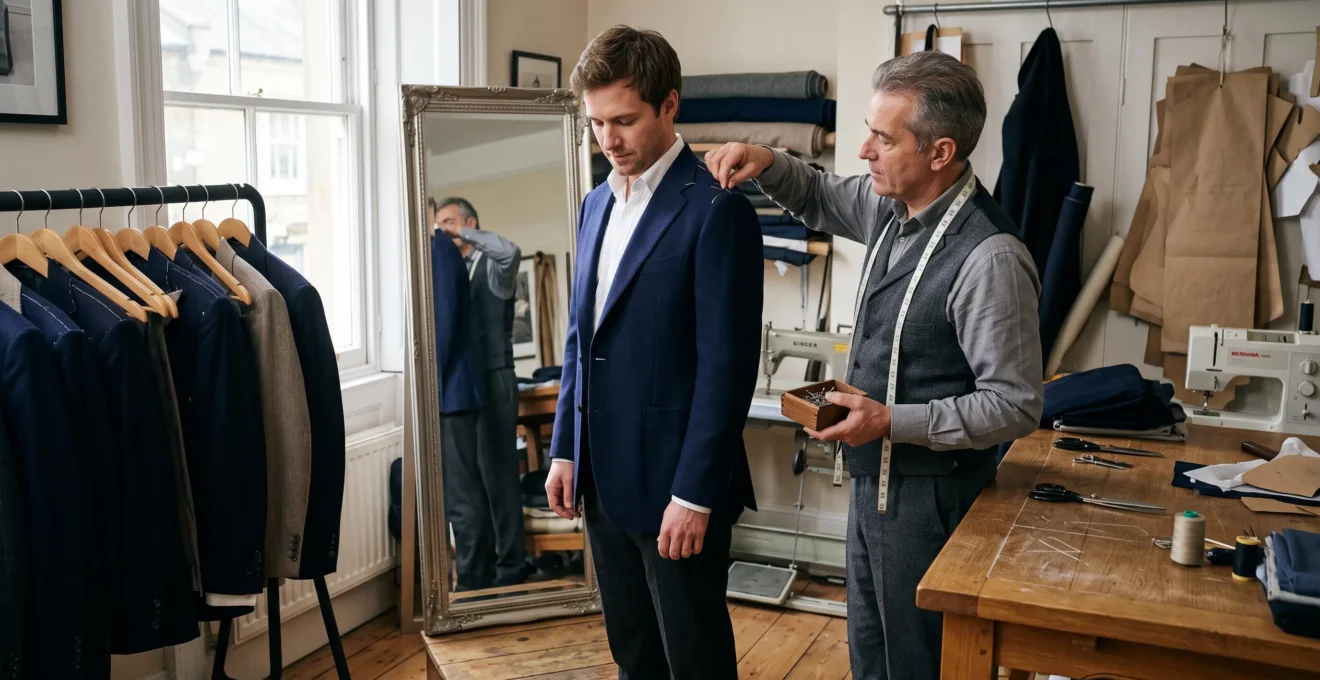
A better-fitting outfit does not have to cling to the body. The difference between a flattering tailored cut and an uncomfortable slim fit lies in **where the garment removes excess fabric and where it preserves room for movement**. A jacket can follow the natural shoulder line, define the waist and create a clean vertical shape without compressing the chest or restricting the arms. Trousers can follow the seat and thigh while retaining enough width to move naturally.
The objective is not to make every part of the body look smaller. It is to organise the proportions of the clothes so that the overall silhouette looks deliberate. Shoulder placement, jacket length, trouser rise, fabric weight and garment drape all contribute to that result.
For men moving away from restrictive slim-fit styling, selective shaping offers a practical alternative. It makes everyday clothing look considered without requiring a full suit, expensive bespoke garments or a wardrobe built around tight cuts. The most useful approach starts with fit, then adjusts individual pieces according to their construction and the way they are actually worn.
The essentials of a comfortable tailored silhouette
- Choose a cut that shapes the waist and follows the shoulders without reducing circumference everywhere.
- Check garments in motion, not just in front of a mirror while standing still.
- Use selective alterations, balanced proportions and appropriate fabrics instead of relying on slim sizing.
- Why Can a Small Change in Garment Cut Transform Your Whole Silhouette?
- How Can You Check Whether a Tailored Cut Fits Properly in Under Two Minutes?
- Slim, Tailored or Relaxed: Which Cut Works Best for Your Build?
- The Fit Error That Makes Tailored Clothing Look Smaller Rather Than Sharper
- When Is Tailoring Worth Paying For on an Everyday Garment?
- How Can You Combine Wide Trousers With a Relaxed Top Without Losing Shape?
- Structured or Unstructured Blazer: Which Works Better for Your Weekly Routine?
- How Can Men Build Elegant Outfits Without Wearing a Full Suit?
Why Can a Small Change in Garment Cut Transform Your Whole Silhouette?
A small change in garment cut can transform an outfit because the eye reads clothing through its proportions, not simply through its measurements. Moving a shoulder seam, refining the waist or adjusting trouser length changes the relationship between the upper and lower body. These adjustments can create a cleaner silhouette without making the garment tighter.
The shoulder is an important visual anchor. On a jacket, its seam establishes the starting point of the sleeve and helps determine how the upper body appears. A seam positioned correctly in relation to the natural shoulder gives the garment a coherent outline. An incorrectly positioned seam can make the shoulders look either disproportionately narrow or unnecessarily broad.
The waist provides another opportunity for controlled shaping. A jacket with excess fabric through the middle can appear boxy, even when its shoulders fit correctly. Selectively reducing that volume creates a more defined outline while leaving the chest sufficiently comfortable. This is shaping, not compression.
Trouser length also changes the visual balance. Excess fabric gathering around the shoes interrupts the leg line, while an appropriate break gives the lower half a more intentional finish. The effect depends on the trouser shape, footwear and desired styling.
**Fabric matters just as much as the pattern.** A heavier, stiffer cloth can hold a defined outline, whereas a softer fabric follows the body more closely. The same nominal cut may therefore look structured in one material and relaxed in another.
Proper Cloth’s guide to tailored jacket fit explains how shoulder, chest, sleeve and waist adjustments influence the appearance and movement of a jacket. Its recommendations are technical fitting guidance rather than independent scientific measurements, but they illustrate why fit must be assessed across several construction zones.
The aim is to create a clean vertical line from shoulder to hem, not to reproduce every contour of the body. A garment should have its own shape, with enough ease to accommodate ordinary movement.
A well-shaped outfit is therefore a balance between visual definition and practical ease. Once the main proportions are right, the next step is checking whether the garment maintains that balance when worn throughout an ordinary day.
How Can You Check Whether a Tailored Cut Fits Properly in Under Two Minutes?
A tailored garment can be checked quickly by examining its shoulders, closure, sleeves and lower-body fit, then testing a few ordinary movements. The most important principle is to identify structural problems before judging smaller details. A jacket with incorrectly positioned shoulders will not become a good fit simply because its sleeves have the right length.
Begin with the shoulders. Stand naturally in front of a full-length mirror, with your arms relaxed. The shoulder seam should sit close to the natural shoulder edge, and the fabric should form a clean line without excessive bunching or an obvious overhang. Proper Cloth recommends a shoulder and sleeve relationship that follows the arm while preserving normal movement.
Next, close the jacket using its intended fastening point. Look for horizontal tension lines around the button, distortion in the lapels or fabric pulling across the chest. These signs can indicate insufficient room. Put This On’s jacket fit checklist similarly emphasises clean lines, correct shoulder placement and the absence of excessive tension. The article is an editorial fitting guide, not a universal measurement standard.
Check the sleeves and collar. The sleeves should allow the arms to move naturally, while the collar should sit close to the neck without pulling away excessively during reasonable movement.
The final assessment concerns movement and trousers. Raise both arms, sit down and cross your legs. Notice whether the jacket rides up, the chest becomes restrictive or the trousers pull uncomfortably across the seat and thighs.
A useful practical assessment is to check whether a flat hand can slide inside the closed jacket at chest level. Treat this as an informal comfort check, not a technically validated fitting standard. The result depends on the garment’s construction, fabric and intended fit.
Watch for the characteristic X-shaped creases around a button. They suggest that the fabric is under tension, particularly when accompanied by distorted lapels or horizontal pulling lines. However, not every small wrinkle means that the jacket is too small; posture, fabric behaviour and construction also matter.
The best result is a garment that maintains a clean appearance both standing and moving. If one area repeatedly creates tension, the solution may be a different cut or a targeted alteration rather than another size reduction.
Slim, Tailored or Relaxed: Which Cut Works Best for Your Build?
The best cut depends on where a garment needs structure and where it needs additional room. Slim fit generally reduces overall volume, tailored fit shapes selected areas while preserving ease, and relaxed fit allows more space throughout. None is automatically superior: the right option is the one that balances the wearer’s proportions and daily comfort.
A **slim cut** usually follows the body closely and reduces circumference through several areas. It can work for men who prefer a narrow outline, provided the chest, shoulders, seat and thighs are not compressed. Its limitation is that a uniform reduction may create tension where the body naturally needs more room.
A **tailored cut** takes a more selective approach. It can define the waist while retaining sufficient chest width, sleeve mobility and trouser room. This makes it useful for men who want a cleaner appearance without the close-fitting effect associated with restrictive slim clothing.
A **relaxed cut** offers more ease, particularly through the torso, seat and thighs. It can work well for broader builds, larger midsections and anyone prioritising mobility. However, excessive volume can make a garment appear shapeless if its length and proportions are not controlled.
The following grid provides a starting point rather than a fixed rule:
| Build or priority | Slim fit | Tailored fit | Relaxed fit |
|---|---|---|---|
| Broader chest | Can restrict chest movement | Preserves chest room while shaping the waist | Comfortable, but may add unnecessary torso volume |
| Slim frame | Can create a neat outline if not tight | Defines proportions without excessive compression | Works with controlled lengths and fabric drape |
| Larger midsection | May pull around the waist | Can shape selectively without squeezing the abdomen | Offers useful room and a more forgiving outline |
| Athletic build | May fit one area but restrict another | Balances shoulders, chest, waist and thighs | Provides movement but may require waist adjustments |
The most practical intermediate option is often to purchase a garment with enough room in the structurally important areas, then have excess fabric removed selectively. A relaxed jacket with a suitable shoulder line may be a better starting point than a slim jacket that is already tight across the chest.
Possible alterations include waist suppression, sleeve shortening and adjustments to trouser waistbands or hems. Darts can also help refine certain garments, depending on their construction and available seam allowance.
The important distinction is to avoid choosing clothes according to an imagined future physique. A garment should fit the body as it is now, not force it into a narrower shape. If a size increase creates excessive volume in one area, selective alterations can address that problem without sacrificing comfort elsewhere.
Once the basic cut is chosen, the next challenge is recognising when a garment has crossed the line from close-fitting to visibly undersized. That distinction is especially important when buying structured jackets and everyday trousers.
The Fit Error That Makes Tailored Clothing Look Smaller Rather Than Sharper
The main mistake is interpreting a smaller circumference as better tailoring. Reducing fabric everywhere can make clothing pull across the chest, ride up at the crotch and distort around fastening points. Instead of creating a sharper silhouette, these tension points interrupt the garment’s lines and make the overall outfit look uncomfortable.
A jacket that is too tight often reveals the problem before the wearer notices it. The lapels may bow or lose their natural position, the button area may develop diagonal creases and the fabric across the upper back may become strained. At the waist, horizontal lines can indicate insufficient room.
The same problem appears in trousers. A tight seat can pull the waistband downward at the back, while insufficient thigh room can restrict walking and sitting. The garment may also shift upward when the wearer moves, making its proportions look shorter.
These signs are not simply cosmetic. A garment that repeatedly pulls against the body is less likely to remain comfortable during a full working day. The objective should be to maintain the intended outline while restoring enough ease at the points where the body bends, rotates or expands during movement.
Four areas deserve particular attention:
– **Chest:** enough room for the garment to close without distorting the lapels.
– **Shoulders:** a natural seam position and unrestricted arm movement.
– **Seat:** sufficient space for sitting without pulling the waistband or back rise.
– **Thighs:** enough ease for walking, sitting and crossing the legs.
There is also a difference between a close cut and a restrictive one. A structured blazer can maintain a defined outline even when worn relatively close to the body. A soft, unstructured garment may reveal tension more readily because it has fewer internal elements supporting its shape.
Sizing up can be a sensible correction when the smaller size consistently pulls across several areas. The excess volume can then be assessed for selective removal, provided the shoulder line and garment construction make alteration practical.
A sharper appearance comes from controlled proportions, not maximum compression. Once the correct size and construction are established, the remaining question is whether alterations provide enough practical value to justify their cost.
When Is Tailoring Worth Paying For on an Everyday Garment?
Tailoring is worth paying for when a relatively limited adjustment significantly improves a garment that is already structurally suitable. Hemming trousers, shortening sleeves or refining a waist can deliver useful improvements. Major reconstruction, especially around shoulders or the seat, is harder to justify on inexpensive or short-lived clothing.
The first consideration is the original garment. Its shoulder line, chest width, fabric quality and general construction should be acceptable before money is spent on alterations. A jacket with poorly positioned shoulders may require substantial work, and that area is among the more difficult parts of a garment to modify.
Simple adjustments are generally more straightforward. Trouser hems, sleeve lengths and some waist alterations can improve the overall appearance without changing the garment’s fundamental construction. Shirts may also benefit from selective waist shaping or sleeve adjustments, depending on their seams and available fabric.
A useful decision framework considers three factors:
1. **Purchase price:** Is the alteration proportionate to what the garment originally cost?
2. **Wear frequency:** Will the adjustment improve a piece worn regularly rather than occasionally?
3. **Technical complexity:** Does the work involve a simple hem or a major structural area?
A moderately priced pair of trousers worn several times a week may justify a hem adjustment more readily than an expensive jacket worn only once or twice a year. Conversely, a high-quality jacket intended to remain in regular use may justify a more substantial investment if its underlying construction is suitable.
The number of required alterations also matters. One small adjustment is different from a project involving shoulder reconstruction, chest expansion, sleeve repositioning and changes to the jacket length. Multiple major interventions can become expensive and may disturb the garment’s original proportions.
Before agreeing to alterations, ask the tailor to identify the exact problem, explain what can realistically be changed and provide a total estimate. A clear assessment is more useful than requesting a vague instruction such as making the garment slimmer.
The strongest investment is often a garment that already fits its most difficult structural areas. A relatively simple alteration can then finish the silhouette without turning an ordinary purchase into a costly reconstruction.
How Can You Combine Wide Trousers With a Relaxed Top Without Losing Shape?
Wide trousers and a relaxed top can create a balanced outfit when their volume is controlled through length, waist definition and fabric contrast. The objective is not to make one piece tight. It is to give the eye a clear point of reference so that the combination looks intentional rather than oversized.
A useful starting point is the waistline. A front tuck, a visible waistband or a shorter top can establish a visual anchor between the upper and lower body. This creates definition without requiring a close-fitting shirt or jacket.
Length is particularly important. A top that falls too far over wide trousers can conceal the waist and make the entire outfit appear like one uninterrupted block of fabric. A shorter jacket, a clean front tuck or a shirt worn at an appropriate hip length can restore balance.
The trouser rise also affects the overall line. A higher rise can make the leg appear to begin higher on the body, depending on the wearer’s proportions and the length of the top. The break should be deliberate: excessive fabric gathering around the shoes can interrupt the vertical line, while a cleaner finish can make the trousers appear more controlled.
Fabric pairing is another useful tool. Two heavy, stiff garments worn together can create excessive visual volume. A fluid top with structured trousers, or a structured overshirt with softer wide-leg trousers, introduces contrast and helps the outfit retain definition.
GQ’s guide to styling wide-leg pants includes examples of pairing wider trousers with shorter tops and more precisely cut upper layers. These are editorial styling suggestions rather than universal rules for every body type.
The following combinations offer practical starting points:
– Wide wool trousers with a tucked-in fine knit.
– Relaxed chinos with a shorter overshirt.
– Wide-leg denim with a simple T-shirt and a cropped jacket.
– Fluid trousers with a structured shirt worn open over a fitted but comfortable base layer.
Shoes also influence the result. Very narrow footwear can look visually disconnected from particularly wide trouser legs, while a shoe with appropriate volume may create a more coherent finish.
The relationship between the top and trousers should be judged in the mirror rather than through a rigid width formula. The height of the wearer, garment lengths, fabric movement and footwear all affect the final proportions.
The result should feel comfortable and deliberate. Once these volume relationships are understood, the same approach can be applied to jackets, particularly when deciding between structured and unstructured construction.
Structured or Unstructured Blazer: Which Works Better for Your Weekly Routine?
A structured blazer works well when the outfit needs a defined shoulder line and a more formal presence. An unstructured blazer is generally better suited to flexible, mixed dress-code settings where lighter construction and easier styling are priorities. The right choice depends on how often the garment will be worn and the situations it needs to accommodate.
A structured blazer uses internal construction to support its shape. Depending on the model, shoulder padding and chest canvassing help create a more defined upper body. This can establish a clearer shoulder line and a more pronounced V-shaped appearance.
An unstructured blazer reduces some of that internal support. FashionBeans’ guide to unstructured blazers describes typical construction features such as the absence of shoulder padding and chest canvassing, alongside lighter lining arrangements. The result can feel closer to a substantial shirt while retaining the visual characteristics of a jacket.
This difference affects how each garment works in everyday settings. A structured blazer is a useful choice for formal meetings, presentations and occasions where a defined outline is desirable. An unstructured version can work with knitwear, T-shirts, chinos and dark denim, making it easier to incorporate into smart-casual outfits.
Neither construction guarantees comfort. A structured blazer can still restrict movement if its chest or shoulders are too narrow. An unstructured blazer can also fit badly if its sleeves, body width or length are unsuitable.
The weekly routine provides a practical decision criterion:
| Consideration | Structured blazer | Unstructured blazer |
|---|---|---|
| Visual effect | More defined shoulders and upper-body shape | Softer outline and more natural drape |
| Typical formality | Suitable for more formal and business-oriented outfits | Suitable for smart-casual and mixed settings |
| Styling | Pairs naturally with tailored trousers and formal shirts | Pairs easily with knitwear, T-shirts and denim |
| Construction | Uses more internal support, depending on design | Typically removes some shoulder and chest structure |
| Practical consideration | Assess weight, lining and movement | Assess fabric drape, crease behaviour and layering |
An unstructured blazer is not automatically wrinkle-proof or easier to maintain. Its softer construction may make it easier to fold and transport, but the actual result depends on the cloth and design. Likewise, a structured blazer is not necessarily unsuitable for travel.
For a first blazer, consider the majority of situations in which it will be worn. A garment that fits the real weekly routine is more useful than one chosen solely for occasional formal occasions.
A blazer should connect naturally with the rest of an outfit rather than dictate an entirely formal dress code. This makes it possible to build elegant combinations without relying on a matching suit.
Key points before building a suit-free outfit
- Start with a garment that has the right structural fit, particularly around the shoulders and chest.
- Keep the formality of the trousers, footwear and upper layer reasonably consistent.
- Use one structured piece and one relaxed piece, then add an intermediate element to connect them.
How Can Men Build Elegant Outfits Without Wearing a Full Suit?
Men can build elegant outfits without a full suit by combining separate garments that share a compatible level of formality. Tailored trousers with a fine knit, a relaxed blazer with dark denim or a clean shirt with well-cut chinos can all create a considered appearance. Elegance comes from proportion, fabric and coordination rather than matching jacket and trousers.
The first principle is to replace suit components with appropriate alternatives. Tailored trousers can provide the structure normally associated with a suit’s lower half, while a fine-gauge knit or refined overshirt creates a less formal upper layer. An unstructured blazer can also work with dark denim when the remaining elements support the combination.
The second principle is to maintain clean visual lines. A jacket that fits correctly at the shoulders, trousers with a controlled break and a shirt that does not create unnecessary bulk can make a simple outfit appear more intentional.
Colour coordination is another important element. A limited palette makes separate garments easier to combine. Navy, charcoal, grey, white and restrained earth tones provide a useful starting point, although the best combinations depend on the garments, materials and occasion.
Fabric quality also affects the impression. A well-finished cotton shirt, wool trousers or textured knit can create depth without relying on prominent branding or formal accessories. The aim is to select materials that work together rather than make every garment visually prominent.
One common mistake is combining a highly formal blazer with very casual, worn-out denim and unsuitable footwear. The contrast can feel accidental rather than deliberate. An intermediary piece helps bridge the difference: a fine knit, a clean polo shirt or understated trainers can connect the two ends of the outfit.
A repeatable formula makes the process easier:
| Element | Role | Example |
|---|---|---|
| Structured element | Creates definition and visual direction | Tailored trousers or a structured blazer |
| Relaxed element | Reduces formality and adds comfort | Dark denim, a soft overshirt or relaxed knitwear |
| Bridging element | Connects the different levels of formality | Fine knit, clean polo or understated footwear |
For example, charcoal tailored trousers, a navy knit polo and clean leather trainers offer a practical smart-casual combination. Another option is dark denim, a textured unstructured blazer and a plain fine-gauge knit. These are styling examples, not mandatory formulas.
The important consideration is whether the individual garments work together in terms of fit and visual weight. A structured jacket can look out of place if the trousers are excessively casual, while an entirely relaxed outfit may lack definition if every piece has the same loose proportions.
Men who prefer wider trousers can retain elegance by keeping the upper half controlled through length, shoulder definition or a visible waistline. Conversely, men who prefer relaxed tops can use a cleaner trouser line to prevent the outfit from appearing oversized.
The most reliable wardrobe is built around clothes that fit comfortably, work in several combinations and reflect the situations in which they are actually worn. Start with one well-fitting pair of trousers, one versatile jacket and a few compatible tops, then refine the proportions gradually rather than replacing the entire wardrobe at once.
Can tailored clothing make a man look slimmer without being tight?
Yes. Tailored clothing can create a more defined appearance by removing excess volume selectively while retaining room across the chest, shoulders, seat and thighs. The aim is to improve the garment’s proportions rather than compress the body. Correct shoulder placement, suitable fabric drape and controlled garment length are particularly important.
Should a tailored jacket feel tight when it is buttoned?
No. A jacket should close without pronounced pulling, distorted lapels or horizontal tension lines. It should also allow normal arm movement and remain reasonably comfortable when sitting. A close silhouette does not require a restrictive fastening point.
Is tailored fit better than slim fit for athletic men?
Not automatically, but tailored fit can be a useful option when a man has broader shoulders or a chest that requires more room than his waist. Selective shaping can accommodate these differences without reducing circumference uniformly. The final choice should be based on the garment’s actual fit rather than its label.
Can an oversized garment be altered to look tailored?
Sometimes. A garment with a suitable shoulder line and sufficient construction quality may be improved through waist shaping, sleeve shortening or trouser adjustments. However, excessive shoulder width, incorrect proportions or several major fitting problems can make alterations impractical. A tailor should assess the construction before recommending extensive work.
What should men alter first when improving their everyday wardrobe?
Start with garments that already fit well in their structural areas. Trouser hems, sleeve lengths and straightforward waist adjustments are useful starting points because they can improve the finish without extensive reconstruction. Prioritise items worn frequently and avoid spending heavily on pieces that require several major alterations.